
A manufacturing sales tax exemption can reduce tax on qualifying machinery, raw materials, utilities, repair parts, and other production inputs. Eligibility depends on the sourcing state, the purchased item, and its role in the manufacturing process, rather than on the buyer’s industry label.
Manufacturing sales tax exemptions change across jurisdictions because each state defines manufacturing activities and the production process independently. Some states provide full relief for production machinery, while others offer partial relief, reduced rates, refunds, or narrower tax incentives.
Documentation can be equally demanding. A manufacturing business may need an exemption certificate, registration number, state approval, or tax exemption certificate tied to a particular purchase. Renewal periods and online lookup options also vary, so valid documentation requires ongoing attention.
This guide explains common qualifying purchases, state differences, verification limits, and audit controls for manufacturing businesses. We will also discuss how Galvix connects certificate work with nexus monitoring, registrations, sales tax returns, notices, and wider sales tax compliance.

What is a Manufacturing Sales Tax Exemption?
A manufacturing sales tax exemption allows an eligible producer to purchase qualifying property without paying some or all applicable sales tax. The rule usually focuses on machinery, supplies, or utilities used to manufacture tangible personal property for later retail sale.
The company must satisfy the state’s use test and certificate requirements. Manufacturer status alone does not determine tax treatment, because identical property can qualify within production and remain taxable when used for administration, storage, or distribution.
How Do Manufacturing Exemptions Work?
Manufacturers usually claim an exemption by providing the seller with the sourcing state’s required certificate before the tax is removed. The accepted record may be a manufacturing form, general certificate, state-issued permit, or use tax exemption certificate supported by registration details.
The seller retains the completed document as supporting documentation for the untaxed purchase. A valid certificate does not, by itself, establish eligibility, because the purchaser must still prove that the item performs the required production function.
Manufacturers therefore need controls for form selection, transaction use, certificate validity, and renewal. A periodic review should also connect documents with invoices, facility records, product descriptions, and evidence supporting the claimed manufacturing exemption.
Why Manufacturing Exemption Rules Differ by State?
States independently define manufacturing, exempt property, production boundaries, and documentation standards. One jurisdiction may focus on the first stage of production, while another considers when the first activity that causes a physical change begins and when the finished product is complete.
Administrative rules also differ. Texas uses Form 01-339 for qualifying manufacturing claims, while California uses CDTFA-230-M for partial relief. New York uses ST-121 for exempt use, and Wisconsin uses Form S-211 for qualifying purchases.
The certificate's duration and verification add another layer. Some records remain effective until information changes, while others require fixed renewal. State tools may confirm a permit or account without validating the certificate or the underlying exemption.
What Purchases May Qualify for a Manufacturing Sales Tax Exemption?
Qualifying purchases depend on function, location, and actual use within manufacturing operations. States may require direct, predominant, exclusive, or primary use in producing goods for sale, so the same equipment can receive different tax treatment across facilities.
Machinery and Equipment
Production equipment, industrial machinery, and qualifying equipment may receive relief when used directly during production. Texas exempts eligible manufacturing equipment, while California provides partial relief for qualified manufacturing machinery and research property.
Businesses should document production boundaries, equipment functions, the use of machinery, and any activities involving the storage of raw materials or their distribution.
Raw Materials and Component Parts
Raw materials often qualify when they become part of the finished product. Metals, chemicals, ingredients, packaging, catalysts, and similar substances may qualify under incorporation rules.
Consumables can follow another standard, so manufacturers should document whether each input enters the product, causes a physical change, or supports the facility.
Utilities and Fuel Used in Production
Electricity, natural gas, steam, water, and fuel may qualify for tax treatment when consumed during production. States can require meter studies, allocation schedules, or provider forms before granting a use tax exemption.
New York uses Form ST-121 to qualify production utilities, while office and employee comfort consumption is treated separately.
Repair Parts and Production Supplies
Replacement parts, molds, dies, lubricants, and repair parts may qualify when they support exempt equipment during production. Hand tools, building work, and taxable services can remain outside the rule when they relate to real property maintenance. Treatment can also change when repairs extend useful life or increase capacity.
Research, Testing, and Environmental Equipment
Research systems and quality control equipment may qualify when connected with production or development. California includes selected research property within partial relief, while Texas recognizes certain testing property.
Specialized rules may also cover pollution control equipment, control equipment, environmental conditions, or property used in the fabrication of a semiconductor product.
Which Manufacturing Purchases Usually Do Not Qualify?
These manufacturing sales tax exemptions often exclude purchases used outside qualifying production. Property supporting offices, warehouses, employee facilities, or distribution can remain taxable, even when the purchaser operates a manufacturing facility.
- Office and Administrative Property: Computers, desks, communications, and an employee information system may remain taxable when they support management rather than production.
- General Facility Maintenance: Janitorial supplies, building materials, safety products, and maintenance equipment may remain subject to tax without a qualifying production use.
- Storage and Distribution Property: Racks, forklifts, loading equipment, and shipping systems may fall outside the scope of relief after production ends.
- Employee-Use Property: Breakroom supplies, clothing, training materials, and comfort systems often remain taxable when serving employees.
Search snippets can also surface an unrelated effective May notice or portal update. Procurement teams should open the official manufacturing guidance before relying on summarized search text.
How Do Manufacturers Claim a Sales Tax Exemption?
Manufacturers should confirm eligibility and documentation before asking a vendor to remove tax. A certificate cannot convert a taxable purchase into an exempt one, so the process must connect the form with actual production use.
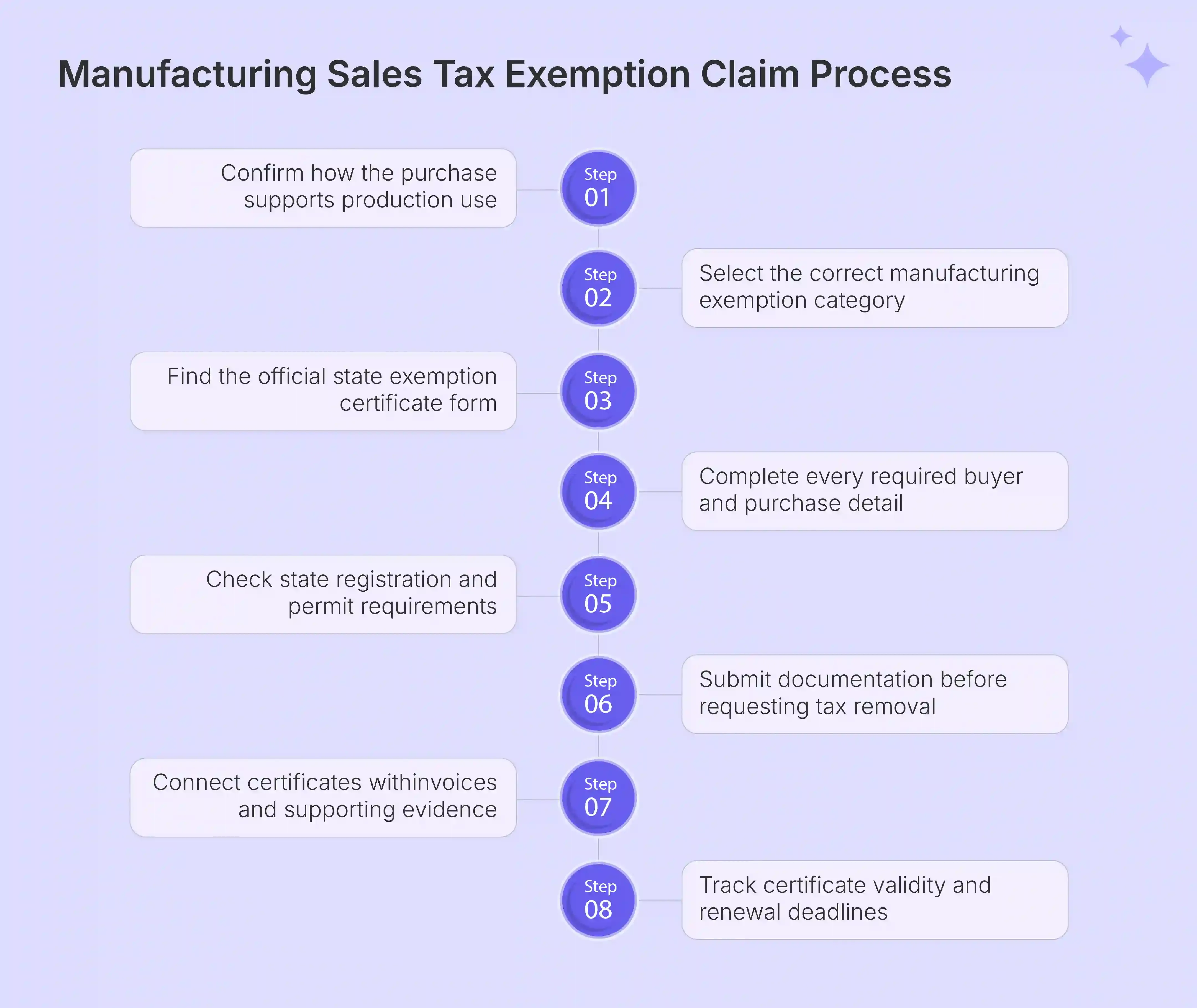
Confirm Purchase Eligibility: Check whether the item satisfies the state’s production-use test before requesting exempt treatment.
- Identify the Exemption Category: Match the purchase with machinery, components, utilities, research, pollution control, repair parts, or another category.
- Select the Named State Form: Use the current official document or an accepted multistate form where permitted.
- Complete Every Required Field: Add buyer details, seller information, registration numbers, purchase descriptions, exemption reasons, signatures, and dates.
- Confirm Registration Requirements: Check whether an in-state permit, exemption number, industry approval, or separate tax account is required.
- Submit Before Tax Removal: Provide the certificate at the time of purchase or within the permitted collection period.
- Connect Evidence With the Purchase: Store certificates with invoices, equipment descriptions, facility details, evidence of use, and verification results.
- Track Validity and Renewal: Record annual, fixed-term, continuing, event-driven, or blanket exemption treatment for recurring purchases.
Registration requirements also change by state before a manufacturer can rely on any exemption document. For instance, Texas sales tax requirements differ significantly from Florida sales tax guidelines. Hence, before making any tax-exempt purchase, manufacturers should review the registration process, required forms, and certificate rules that apply in the sourcing state.
How Do Manufacturing Sales Tax Exemption Rules Differ by State?
Manufacturing sales tax exemption rules differ because states independently define production, qualifying property, certificate forms, validity, and seller controls. These examples show why manufacturers need state-specific decisions before treating purchases of machinery, utilities, materials, or supplies as exempt.
| State | Manufacturing or Related Form | Validity and Renewal | What Manufacturers Should Check |
|---|---|---|---|
| Texas | Form 01-339 supports qualifying exemptions | No stated general expiration; review changed facts | Confirm direct manufacturing use and separate storage or post-production property |
| California | CDTFA-230-M supports qualified partial relief | Continues until revoked or information changes | Confirm purchaser status, qualifying equipment, and the reduced sales tax rate |
| New York | ST-121 supports exempt-use purchases | Continues until purchasing circumstances change | Document direct and predominant production use |
| Wisconsin | S-211 or S-211-SST supports qualifying claims | Continuous certificates remain valid until changed | Review machinery, utilities, fuel, supplies, and packaging separately |
| Louisiana | R-1070 applies for manufacturer certification | Follow current approval and purpose-specific instructions | Review local tax, document type, state sales rules, and recent reforms |
| North Carolina | E-595E supports several exempt purchases | No fixed general expiration unless facts change | Select the correct reason and preserve use evidence |
California allows blanket certificates for recurring qualifying purchases until they are rescinded. Louisiana uses R-1070 for manufacturer certification, while R.S. 47:305.5 governs qualifying machinery and equipment provisions. North Carolina uses Form E-595E for resale and several other exempt purchase categories.
Texas adds another layer through its divergent-use rules. When exempt machinery performs taxable work during its first four years, businesses may calculate the taxable share using operating hours or total output. Manufacturers should therefore retain purchase records, usage data, and evidence of output supporting the applied tax treatment.
Can Manufacturers Verify an Exemption Certificate Online?
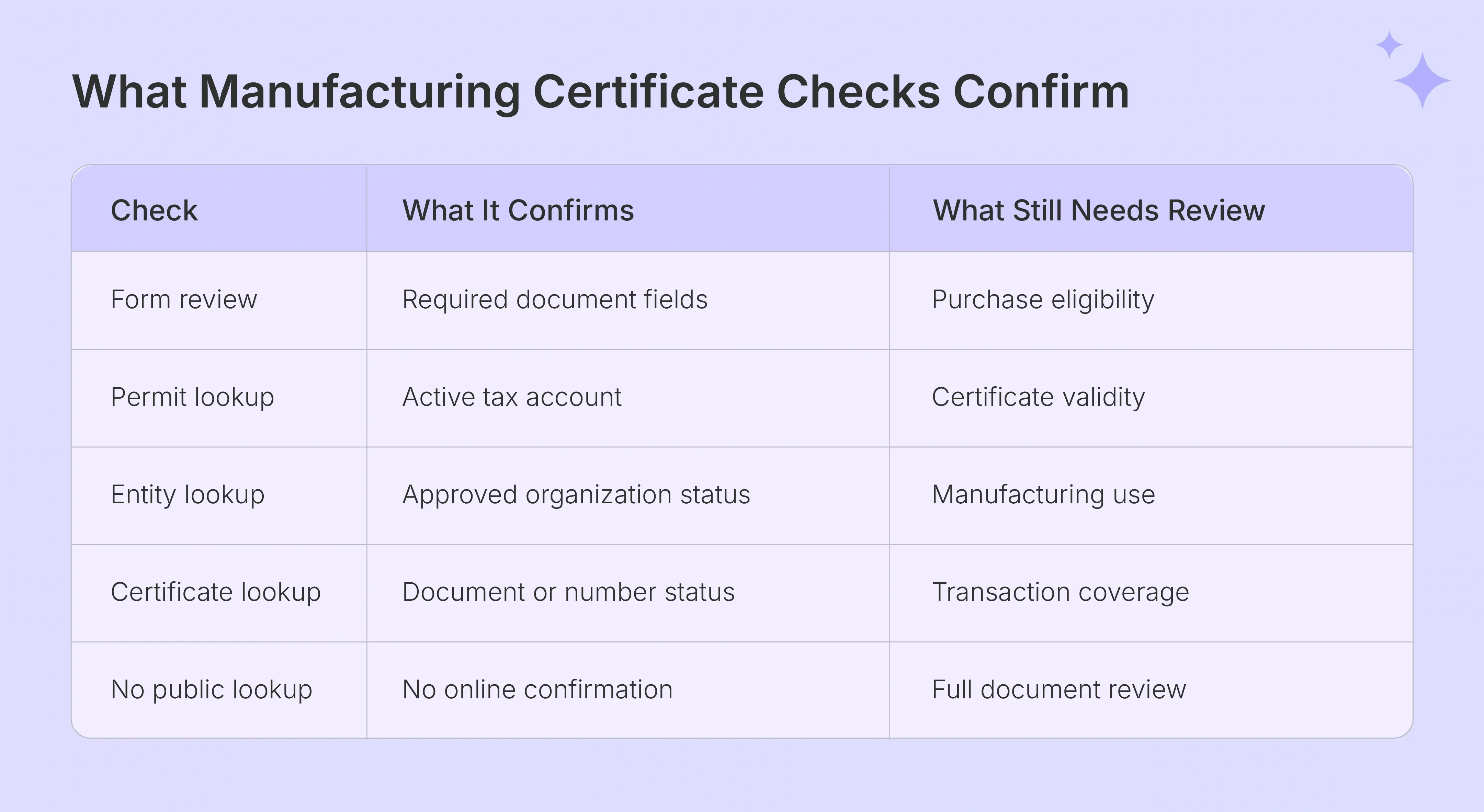
Online verification remains uneven. Galvix’s July 2026 research found that 7 of 46 sales-tax jurisdictions offered broader certificate-level lookups, 6 offered partial checks, 17 mainly confirmed permits or registrations, and 16 offered no relevant public lookups.
A permit result may confirm that the purchaser holds an active registration without proving the manufacturing form is complete or current. It also does not establish that machinery, utilities, components, or supplies qualify under the claimed exemption.
Verification should remain a single control within a broader tax compliance process. Manufacturers still need document review, eligibility analysis, transaction mapping, renewal monitoring, and evidence showing how the purchase supported manufacturing operations.
How Is Permit Verification Different From Certificate Verification?
A permit lookup confirms the presence of an active sales tax or reseller account without validating the completed form. The seller must still review purchaser details, production use, transaction timing, and the claimed exemption.
What Does Partial Verification Cover?
Partial tools may confirm an exempt entity, reseller number, or selected program, but not manufacturing documents. Teams should record the exact source and result rather than assigning a single verified status across different exemption types.
What Can Online Verification Not Confirm?
Certificate-level tools may not verify signing authority, sourcing, actual use, or all required fields. Growing facilities need connected certificate management and transaction records to preserve that context.
Why Does Exemption Management Get Harder as Manufacturers Grow?
Exemption management becomes complex as facilities, vendors, product lines, and jurisdictions expand. Similar equipment may receive different treatment by location, while the volume of certificates, renewal work, nexus exposure, and audit retrieval requirements increase together.
- Procurement Needs Clear Rules: Buyers need guidance on which purchases qualify at each plant and for each vendor relationship.
- Finance Needs Connected Evidence: Certificates should be linked to invoices, facility details, equipment descriptions, and use records.
- Tax Teams Need State Visibility: Teams must track nexus, registrations, exempt sales, and continuing sales tax obligations.
- Verification Controls Differ: States may check documents, confirm permits, or provide no public lookup.
- Renewals Follow Each Document: Certificates can expire annually, continue for fixed periods, or remain effective until facts change.
Manufacturers should also link exempt purchases to nexus analysis, as exempt revenue may still affect registration thresholds in certain jurisdictions.

How Does Galvix Help Manufacturers Manage Exemption Work?
Galvix helps manufacturers manage manufacturing sales tax exemption work through structured technology and specialist support. We collect certificates, review submitted information, organize records, follow up before expiration, and maintain clearer evidence for audits and compliance reviews.
Exemption records are often handled inconsistently across procurement, finance, facilities, and tax teams. As volume grows, documents can become separated from invoices, use evidence, registration details, or renewal triggers.
Galvix connects exemption certificate management with sales tax nexus monitoring, tax determination, state registrations, return preparation, and notice management. Manufacturers can also connect Galvix with ERP and billing systems through integration available for NetSuite, WooCommerce, Shopify, BigCommerce and several other platforms.
What Does Galvix Manage for Manufacturers?
The managed process covers the following recurring activities that help manufacturers maintain consistent exemption records:
- Certificate Collection: We collect exemption and resale documents through a structured workflow that connects each record with the relevant account.
- Document Review: Our specialists check required fields, registration details, dates, signatures, and exemption reasons before accepting a record.
- Record Organization: We store certificates with available transaction details, creating a clearer trail for state review.
- Renewal Follow-Up: Our team tracks certificate validity and contacts the relevant party before replacement becomes necessary.
- Audit Preparation: We organize certificates, account information, transaction evidence, and review history before a state samples exempt activity.
Together, these steps replace inconsistent handling with one managed process. Manufacturers gain clearer ownership, fewer renewal gaps, and faster access to records during state reviews.
How Does Galvix Pricing Work for Manufacturers?
Galvix uses modular pricing, so manufacturers pay only for the services they select rather than for a single fixed package. Exemption certificate management scales with exempt-account volume and the work required to collect, review, renew, and organize documentation. Nexus monitoring, registrations, return preparation, and tax determination use workload dimensions suited to each service.
Book a free demo with Galvix to start reviewing your certificate volume, state coverage, and current compliance gaps.
Frequently Asked Questions
Do Raw Materials Qualify for a Manufacturing Sales Tax Exemption?
Raw materials often qualify when they become ingredients or recognizable parts of the finished product sold to customers. Consumables and indirect materials can receive different treatment when they disappear during production or support the facility. Manufacturers should confirm compliance with the state’s incorporation test and retain invoices documenting product use.
Are Manufacturing Utilities Exempt From Sales Tax?
Electricity, natural gas, steam, water, or fuel may qualify when consumed directly in manufacturing. States may require a predominant-use study, separate metering, or production percentages before granting relief. Office consumption and employee areas can remain taxable, so manufacturers should document allocation methods and update studies when operations change.
What Certificate Does a Manufacturer Need for Tax-Free Purchases?
The required document depends on the sourcing state and exemption category. A manufacturer may need a manufacturing-specific form, a general exemption certificate, a state-issued permit, or a use tax exemption certificate supported by registration. The buyer should use the current official form and complete every field before requesting tax-free treatment.
Can Manufacturers Use Resale Certificates for Production Equipment?
Resale certificates usually apply when goods are purchased for resale rather than for the buyer's consumption. Production equipment is normally used by the manufacturer, so a separate manufacturing sales tax exemption may apply instead. The purchaser should use the state’s manufacturing form and avoid treating equipment as resale inventory.
What Happens if a Manufacturing Exemption Is Claimed Incorrectly?
An incorrect claim can lead to unpaid tax, interest, penalties, vendor disputes, or additional audit work. The outcome depends on state law, the purchase, available documentation, and any correction process. Manufacturers should review questionable claims early, correct vendor records, and preserve evidence supporting reasonable treatment.
How Does Galvix Manage Manufacturing Exemption Certificates?
Galvix collects certificates, reviews completed information, organizes records, follows up before expiration, and prepares audit-ready evidence. Manufacturers can also add nexus monitoring, registrations, return preparation, tax determination, or notice management. Galvix pricing remains modular, with each selected service priced according to the volume of work required.
Legal Disclaimer
This article provides general information and does not constitute legal, accounting, or tax advice. Manufacturing exemption rules, forms, rates, qualification tests, and administrative practices can change. Businesses should confirm current requirements with the relevant state authority or a qualified tax professional before claiming an exemption.