
Learning how to get a sales tax exemption certificate begins with identifying why the purchase qualifies under the sourcing state’s rules. The document may support resale, manufacturing inputs, agricultural use, direct payment authority, or approved organizational status for otherwise taxable purchases.
The process changes across different states because each jurisdiction sets its own rules for applications, buyer-completed forms, registration numbers, and approvals. Some buyers provide documentation directly to sellers, while others need a state-issued permit, exemption number, annual document, or approval letter first.
The required form also depends on the transaction. Texas combines resale and other claims on Form 01-339, while New York State uses purpose-specific documents. Florida issues an annual resale document, and Washington relies on a state-issued reseller permit for qualifying wholesale purchases.
This guide covers how to get a sales tax exemption certificate, prepare the required information, submit documentation, and manage future renewals. It also explains how sellers can evaluate certificates before approving exempt purchases and how Galvix supports ongoing certificate management.
What Is a Sales Tax Exemption Certificate?
A sales tax exemption certificate provides written support for excluding tax from an otherwise taxable purchase. The document should identify the buyer, seller, exemption reason, and covered transaction. Incomplete evidence can create additional tax, interest, penalties, or audit work for the seller.
How Does an Exemption Certificate Work?
The buyer completes or obtains the applicable certificate and gives it to the seller during the purchasing process. The seller reviews the document and retains it as support for the exempt sale rather than sending most buyer-completed forms to the state.
The route depends on the jurisdiction and exemption category. A buyer may complete a form, receive an issued document, use an active account number, or present separate approval from the relevant Department of Revenue.
How Does It Differ From a Sales Tax Permit?
A sales tax permit allows a business to collect and remit sales tax. An exemption certificate explains why tax was not collected on a specific purchase. For resale exemptions, many states require the buyer to hold a valid permit or registration number before issuing the certificate.
Sellers should also distinguish permit verification from certificate verification. A state tool may confirm that a permit or registration is active without confirming that the submitted certificate is complete, appropriate, or valid for the transaction.
Who Can Get a Sales Tax Exemption Certificate?
A buyer asking ‘how do I get a sales tax exemption certificate’ may proceed only when state tax laws recognize the claimed exemption. Eligibility depends on the buyer’s status, intended use, purchased item, sourcing location, and the specific requirements established by the jurisdiction.
Resellers and Wholesalers: Resellers often need a permit or registration before providing a resale certificate. The resale exemption applies when tangible personal property is purchased for resale to an end consumer, rather than for use in the buyer’s operations.
Nonprofits and Public Buyers: Nonprofits and government entities may qualify for sales tax exemptions in some states, but federal tax-exempt status does not automatically create a sales tax exemption everywhere. States may require a separate exemption number, approval letter, or purpose-specific certificate.
Manufacturers and Other Industries: Manufacturers, agricultural businesses, contractors, and research organizations may qualify under different exemption types. Eligibility is determined by the purchased item’s use, so industry status alone does not support every request for machinery, components, utilities, or project materials.
How to Get a Sales Tax Exemption Certificate?
To know how to get a sales tax exemption certificate, follow these steps:
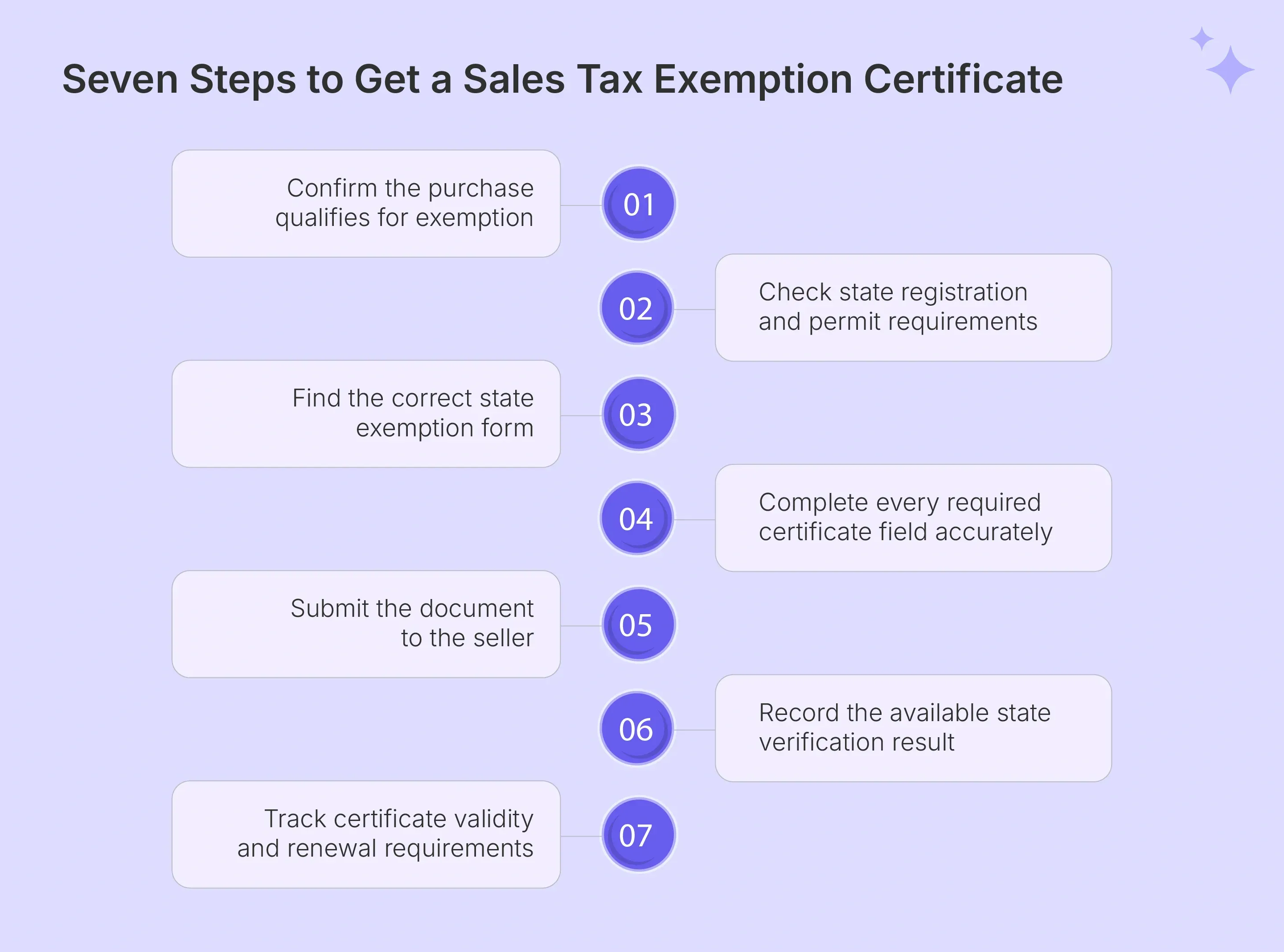
Step 1: Confirm the Exemption Reason
Start by identifying the legal basis for the tax exemption. Common routes cover resale, manufacturing use, agriculture, government purchasing, direct payment authority, and approved charitable activity.
The claimed reason must match the actual purchase, as a buyer’s industry or organizational status does not exempt every purchase.
Step 2: Check Whether State Registration Is Required
Many resale claims require a permit, reseller number, or state registration before the buyer issues documentation. Some jurisdictions accept a home-state number, while others require local registration before the time of sale.
Registration procedures also change by state before a buyer can rely on an exemption document. For a practical comparison, review how Texas sales tax registration works and how it differs from Florida sales tax registration in terms of applications, account setup, and filing responsibilities.
The buyer should also check whether streamlined sales tax documentation, a Multistate Tax Commission form, or a destination-state certificate is allowed. Acceptance remains conditional because participating jurisdictions retain separate identification rules and transaction limits.
Step 3: Find the Correct State Form
Anyone learning how to get a sales tax exemption certificate should use the current state document or an approved multistate form. The correct route may involve a certificate of exemption, a resale form, an industry-specific application, an approval letter, or a state-issued permit.
California uses CDTFA-230 for many resale purchases, while Texas uses Form 01-339. The New York State Department of Taxation lists ST-120 for resale; Florida issues DR-13 annually; North Carolina uses E-595E; and Washington issues reseller permits.
These examples show why buyers should not limit themselves to comparing form names. The issuing method, renewal cycle, and seller control can change how each certificate is obtained and reviewed.
We will add the sales tax exemption certificate tool here once ready. The content/ design will be added at that time.
How Do Common State Forms Compare?
Galvix’s official-source research shows that buyers follow different documents and control points across six common jurisdictions. This comparison helps businesses identify the correct exemption certificate before customer outreach or account changes begin.
| State | Primary Resale Route | How Buyers Obtain It | Main Control Point |
|---|---|---|---|
| California | CDTFA-230 | Buyer completes the form | Seller permit details may be required |
| Florida | DR-13 | State issues it annually | Confirm the current calendar-year document |
| New York | ST-120 | Buyer completes the form | Use the purpose-specific state document |
| North Carolina | E-595E | Buyer completes the form | Select the correct exemption reason |
| Texas | Form 01-339 | Buyer completes the form | Match business activity with the purchase |
| Washington | Reseller Permit | State issues the permit | Verify permit status before the sale |
Once the correct document is identified, businesses still need to understand its validity, multistate treatment, and verification limits. The administrative workload also varies significantly across states, which Galvix measures using its exemption certificate complexity score.
How Difficult Is Exemption Certificate Compliance Across States?
Finding the correct form is only one part of the process. Some jurisdictions create heavier workloads through multiple forms, limited online checks, frequent renewals, stricter out-of-state rules, or higher penalty exposure.
Galvix created a 0–100 complexity score for the 46 jurisdictions with a general sales tax. A higher score indicates that businesses may need greater effort to collect, review, renew, and support exemption documentation.
The score combines six factors: form volume, blanket-certificate availability, renewal burden, online verification access, out-of-state acceptance, and penalty severity. It provides a comparative overview rather than predicting the outcome of an individual transaction or audit.
Galvix research ranks Louisiana as the most complex jurisdiction and North Carolina as the least complex.
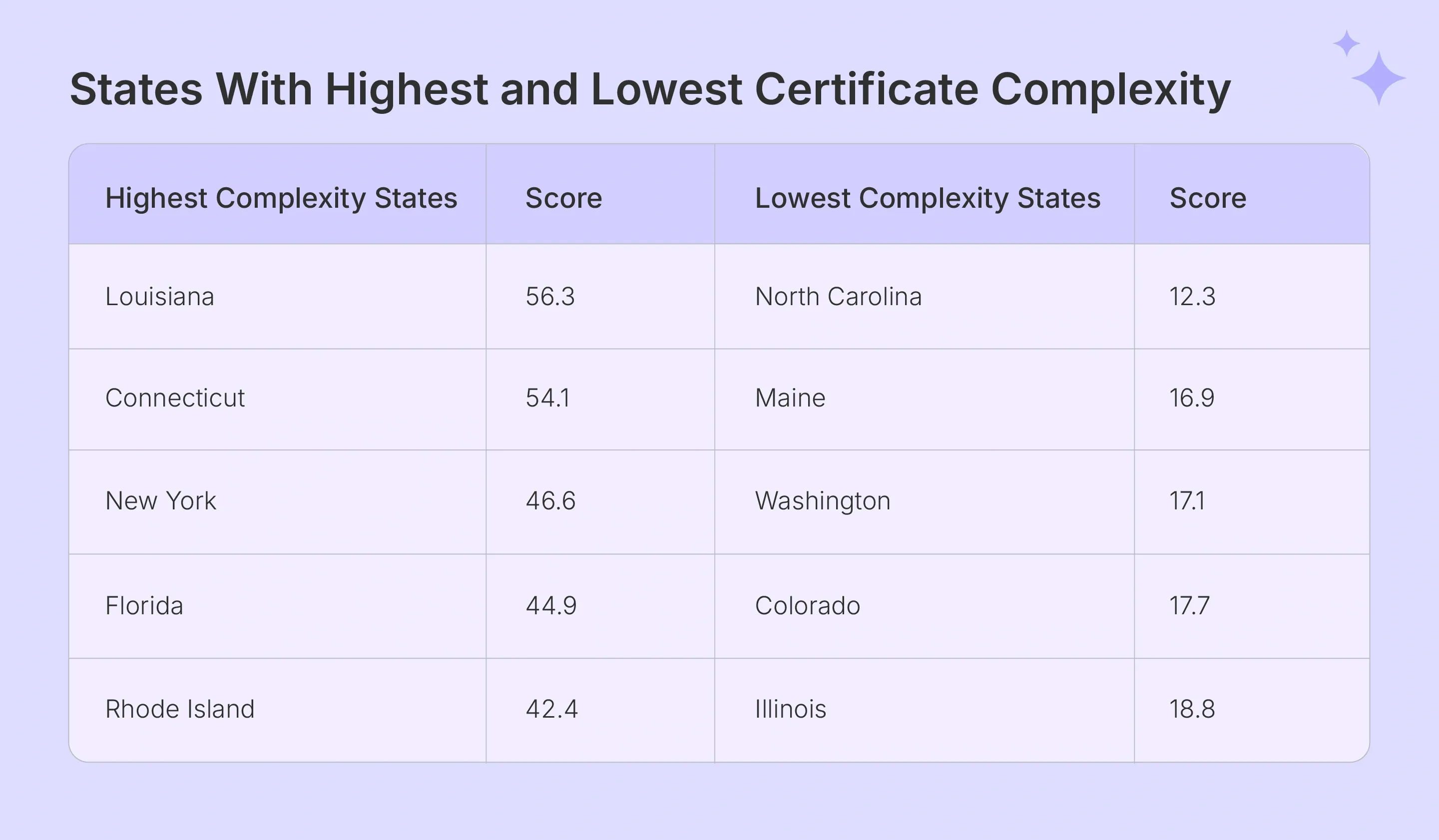
The comparison shows that obtaining the right certificate does not capture the full administrative burden. Businesses must also consider renewal effort, verification limits, out-of-state acceptance, and the controls needed to support future transactions. The Galvix Sales Tax Exemption Certificate Tool brings these state-level details into one searchable resource.
How Can the Galvix Sales Tax Exemption Certificate Tool Help?
The Galvix Sales Tax Exemption Certificate Tool helps teams learning how to get a sales tax exemption certificate compare state forms and verification routes. Its state pages organize validity rules, multistate treatment, out-of-state conditions, and official guidance within one consistent resource.
Buyers can identify the likely document, while sellers can understand what each government lookup confirms. This context separates permit status, certificate status, transaction eligibility, and renewal scope, helping teams avoid grouping different certificates under one compliance decision.
Step 4: Complete Every Required Field
Most forms request the buyer’s legal name, address, registration details, exemption reason, signature, date information, and purchase description. The seller’s name and address may also be required before the document becomes a valid certificate.
Blank fields, mismatched details, or vague descriptions can weaken audit support and delay certificate acceptance. Review the instructions because tax regulations may require attachments, a date of issuance, project details, or exemption-specific identification beyond standard customer information.
Step 5: Submit the Certificate to the Seller
In most cases, the buyer gives the correct exemption certificate directly to the seller rather than filing it with the state. The seller should review and retain the document before changing the customer or transaction to tax-exempt status.
Some exemptions require an application, issued number, or government approval before the buyer can provide usable evidence. For example, the Alabama Department of Revenue directs qualifying applicants to use its sales tax certificate of exemption application.
Step 6: Check What the State Can Verify
State tools may provide broader certificate checks, partial entity verification, permit searches, registration results, or no relevant public lookup. Businesses should record the source, date, reference, and exact result for each available check.
An active registration can support account status without proving the completeness of the certificate or transaction eligibility. A valid exemption certificate still requires the correct form, purchaser information, exemption reason, and covered purchase.
Step 7: Record the Validity and Renewal Rule
Some documents expire annually, while blanket certificates may remain valid for fixed periods or continue until revoked. Replacement may also follow ownership, address, registration, business activity, or the purchaser's circumstances.
Store the applicable rule with each record and begin follow-up before the end of the period. For a blanket certificate, confirm whether the continuing validity covers future purchases and whether inactivity triggers a replacement.
How Do You Get a Tax Exemption Certificate Online?
Businesses asking how to get tax exemption certificate online should start with the relevant state tax authority when learning how to get a sales tax exemption certificate. Online access may involve downloading a form, registering for a permit, receiving approval, or checking an existing record.
Use State Revenue Department Websites First
Official state websites provide current forms, instructions, sales tax rates, registration portals, lookup tools, and renewal guidance. A Department of Revenue page should determine the final requirement, even when third-party resources make the research easier.
Searches such as how do I get sales tax exemption certificate reflect different situations, so save the current policy and form instructions. This practice helps teams show which document version supported the application or acceptance decision.
Use the Streamlined Sales Tax Certificate When It Applies
The Streamlined Sales Tax certificate is accepted by all 24 participating jurisdictions, including 23 full members and Tennessee as the associate member. Buyers must still provide the information and exemption reason required by each state.
Participation does not create one universal sales tax certificate of exemption, and states without a general sales tax follow separate rules. Each jurisdiction can apply its own conditions concerning registration numbers, exempt entities, product categories, and supporting evidence.
Use the MTC Certificate for Resale Where Accepted
The Multistate Tax Commission states that 36 jurisdictions have indicated its current uniform form can support qualifying resale transactions. The form contains state-specific limitations, so purchasers should review every applicable instruction before use.
A couple of states may require local registration, supplemental details, or another prescribed document. The MTC form is mainly a resale certificate and does not replace every tax certificate of exemption used for manufacturing or organizational claims.
Do Not Confuse Online Access With Online Verification
A downloadable tax certificate does not guarantee that sellers can verify the completed document through a public state tool. Some websites confirm only a permit or registration, while other jurisdictions provide no relevant search.
The buyer must still complete the form, and the seller must review the reason for the exemption. Online access supports the process without replacing judgment under applicable exemption certificate rules.
What Information Do You Need Before Completing the Certificate?
Before learning how to get a sales tax exemption certificate, gather the information required by the jurisdiction and exemption category. Most forms request buyer details, seller information, registration numbers, purchase descriptions, signatures, and dates.
Buyer and Seller Information
The certificate should show the buyer’s legal name, address, and required identification details. Informal trading names can create mismatches when the state expects the registered entity making the purchase.
Seller details should match the business completing the exempt sale. Both records should align with invoices, customer accounts, shipping information, and registration documents maintained for sales tax compliance.
Exemption Reason
The buyer should state why the purchase qualifies for sales tax exemption under the sourcing jurisdiction’s tax laws. The explanation must match the exemption category recognized by that state.
Common claims cover resale, manufacturing, agricultural use, government purchasing, and approved nonprofit activity. Generic wording such as “tax exempt” may not satisfy the state’s certificate requirements.
Purchase Description
The document should explain what the buyer is purchasing and how the item will be used. A resale claim should identify goods intended for resale rather than internal consumption.
Use-based claims may require details about equipment, components, agricultural inputs, utilities, or project materials. These descriptions help sellers distinguish qualifying purchases from goods used by the buyer.
Registration Numbers and Signature
The buyer may need a permit number, an exemption number, a reseller number, or a state-issued account reference. The required identifier depends on the exemption route and the jurisdiction’s own rules.
An authorized person should sign and date the document before submission. A federal employer identification number should not replace a state-required number unless the jurisdiction expressly allows that substitution.
What Should Sellers Check Before Accepting a Certificate?
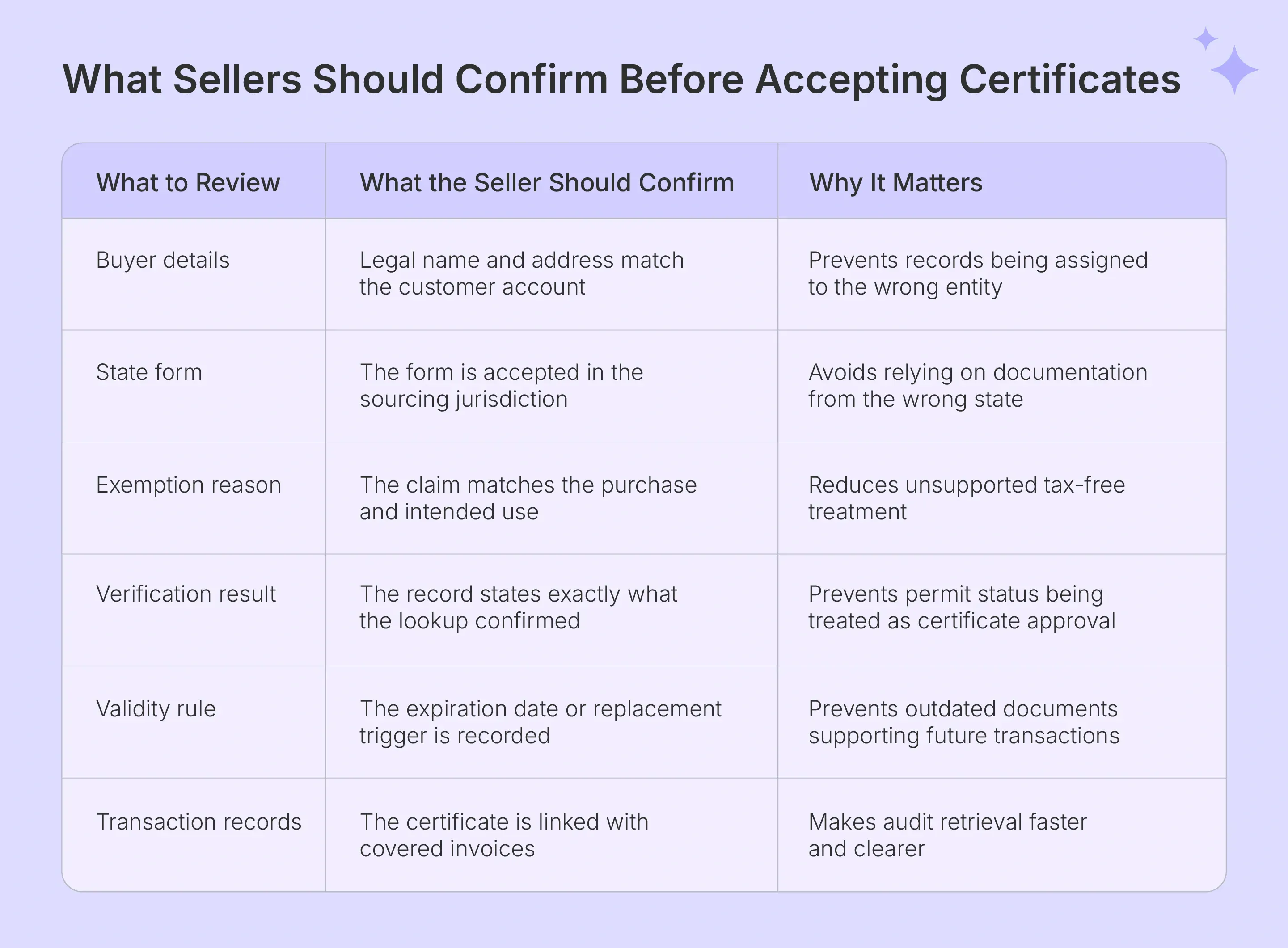
Sellers reviewing how to get a sales tax exemption certificate accepted should confirm more than the presence of an uploaded document. The record must match the sourcing state, customer, exemption reason, and covered purchase, and remain traceable to the related invoice.
- Required Fields: Review names, addresses, signatures, registration numbers, exemption reasons, and purchase descriptions before approving the transaction. Keep the tax applied until the missing information is corrected and the record supports an exempt sale.
- State Relevance: Confirm that the document applies to the jurisdiction where the sale is sourced. A form accepted in one jurisdiction may not be accepted for the same exemption elsewhere because different states have different certificate requirements.
- Exemption Fit: Check whether the claim aligns with the buyer’s business and purchased goods. A resale document should not cover products consumed internally rather than transferred to an end consumer.
- Verification Scope: Determine whether the state checks a completed exemption certificate, entity number, reseller permit, tax permit, or business registration. Record exactly what was verified instead of assigning one universal status.
- Customer Account Match: Connect the document with the correct legal entity, tax account, billing profile, and shipping record. Unexplained differences can weaken support when authorities review exempt transactions.
- Transaction Linkage: Store the document with invoices, jurisdiction, exemption reason, and covered product category. A standalone folder increases audit risk when certificates cannot be traced to sampled sales.
Businesses should also preserve economic nexus totals and threshold conditions because exempt revenue may still influence registration analysis in certain jurisdictions. Certificate records should therefore remain connected with the company’s wider state footprint rather than being managed as an isolated document library.
Finance teams preparing for state inquiries can also review Galvix’s guide to managing sales tax audits for additional context on record retention, audit preparation, and supporting exempt transactions.
When Should Sellers Charge Tax Instead?
Sellers should keep tax applied when documentation remains missing, incomplete, or unsuitable for the purchase. Charging tax can be safer than approving unsupported treatment and reconstructing records during an audit.
- Only a Tax Number Arrives: A federal identifier, permit number, or reseller reference alone may not satisfy documentation rules. Request the completed form or required state-issued evidence before approving the exemption.
- Documentation Arrives Later: Some jurisdictions offer a limited cure period, while others apply stricter standards. Confirm the applicable rule rather than assuming that a document collected during an audit supports earlier sales.
- The Purchase Does Not Match: A buyer may qualify for one exemption without qualifying for every product. Charge tax or request corrected evidence when the purchase conflicts with the stated use.
- The Lookup Does Not Support the Claim: An active permit does not establish eligibility for resale, manufacturing, nonprofit, or government purposes. Request additional evidence when the lookup, certificate, and transaction do not align.

How Does Galvix Manage Sales Tax Exemption Certificates?
Learning how to get a sales tax exemption certificate is only the first step. Businesses must keep documents current across customers, jurisdictions, billing systems, renewal cycles, and audits. Galvix combines structured technology with specialists who manage ongoing exemption certificate management.
Businesses using several billing or ERP systems can review the complete list of Galvix integrations. This helps teams understand how transaction information can remain connected with certificate records and wider sales tax workflows.
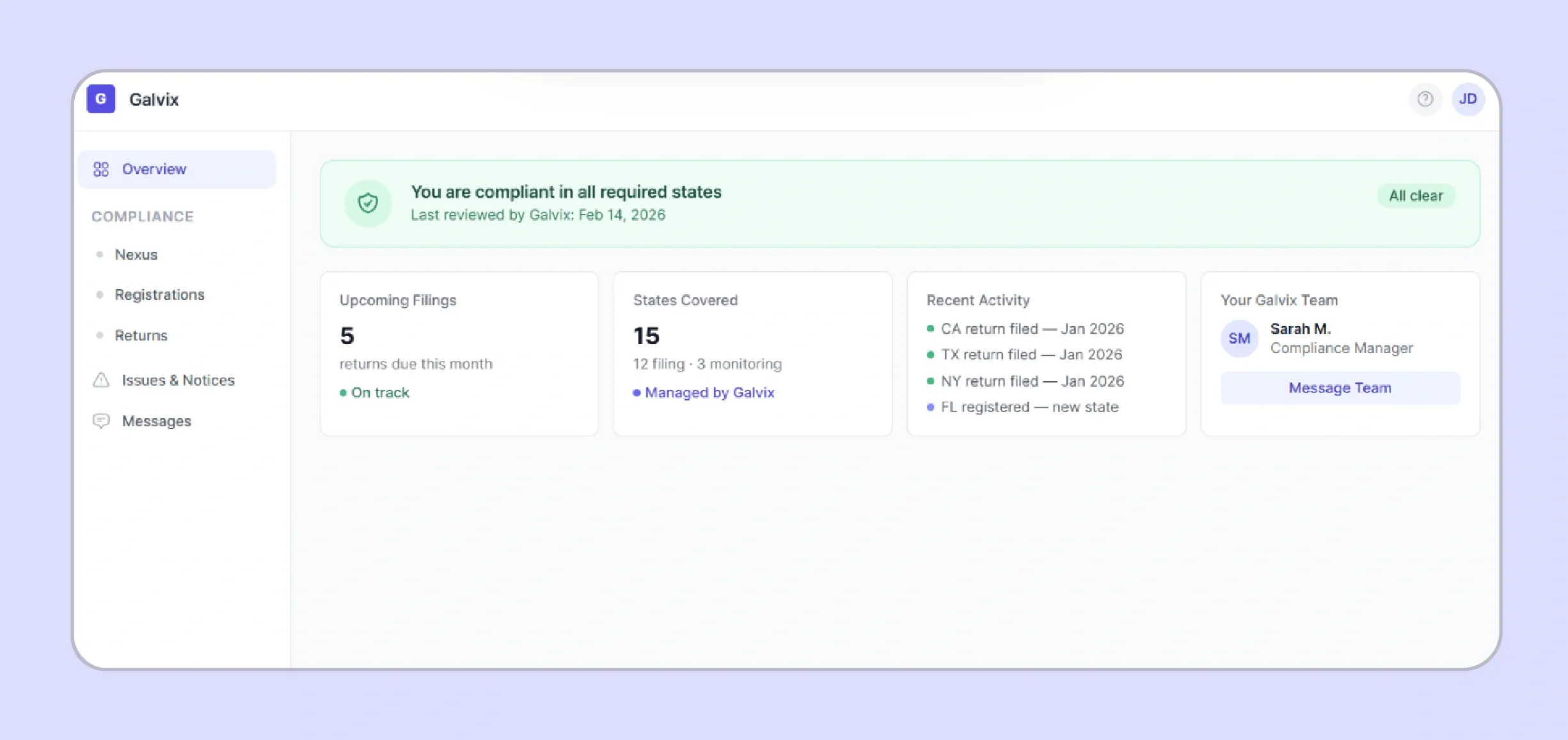
At Galvix, we manage exemption certificate work as part of our broader sales tax compliance service. Our team collects certificates, reviews submitted information, stores records against customer accounts, tracks certificate-specific renewal requirements, follows up before expiration, and prepares audit-ready documentation.
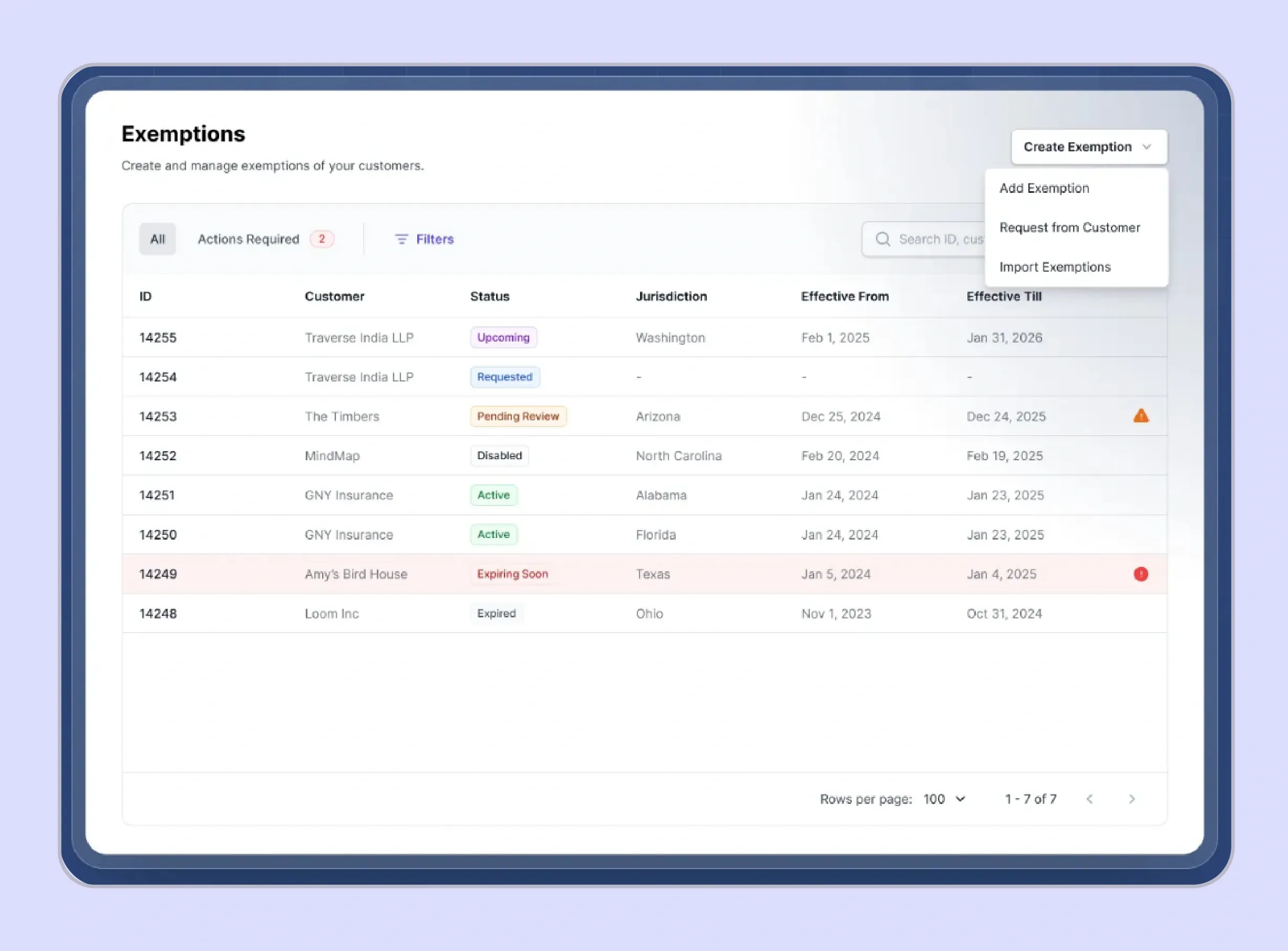
Certificate Collection: We collect exemption and resale certificates through a structured customer workflow. This reduces manual chasing and more reliably keeps documents attached to the right account from the start.
- Certificate Review and Status Checks: Our experts review submitted details for missing fields, mismatched names, expired documents, and unclear exemption reasons. Where supported, available state tools help confirm certificate, permit, registration, or exempt-entity status within the limits of that tool.
- Renewal Follow-Up: We record the validity rule attached to each document and contact customers before replacement becomes necessary. This helps prevent expired or outdated evidence from being used to support future exempt sales.
- Audit-Ready Records: Our team stores certificates against customer accounts, transactions, and supporting details. This gives finance teams clearer evidence when a state later requests proof of exempt sales during compliance reviews.
- Wider Compliance Support: We connect certificate work with nexus monitoring, taxability, registrations, return preparation, and notice management. This keeps exemption records aligned with broader sales tax obligations across active states.
Galvix uses modular pricing, so businesses pay only for the services they select. The Galvix pricing page explains the workload factor used for exemption management and every other compliance module.
Review current certificate gaps before unsupported exempt sales are subject to an audit. Book a demo with Galvix today to get started.
Frequently Asked Questions
How Do You Obtain a Sales Tax Exemption Certificate for Resale?
To understand how to obtain a sales tax exemption certificate, check whether the destination state requires registration or accepts a home-state number. Find the current resale form, complete every required field, and give it to the seller. SST or MTC documentation may work where accepted under state instructions.
Is a Resale Certificate the Same as a Sales Tax Exemption Certificate?
A resale certificate is one type of sales tax exemption certificate used for goods purchased for resale. Other certificates support manufacturing, agriculture, government use, direct payment authority, or approved nonprofit activity. The correct document depends on the purchaser, intended use, sourcing state, and exemption claimed.
Do You Need a Sales Tax Permit Before Getting an Exemption Certificate?
Many resale routes require a permit or registration number before the buyer completes an exemption certificate. Other exemptions may depend on government approval, organizational status, or a separately issued number. Review the relevant state instructions because registration requirements differ across purchaser categories and exemption types.
Can One Exemption Certificate Be Used in Multiple States?
No document achieves universal acceptance across all jurisdictions. SST documentation works across participating member states, while the MTC resale form is accepted with state-specific limitations. Buyers may still need local registration, supplemental details, or purpose-specific forms, depending on the purchaser and transaction.
How Long Does a Sales Tax Exemption Certificate Remain Valid?
Validity can be annual, fixed-term, continuing, or triggered by a change in purchaser information. Ownership, address, registration, business activity, or exemption circumstances may require replacement. Record each document’s renewal rule instead of applying one standard date at the end of each customer cycle.
How Does Galvix Manage Sales Tax Exemption Certificates?
Galvix manages collection, specialist review, customer mapping, renewal tracking, and audit-ready records through one service relationship. Businesses can add nexus monitoring, registrations, return preparation, or notices as needed. Pricing remains modular, and exact costs depend on the volume of work for each selected service.