


Businesses registered for Maine sales and use tax file their returns through the Maine Tax Portal, which is managed by Maine Revenue Services. The state applies a 5.5% general rate, while prepared food, lodging, short-term rentals, cannabis, and several other transactions use different rates.
This rate structure makes classification central to Maine sales tax filing. There are no general local sales taxes, so businesses avoid city and county allocation. They still need to separate transactions correctly, as the portal calculates tax based on the selected rate category.
The Maine sales tax return also reflects significant changes that took effect in January 2026. Adult-use cannabis moved to 14%, while the former Service Provider Tax was repealed and several previously covered taxable services moved into the sales and use tax system at 5.5%.
This blog explains how to file Maine sales tax online, prepare transaction data, complete the portal workflow, support exemptions, and retain proof of filing. It also explains how Galvix can help businesses manage their Maine sales tax return alongside other states without having to rebuild the filing process for each jurisdiction.

Why Does Maine Sales Tax Filing Require Rate Specific Reporting?
Maine's sales tax return uses a single statewide filing system, although different transactions may apply varied tax rates. Businesses therefore need to classify their sales before filing so Maine Tax Portal can apply the correct rate to each taxable base entered.
Maine Uses Several State Sales Tax Rates
The 5.5% state sales tax applies to most ordinary retail transactions, while other categories receive their own rates. Separating those categories before filing helps keep the portal entries consistent with source records.
| Transaction | Current Maine Rate |
|---|---|
| General taxable sales | 5.5% |
| Prepared food and qualifying liquor | 8% |
| Lodging | 9% |
| Short-term auto rentals | 10% |
| Adult-use cannabis | 14% |
| Medical cannabis | 5.5% |
| Prepared food containing medical cannabis | 8% |
Most ordinary sales of tangible personal property fall under the general rate unless a specific exemption or special rule applies. The portal then asks filers to divide the total taxable amount across the rate categories that apply to their business.
Former Service Provider Tax Sales Now Enter Sales Tax
Maine repealed its service provider tax from January 1, 2026. Services previously covered include cable and satellite services, telecommunications, certain equipment services, and fabrication services, which now generally enter the sales tax system at 5.5%.
The practical change is important for any former service provider. Businesses that previously reported these activities separately now need to include their affected sales in the current return, along with other taxable activities subject to Maine’s sales and use tax rules.
Maine Has No General Local Sales Taxes
The State of Maine does not add general municipal or county sales taxes to the statewide rates. That removes the jurisdiction-allocation work found in several other states, while transaction classification still matters because special statewide categories use different rates.
For businesses operating across several jurisdictions, sales tax rules by state can differ significantly in rates, nexus thresholds, return formats, and filing requirements. Maine’s statewide structure therefore should not be treated as a model for filing elsewhere.
Who Needs to File a Maine Sales Tax Return?
Businesses with physical presence in Maine generally register when making regular taxable sales. Remote sellers can also create an obligation after exceeding the state’s current economic nexus threshold, while registered businesses must continue filing according to their assigned schedule.
Maine Retailers and Remote Sellers
A retailer may need sales tax registration when its activities create physical nexus or when remote activity establishes economic nexus. Businesses often call the registration a sales tax permit, although Maine formally issues a Retailer Certificate after registration.
- Retailers regularly selling tangible personal property in Maine.
- Businesses providing specifically enumerated taxable services in Maine.
- Remote sellers exceeding the current Maine sales threshold.
- Registered sellers combining marketplace activity with direct sales.
For remote sellers, the threshold is more than $100,000 of relevant gross revenue from direct Maine deliveries during the current or previous calendar year. Maine no longer applies the former 200-transaction threshold.
Businesses monitoring that exposure can review their current Maine sales tax nexus position before crossing the threshold. Teams operating nationally can also compare broader sales tax nexus thresholds as their footprint changes.
Marketplace Sellers Need to Separate Direct Sales
A marketplace-only seller without Maine physical presence may avoid registration when its facilitator provides written confirmation that it collects and remits the tax. Maine specifically requires marketplace facilitators to provide this written statement to marketplace sellers.
For a seller making both facilitated and direct Maine sales, only its direct activity counts toward the $100,000 threshold. Once registered, facilitated transactions covered by the required written statement can be included within exempt sales for the relevant reporting period.
Filing Frequency Depends on Average Tax Liability
Maine Revenue Services assigns filing frequency according to average tax liability. Registered retailers still need to file Maine sales tax online when all sales for a period are exempt, even when no payment is due.
| Filing Frequency | Maine Rule |
|---|---|
| Monthly | $600 or more average monthly liability |
| Quarterly | $100 to less than $600 monthly |
| Semiannual | Less than $100 monthly and over $50 annually |
| Annual | Less than $50 annual liability |
Returns are due on the 15th day of the month following the period. When the due date falls on a weekend or state holiday, the deadline moves to the next business day.
What Data Is Required to File Maine Sales Tax Online?
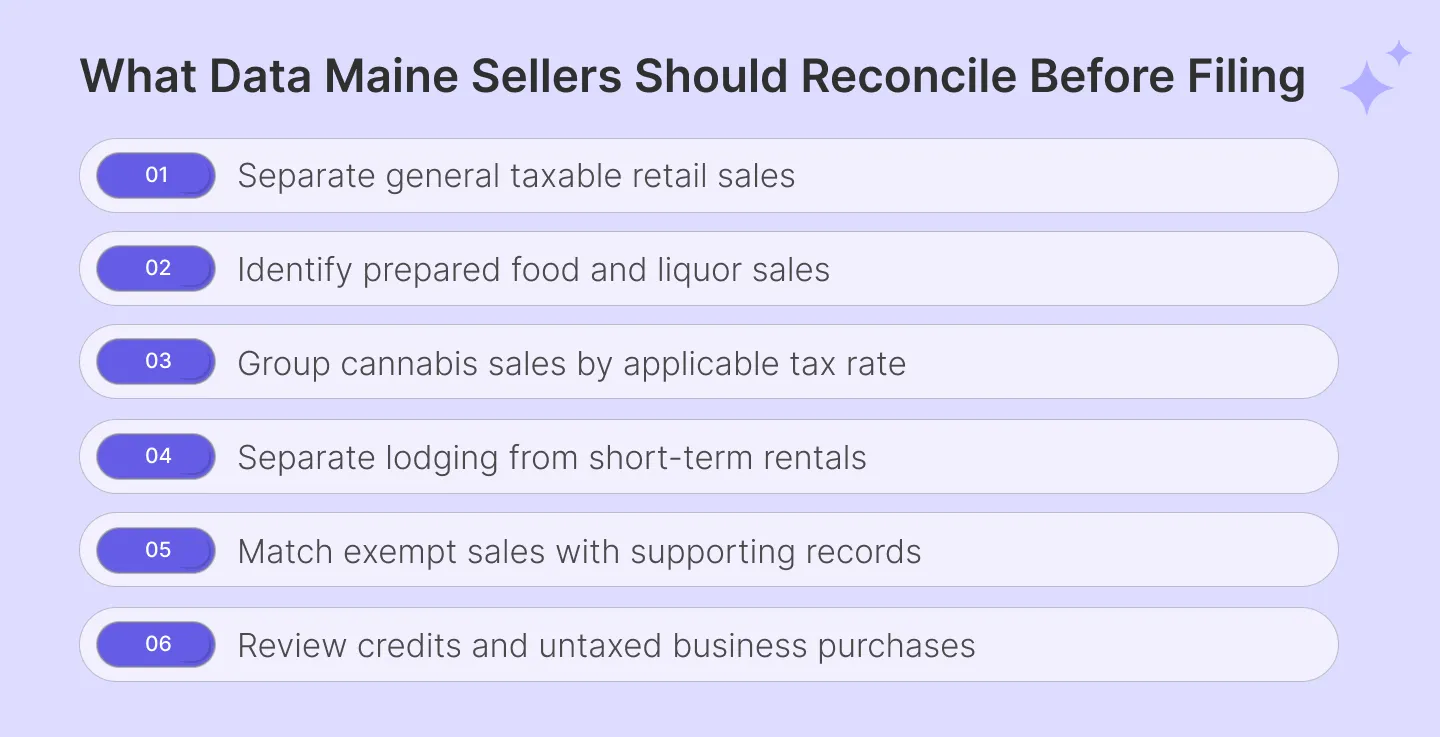
Before beginning ME sales tax filing, reconcile the figures that feed the return. Maine Tax Portal calculates several totals after entry, although the business remains responsible for determining which transactions are exempt, which are taxable goods, and which special-rate category applies.
| Prepare | Why It Matters |
|---|---|
| Maine Tax Portal login | Opens the correct account |
| Gross sales | Creates the starting return amount |
| Exempt sales | Reduces the taxable base |
| Sales by rate | Separates special-rate activity |
| Cannabis activity | Supports cannabis rate reporting |
| Rental activity | Separates lodging and vehicle rentals |
| Tax-free purchases | Captures qualifying use tax |
| Credits | Adjusts final amount where allowed |
| Bank details | Supports ACH payment |
The starting point is gross sales, followed by supported deductions and adjustments. Maine Tax Portal calculates taxable sales from those entries before the filer assigns the taxable base across the rate screens.
Marketplace Sales Need Separate Treatment
Businesses should separate facilitated activity from total direct sales before initiating the return. MRS states that covered marketplace transactions may qualify as exempt sales when the seller holds the required written facilitator statement confirming responsibility for collection and remittance.
This also prevents marketplace activity from being confused with direct sales used for the state’s nexus test. Accurate source data therefore supports both the return and ongoing exposure monitoring.
Special Rate Sales Should Be Reconciled Before Filing
The live portal moves filers through separate screens for general sales, cannabis, rentals, fees, credits, and other items. Every applicable taxable base should be prepared before the filing process starts because each screen can remain at zero without preventing submission.
When transaction data comes from several ecommerce, accounting, payment, or ERP systems, supported sales tax integrations can consolidate those records into a single filing workflow. API connections and file uploads can support other source systems where a direct integration is unavailable.
How Do You File Maine Sales Tax Online Through Maine Tax Portal?
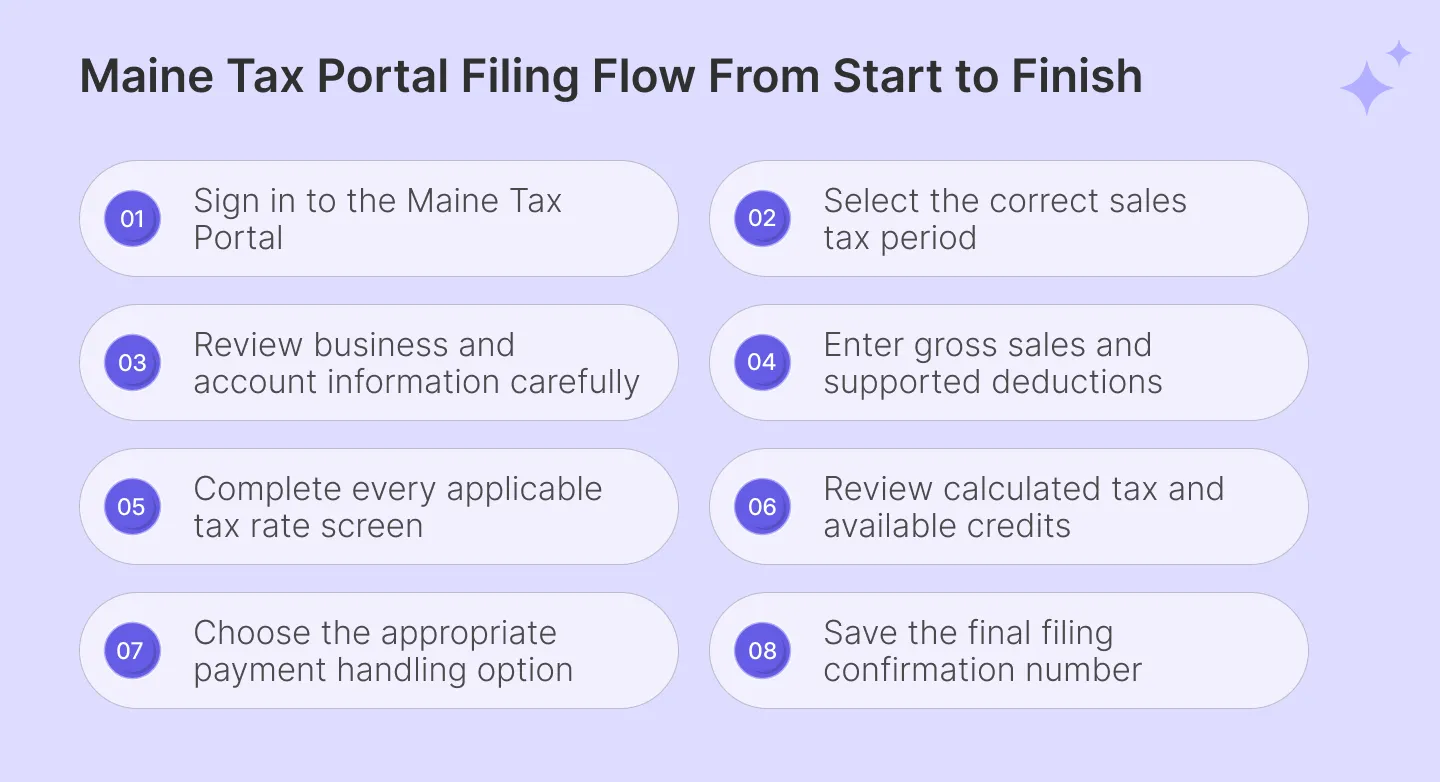
To file Maine sales tax online, sign in to the portal, open the correct tax return, enter the sales breakdown, complete every relevant rate screen, review the calculated tax due, choose payment handling, and submit the return for confirmation.
Step 1: Sign In to Maine Tax Portal
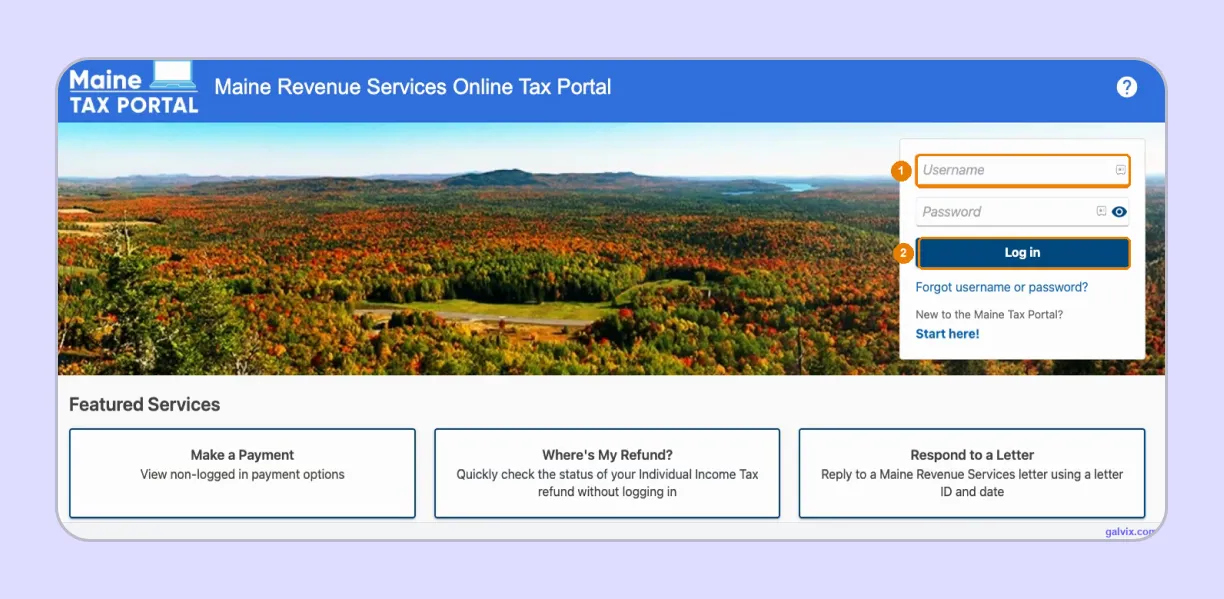
To file Maine sales tax online, enter the username and password linked to the correct portal profile, then select Log in. Maine Tax Portal also sends a two-step security code to the email address associated with the account.
If you manage several entities, confirm the login before proceeding. Starting with the wrong profile can lead to another business account before the return period is selected.
Step 2: Select the Correct Filing Period
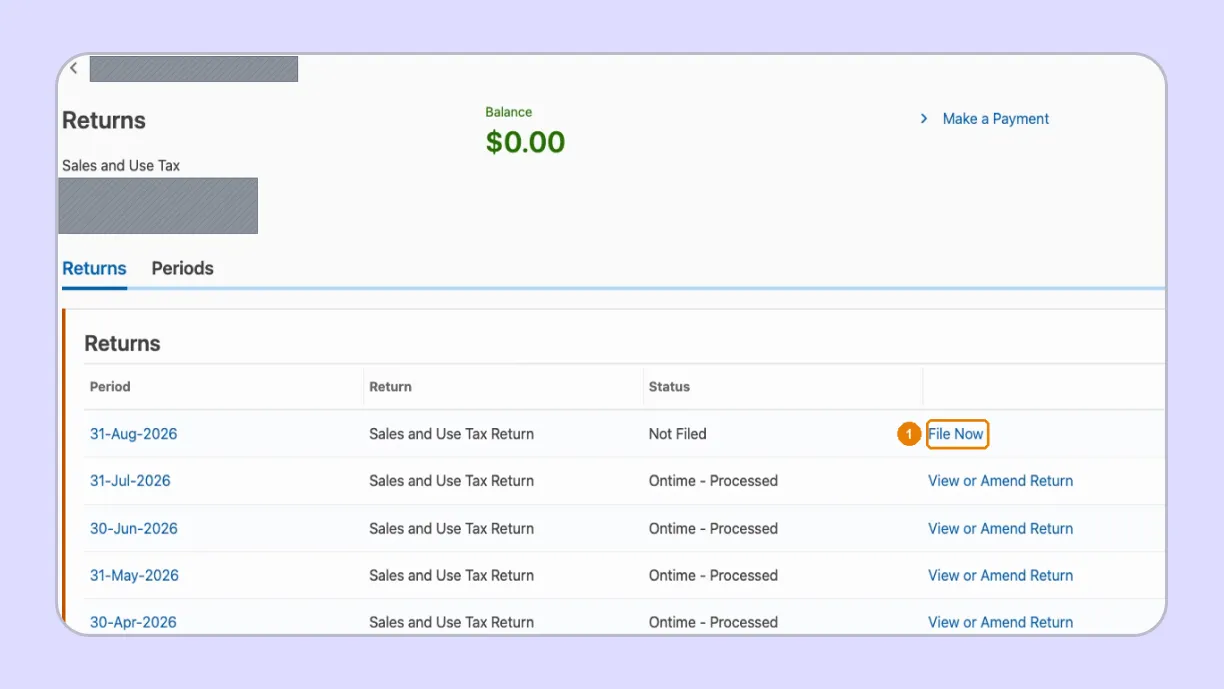
Open the Sales and Use Tax account and review the Returns list. A period awaiting filing appears as Not Filed with File Now, while completed periods display Ontime Processed and View or Amend Return.
For teams asking how to file ME sales tax, matching the correct period is an important early check. The portal keeps prior returns in the same list, so use the period date rather than assuming the first row is correct.
Filed and unfiled periods appear together. Select File Now only for the intended open period, since corrections to an older period begin through View or Amend Return instead.
Step 3: Review Demographic Information
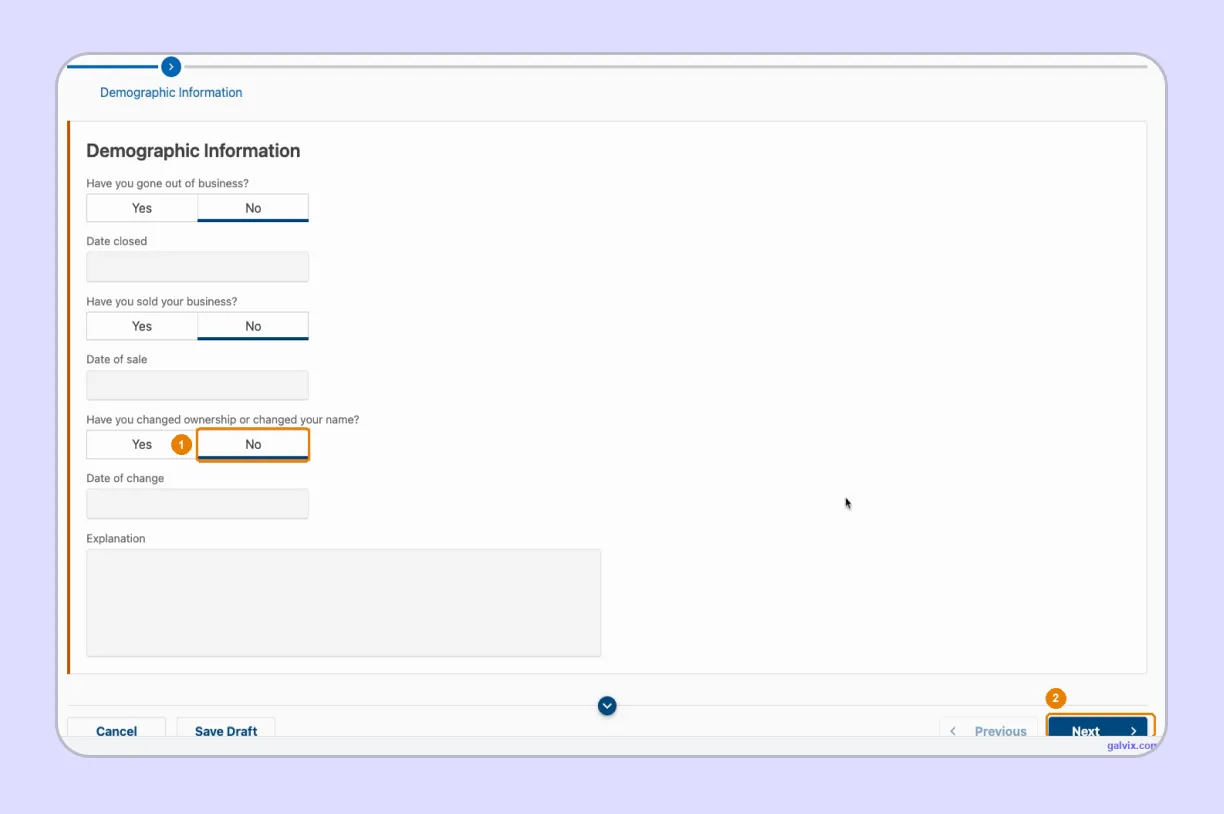
The portal next asks whether the business closed, was sold, or changed ownership or name. For an ongoing business with no such change, answer No and continue with Next.
A Yes response opens fields for the relevant date or additional information. Use those options only when the stated change occurred because they can begin an account closure or transfer process.
Step 4: Enter Gross Sales and Deductions
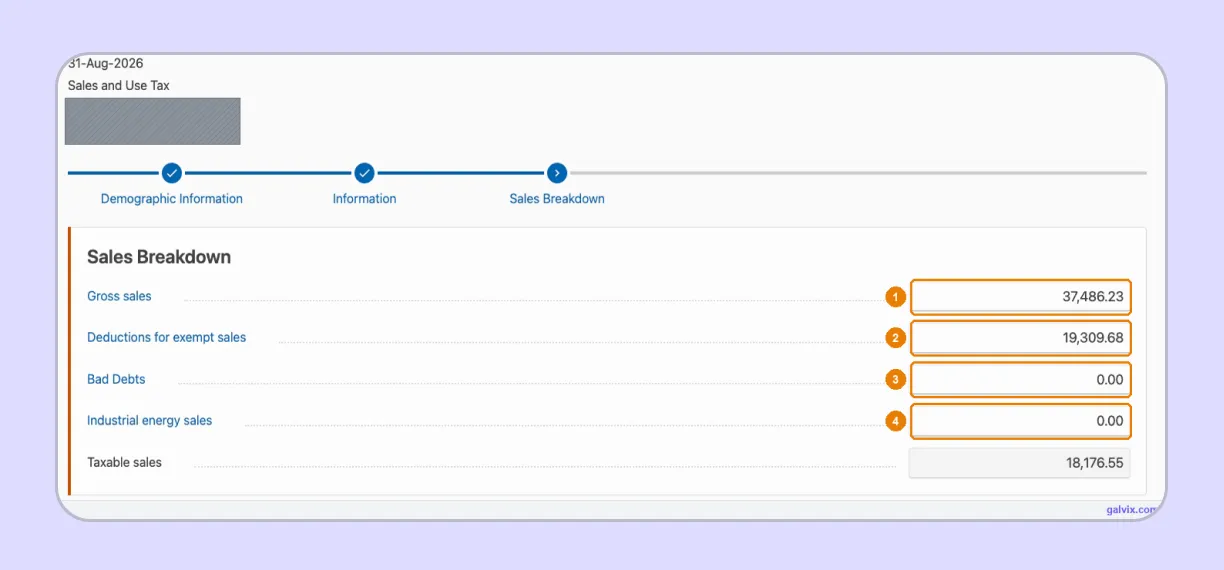
The Sales Breakdown asks for Gross Sales, Deductions for Exempt Sales, Bad Debts, and Industrial Energy Sales. The portal then calculates taxable sales rather than asking the filer to enter that total manually.
A business researching how to fill out sales and use tax return Maine should pay close attention to deductions. The calculated result can be mathematically correct even when an exempt transaction was placed in the wrong deduction category.
Supporting records should exist before deductions reduce the taxable amount. The portal calculates from what you enter and does not independently decide whether a claimed exemption qualifies.
Step 5: Enter General and Prepared Food Sales
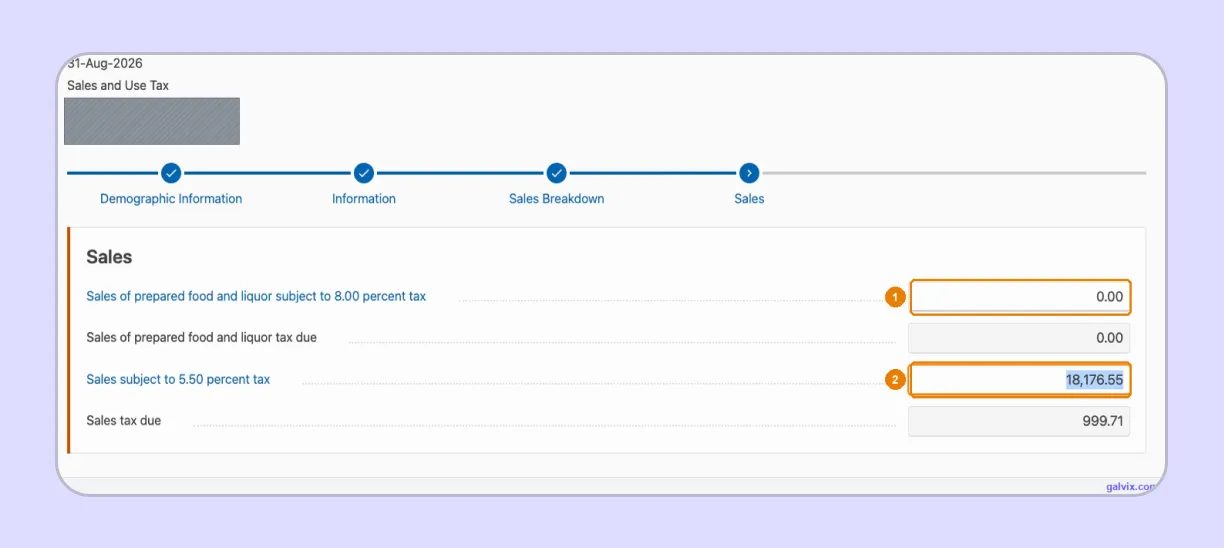
The Sales screen asks how the taxable amount should be divided. Enter prepared food and qualifying liquor sales on the 8% line, while ordinary taxable activity goes into the 5.5% general category.
Maine Tax Portal calculates the amount of sales tax for each line after the taxable base is entered. The filer therefore supplies the sales amount, while the portal applies the displayed sales tax rate.
The individual rate bases should reconcile with total taxable sales calculated earlier. A return can balance overall while still understating tax when part of the taxable base enters the wrong rate bucket.
Step 6: Complete Cannabis and Rental Screens
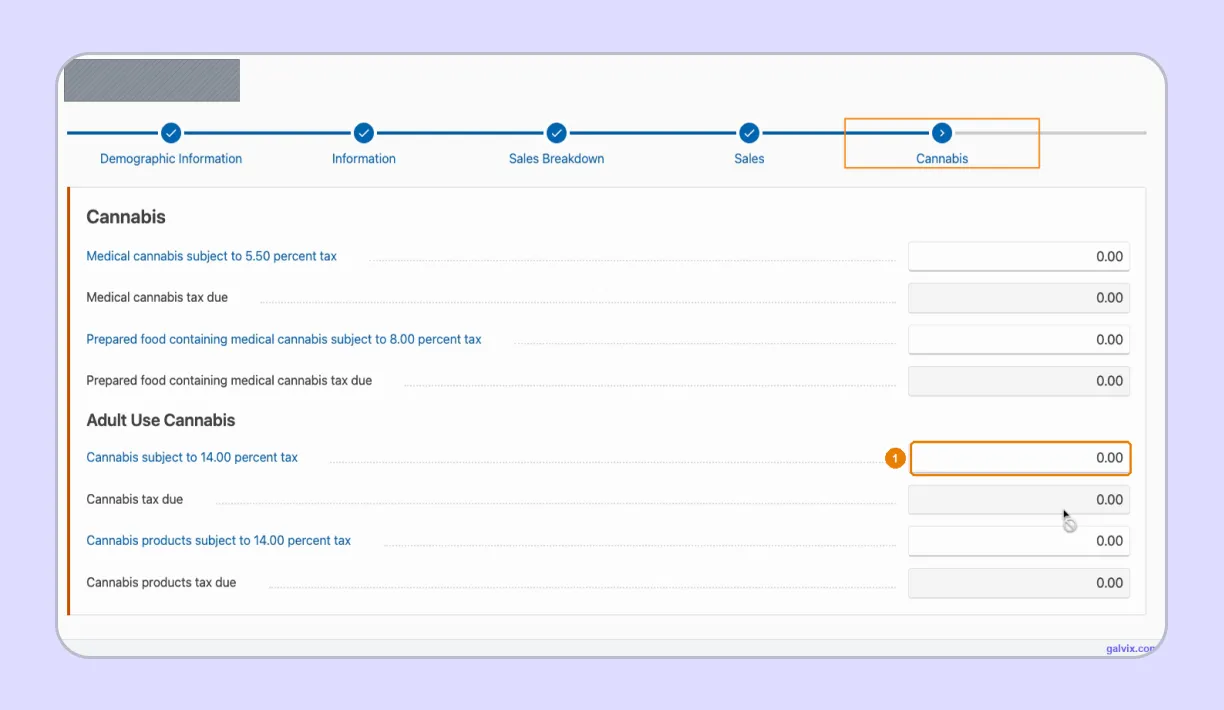
Businesses with cannabis activity should report medical cannabis at 5.5%, qualifying prepared food containing medical cannabis at 8%, and adult-use cannabis products at 14%. Maine increased the adult-use rate from 10% effective January 1, 2026.
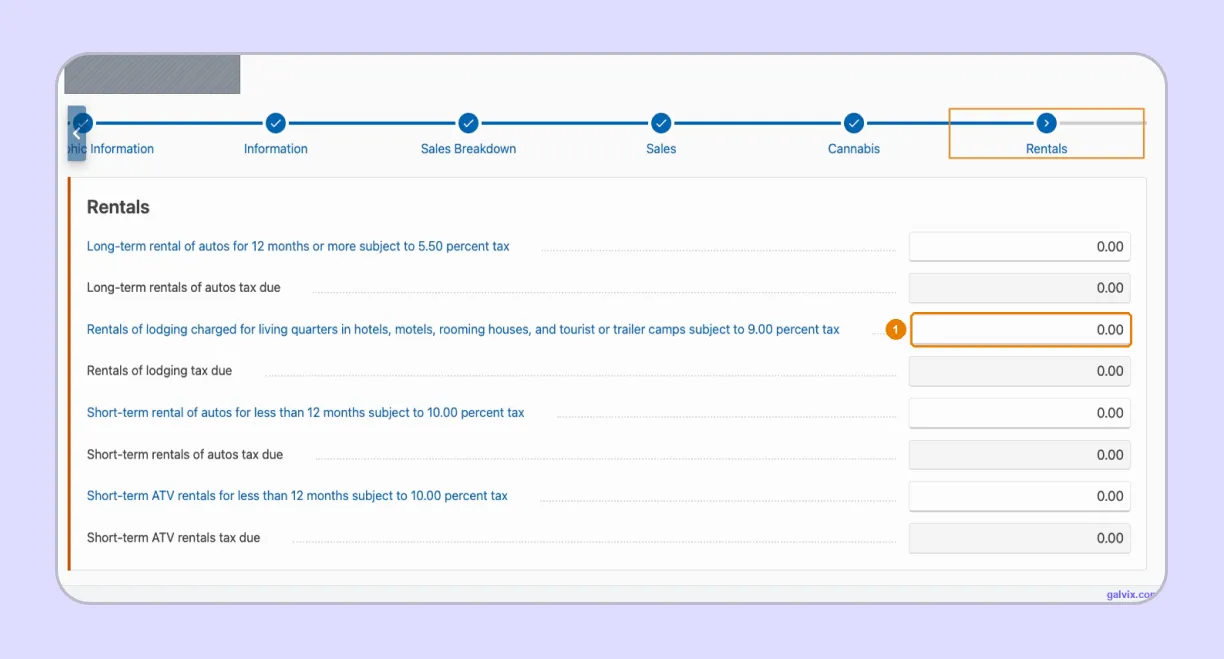
The Rentals screen separately covers long-term automobile rentals at 5.5%, lodging at 9%, and short-term auto or ATV rentals at 10%. The portal computes tax after each applicable taxable base is entered.
Special-rate screens begin at zero. Businesses need to know which screens apply because the portal can continue even when an applicable cannabis, lodging, rental, or fee field remains blank.
Step 7: Review the Summary and Credits
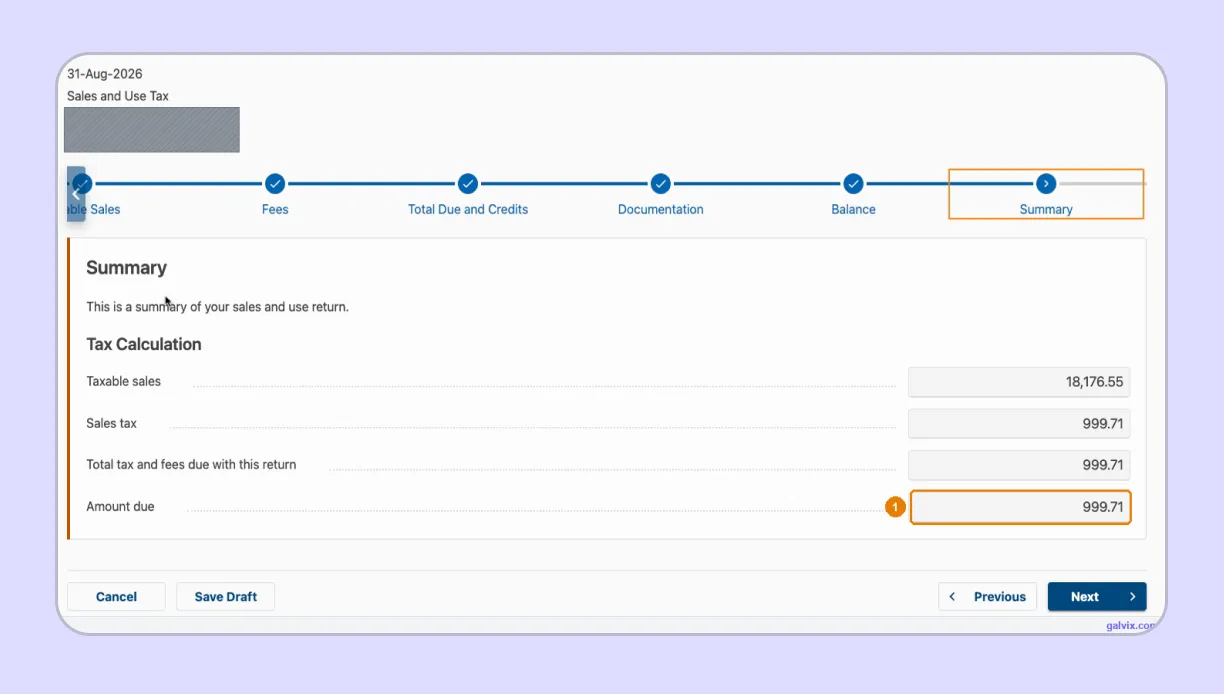
Before the final Summary, Maine Tax Portal presents Taxable Sales, Total Due and Credits, Documentation, and Balance screens. Enter a supported credit where applicable, then review the final calculated figures against your reconciliation.
The Summary shows taxable sales, calculated tax, total tax and fees, and the amount due. For businesses learning how to file sales tax return in Maine, this is the last practical point to trace an unexpected total back to its source field.
Step 8: Choose How to Pay
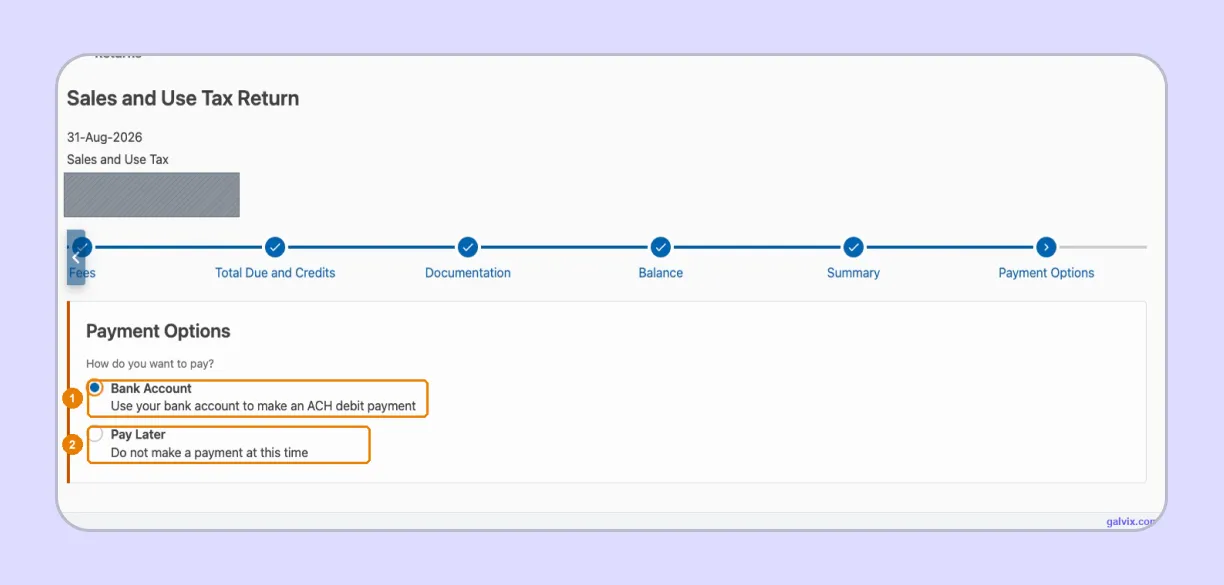
Businesses asking how to pay sales tax in Maine can choose Bank Account for an ACH debit or Pay Later when payment will be completed separately. Filing and payment remain distinct actions within the portal workflow.
If Bank Account is selected, the following screen asks for the payment amount and date. The portal can default that payment date to today, so review it before authorizing the bank account debit.
Pay Later schedules no payment. A return can therefore be filed on time while payment remains outstanding, so track the payment deadline separately.
Step 9: Submit and Save Filing Proof
After payment handling, continue to the final review and select Submit. The portal then provides a confirmation number, which is the evidence that the tax filing was transmitted successfully.
Save that confirmation with the filed return and supporting workpapers. If payment was made separately, retain its confirmation as well, because the filing record and the payment record support different actions.
This distinction is important when you file Maine sales tax online near a deadline. Reaching Payment Options does not complete filing, and the supplied portal capture deliberately stops before final submission.
What Should You Check Before Submitting a Maine Sales Tax Return?
A final review should connect the Maine sales tax return online with its supporting records. Check taxable bases, exemptions, special-rate activity, credits, payment handling, and confirmation rather than assuming a portal-calculated total proves every transaction received the appropriate tax treatment.
| Check | What to Verify |
|---|---|
| Gross sales | Matches period records |
| Exempt deductions | Supported by documentation |
| General sales | Uses the 5.5% category |
| Special rates | Food, rental, and cannabis classified correctly |
| Credits | Supported before being claimed |
| Payment | Amount and payment date checked |
| Confirmation | Saved after successful filing |
Shipping treatment can also affect the sales base. Maine allows qualifying transportation charges to be excluded when goods are shipped directly through a common carrier, contract carrier, or mail, and the transportation cost is separately supported. Combined shipping and handling charges may be treated differently.
Before submission, compare the portal result with your own reconciliation. That check matters because the portal computes the tax based on the entered categories, while the business remains responsible for ensuring that the underlying transaction received the correct classification.
How Do Exemption Certificates Affect Maine Sales Tax Filing?
Exempt transactions can reduce the taxable base, so businesses in Maine need records showing why collection was not required. A current exemption certificate or resale certificate supports certain transactions, while certificate status and transaction-level eligibility remain separate questions under Maine tax laws.
Retailer and Resale Certificates Serve Different Purposes
A Retailer Certificate confirms that a business is registered for the collection and remittance of taxes. Maine issues a Resale Certificate so qualifying retailers can purchase inventory for resale without paying tax to the vendor.
To qualify for a Resale Certificate, an active retailer generally needs at least $3,000 in annual gross sales. Sellers should verify the relevant record before relying on the claimed sales tax exemption.
A valid exemption also depends on what is being purchased. Direct purchases by certain government agencies are exempt, while Maine separately exempts qualifying prescription drugs, durable medical equipment for home use, and specified mobility-enhancing products. Other medical devices can remain taxable unless a specific exemption applies.
Maine does not currently have broad annual sales tax holidays, so temporary holiday treatment should not be assumed when reviewing ordinary taxable transactions.
Certificate Verification Does Not Replace Transaction Review
Checking certificate status establishes whether the document remains active. The seller still needs to determine whether the buyer, product, and intended use support the claimed Maine sales tax exemption for that specific transaction.
That distinction matters when customers make both exempt and taxable purchases. Maine rules place responsibility on the seller to retain supporting documentation and apply an exemption only when the sale fits the certificate’s permitted use.
Maine also does not permit registration through the Streamlined Sales Tax Registration System. Businesses using Streamlined Sales processes in member states must therefore handle their Maine registration directly through MRS.
The sales tax exemption certificate guide can help teams compare certificate requirements and seller responsibilities across states. Galvix can also manage certificate collection, verification, renewals, storage, and audit-ready records as part of ongoing compliance.

How Does Galvix Help Businesses File Maine Sales Tax Online?
Galvix manages Maine sales tax filing through a supported service that begins with reconciled transaction data rather than manual portal preparation. Returns are prepared, reviewed by specialists, approved by the customer, and filed according to the assigned schedule for each registered state.
For Maine, supported sales tax integrations from Galvix can bring direct sales, marketplace activity, exemptions, rentals, cannabis, and use-tax data into the same workflow. This keeps the prepared return connected with the underlying records that support each reported figure.
Nexus monitoring can remain connected with filing as the business expands into other states. Galvix tracks economic and physical exposure across all 50 states, while modular pricing lets customers select only the services they need, with pricing based on the workload.
What Can Galvix Manage for Maine Sellers?
As transaction volume grows, recurring filing involves more than entering numbers into Maine Tax Portal. Galvix can take over operational handoffs around return preparation while keeping the business involved in approval.
- Reconcile sales before return preparation
- Review special rate transactions
- Connect exemptions with records
- Track nexus across states
- Manage filings and notices
Businesses already using accounting or ecommerce platforms can keep those source records connected with filing. For example, the QuickBooks sales tax integration can sync transaction data into the compliance workflow, while Shopify sales tax support can connect ecommerce activity with return preparation and review.
Book a Galvix demo to review your Maine workflow and identify how recurring filings, registrations, nexus monitoring, and exemption management can be consolidated into one accountable process.
Frequently Asked Questions
Can I amend a Maine sales tax return after filing it?
Yes. To amend a filed return, open the Sales and Use Tax account in Maine Tax Portal and locate the relevant period. Previously processed periods display View or Amend Return, while an unfiled period shows File Now. This distinction is visible in the live portal workflow.
Does Maine require a separate return for each business location?
Maine can permit consolidated reporting for businesses with multiple locations under the same ownership and with the same identifying information. The exact account setup should be confirmed with MRS before assuming each location requires a separate return. The registration application specifically provides for consolidated reporting in qualifying cases.
Can I save an unfinished Maine Tax Portal return and finish it later?
Yes. Maine Tax Portal displays Save Draft throughout the filing workflow, allowing a partially completed return to be saved before submission. Saving a draft does not count as filing, so the business still needs to complete submission before the applicable deadline.
Does Maine offer a timely filing discount for sales tax?
Maine does not provide the type of standard vendor discount offered by some other states for ordinary timely sales tax filing. Businesses should instead focus on meeting their assigned filing frequency and payment deadlines. Current rate and filing guidance should be checked with Maine Revenue Services before each filing cycle.
Can I file a Maine sales tax return on paper?
Electronic filing is required for sales and use tax returns under Maine rules, although taxpayers unable to file online may request a waiver. Approved waiver recipients can receive paper returns. Businesses learning how to file sales tax return in Maine should therefore treat electronic filing as the standard process.
How do I close a Maine sales tax account after the business shuts down?
Account closure should be reported through the appropriate Maine Revenue Services process once business activity ends. The portal’s Demographic Information step also asks whether the business has closed or been sold. Keep current contact information available so final notices and account correspondence reach the responsible person.
Can I pay a Maine sales tax balance separately after filing?
Yes. Maine Tax Portal offers Pay Later, which allows the return to be filed while payment is handled separately. Businesses should still meet the required payment date because choosing Pay Later does not extend the deadline. This separation is important when you file Maine sales tax online close to the 15th.