
Numeral vs Avalara is one of the more frequently searched comparisons in the sales tax software space, largely because businesses today are dealing with increasingly complex sales tax calculation requirements across multiple jurisdictions. As companies scale across multiple sales platforms, the need for accurate tax rates, seamless automation, and reliable compliance workflows becomes critical.
Avalara is an enterprise-grade platform with over 1,400 integrations, global coverage for indirect tax compliance, and a modular architecture designed for large businesses with dedicated internal tax teams. Numeral launched in 2023 as a modern, API-first alternative, positioning itself as the platform that reduces sales tax workload to under five minutes a month for e-commerce and SaaS businesses.
The Avalara vs Numeral comparison rarely yields a clear winner. The right choice depends on your business size, billing infrastructure, and how much compliance ownership your finance team is prepared to retain after onboarding either platform. What is also worth noting upfront is that Numeral's publicly listed pricing applies only to a limited set of use cases, primarily Shopify and similar direct integrations.
This guide breaks down the differences between Avalara and Numeral across the dimensions that matter most to a growing US business. We will also discuss Galvix as an alternative to Avalara and Numeral, and why is it worth evaluating before you decide.

How Do Avalara and Numeral Compare at a Glance?
Here is a direct Numeral vs Avalara comparison across the dimensions that matter most for finance leaders evaluating their next sales tax compliance platform.
| Basis | Avalara | Numeral |
|---|---|---|
| Best For | Large enterprises with ERP systems and global tax obligations | E-commerce and SaaS businesses on Shopify and similar platforms |
| Pricing Model | Custom quote; modular per-product fees | $75/return, $150/registration (Standard); revenue percentage model (Pro) |
| Global Coverage | VAT and GST across 70-plus countries | Global coverage on Pro plan only |
| Filing Model | Avalara Returns as a separate paid module | Automated per-return filing with remittance |
| Contract | Annual with termination penalties | Month-to-month |
| Audit Defense | Not included | Not included |
| Human Review Before Filing | No | No |
Where Does Numeral Have the Advantage Over Avalara?
In the Numeral vs. Avalara debate, Numeral wins on two key dimensions that matter to faster-moving businesses seeking affordable and low-commitment compliance tools.
Transparent Entry-Level Pricing for Shopify and Stripe Users
Numeral's Standard plan offers a level of pricing clarity that Avalara never has. The flat-rate structure means early-stage businesses can forecast compliance costs before a sales conversation.
- Standard plan publishes a flat $75 per return and $150 per registration, applicable to Shopify, Stripe, Amazon, and Walmart integrations.
- No annual contract is required; businesses exit without facing early termination penalty clauses.
- Free monitoring tier lets businesses assess economic Nexus exposure before committing to any paid plan.
Simpler Interface and Faster Setup for Small Teams
Where Avalara AvaTax demands ERP configuration and often external implementation support, Numeral's dashboard is built for lean finance teams without dedicated IT resources. Pre-built connectors for Shopify, Stripe, and Amazon allow direct-channel sellers to go live in a fraction of a typical Avalara setup timeline.
The simplified interface addresses one of the most consistent complaints in online reviews about Avalara: a steep learning curve that slows adoption for teams without a dedicated tax function. Numeral's design prioritizes ease of use, removing the enterprise configuration overhead that adds weeks to Avalara implementations for smaller businesses.
Where Does Avalara Outperform Numeral?
When the comparison shifts to scale and depth, Avalara vs Numeral produces a clear result for enterprise operations. Avalara was built for complexity. Numeral was built for speed.
Broader ERP and Enterprise System Integration Depth
Avalara's integration library represents decades of certified partner development. No other sales tax solution in the Numeral vs Avalara space comes close to this breadth.
- Certified connectors available for SAP, Oracle, NetSuite, and Salesforce ERP billing stacks.
- Over 1,400 ERP integrations covering e-commerce, POS, and marketplace platforms across industries.
- Modular structure allows enterprise teams to activate only the compliance scope their operations require.
Global Indirect Tax Coverage for International Sellers
For businesses consolidating US sales tax and international VAT or GST under one platform, Avalara is the practical choice. Numeral and Avalara diverge sharply here.
- Avalara supports VAT and GST compliance across 70-plus countries for businesses with cross-border obligations.
- Numeral's global coverage sits behind the Pro plan and requires a direct demo engagement before pricing is disclosed.
- Businesses managing international indirect tax find Avalara or Numeral a straightforward decision at this scale.
Transaction Volume and Multi-Entity Processing Capacity
Avalara AvaTax was designed to handle high transaction volume across multiple entities and complex holding company structures, which is where its modular architecture genuinely earns its cost. Multi-entity businesses with separate state footprints across subsidiaries are well-supported at the Avalara enterprise tier in ways Numeral cannot replicate.
Numeral's platform suits single-entity ecommerce and SaaS businesses with a smaller number of active jurisdictions. Once a business adds subsidiaries, separate legal entities, or significant cross-border obligations, the platform's narrower scope creates gaps that require either a platform change or internal workarounds to manage.
How Does Avalara vs Numeral Pricing Actually Break Down?
Pricing is where the Numeral vs. Avalara comparison is most consequential for growing businesses. The published numbers rarely reflect what either platform costs at scale.
Avalara Pricing Is Modular, Opaque, and Contract-Heavy
Avalara's pricing model is built around selling each compliance function as a separate product. The total cost grows quickly once a business moves beyond basic tax calculation.
- Core AvaTax subscription requires a custom quote; Avalara products for returns filing and exemption certificate management cost extra on top.
- ERP connectors carry separate fees and may limit the transaction volume fetched per sync cycle, creating data gaps.
- Annual contracts with automatic renewal terms and early termination penalties increase switching costs and reduce pricing leverage at renewal.
- Annual costs reported by Vendr buyers average around $19,143 but can go up to $77,497.
Numeral Pricing Scales With Revenue for Pro Plan Customers
The published $75 per return applies only to Standard plan customers on Shopify and similar integrations. The full picture is less straightforward for businesses on more complex billing platforms.
- Published $75 per return applies only to Standard plan numeral customers on Shopify and direct-channel integrations.
- Pro plan covers QuickBooks, NetSuite, Xero, and Chargebee users under a revenue-percentage pricing model.
- Pro plan pricing is not published on Numeral's website and is only disclosed after a direct sales team call, making upfront budget forecasting difficult for most growing businesses.
- Several customers have remarked that revenue-linked pricing compresses gross margins as the business scales, a structural issue that flat-rate alternatives like Galvix avoid entirely.

Where Do Avalara and Numeral Both Leave You Exposed?
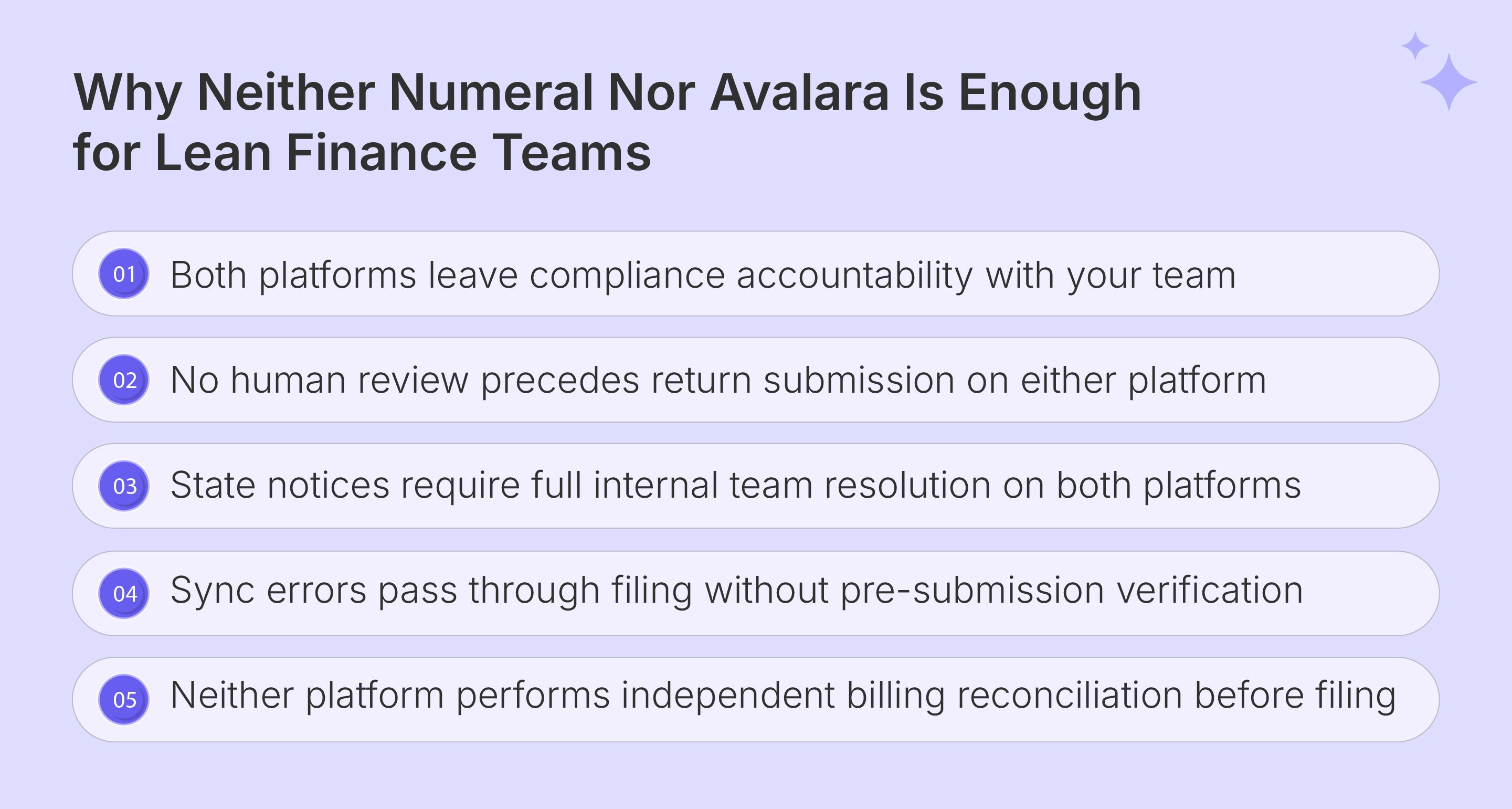
An honest Numeral vs. Avalara evaluation reveals that neither platform removes compliance accountability from your team. Both automate filing, yet the operational gaps they leave open are nearly identical.
Your Team Still Owns Every Compliance Outcome
The central limitation of Avalara and Numeral is identical: they are tools your team operates, not teams that own your outcomes. When something goes wrong, the resolution work returns to you.
- Both platforms automate filings but leave threshold monitoring, error correction, and taxability reviews with the customer's internal team.
- Sync errors and product taxability misconfigurations are processed and submitted without any pre-filing human review step.
- When a return is filed incorrectly, both platforms direct the resolution work back to the customer's finance team to resolve.
State Notices Remain the Customer's Full Responsibility
- Neither Avalara or Numeral provides proactive notice management. State correspondence lands on your team regardless of which platform you used to prepare and submit your returns.
- Neither platform manages direct state correspondence on the customer's behalf across discrepancy notices, audits, and frequency changes.
- Finance teams stretched across payroll, billing, and reporting face growing compliance workload every time any state sends correspondence.
The absence of notice management is a shared gap that both platforms treat as outside their standard service scope.
No Independent Reconciliation Before Returns Are Filed
This shared limitation creates the most consequential exposure in the Numeral vs Avalara comparison. Neither platform verifies accuracy independently before submission.
- Both platforms file based on synced transaction data without cross-checking that data against actual billing records independently.
- Discrepancies between what was invoiced and what was reported pass through undetected until a state revenue authority flags them.
- Proactive reconciliation before filings is the step that prevents most avoidable compliance penalties, and it is absent from both platforms.
Avalara or Numeral: Which One Should You Choose?
The answer depends entirely on your operational structure, your business size, and your tolerance for ongoing compliance workload after implementation.
When to Choose Avalara: If you operate SAP or Oracle ERP environments, have international tax obligations, and employ a dedicated internal tax function with the capacity to configure and maintain an enterprise compliance platform. The depth is real, and for the right business profile, the high costs are justifiable given the breadth of Avalara's products.
When to Choose Numeral: If you operate on Shopify or Stripe, file in a small number of states, and need straightforward per-return billing with no annual commitment. Businesses on QuickBooks, NetSuite, or Xero should factor in the revenue-percentage Pro plan pricing before committing, as annual costs can grow faster than expected as revenue scales.
When to Consider neither if your finance team is lean, your state footprint is growing, and your goal is to remove sales tax compliance from your operational workload entirely rather than switch from one self-service dashboard to another.
Why Galvix Is a Better Alternative to Both Avalara and Numeral?
The Numeral vs. Avalara debate tends to frame sales tax compliance as a platform selection problem. Find the right tax compliance software, configure it correctly, and the compliance burden disappears. For most growing businesses with lean finance teams, that premise is where the operational difficulty begins.
Galvix operates on a different model entirely. It is not a tax compliance tool that your team configures and monitors. It is a dedicated compliance team that handles setup, Nexus tracking, sales tax registration, monthly filing, and state correspondence on your behalf. Your team reviews and approves through a clean dashboard. Galvix does the rest.
Here is what Galvix delivers that both Avalara and Numeral do not, covering the gaps that make the right sales tax software selection so consequential for growing businesses with limited internal capacity:
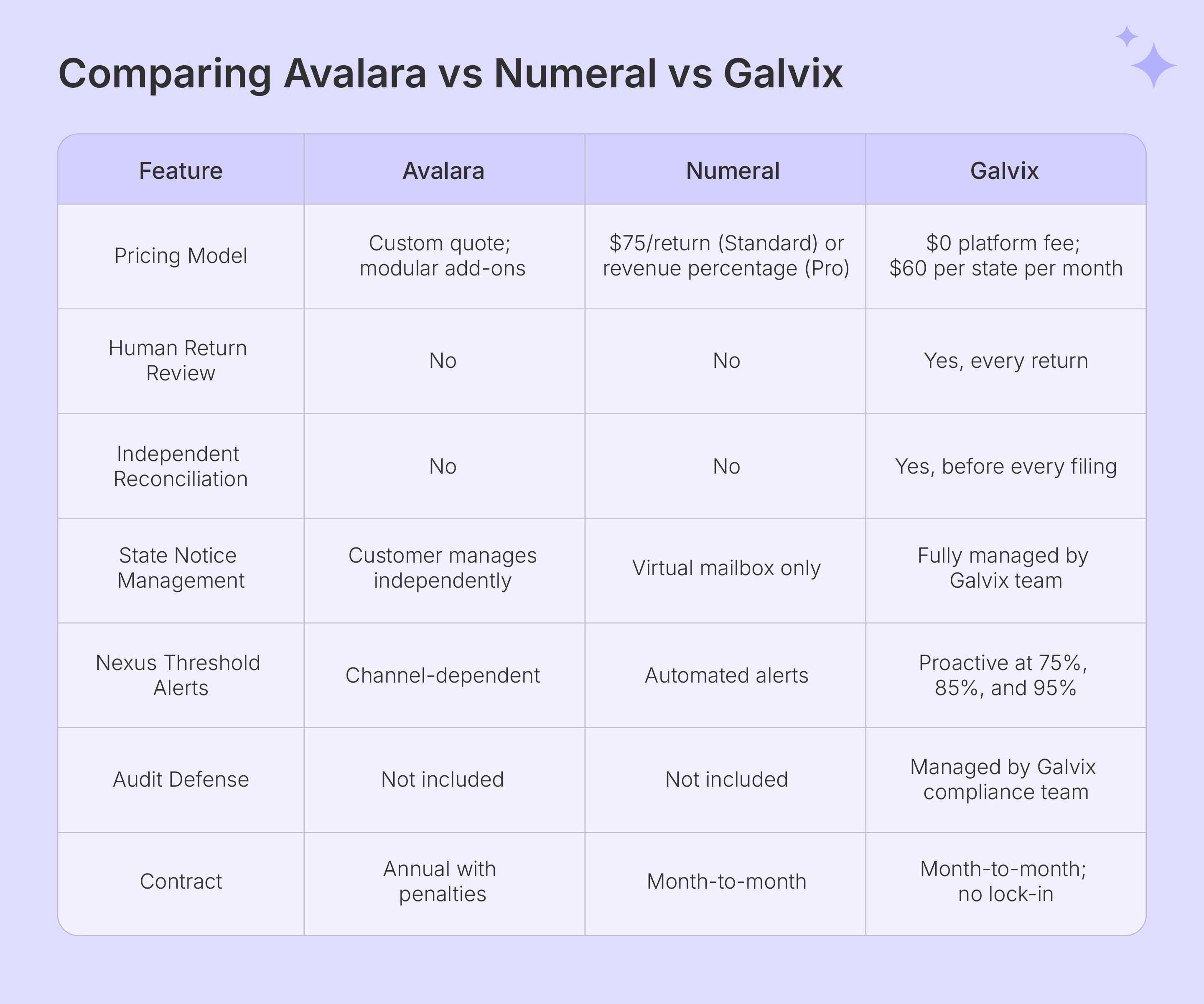
- Every return is reviewed by a human specialist before submission to any state revenue authority, preventing errors that automated platforms pass through without flagging.
- Independent reconciliation against billing data performed before every return is filed, a step absent from both the Avalara and Numeral filing models.
- Full state notice management across all correspondence types, including audit inquiries, rate updates, and filing frequency changes handled on your behalf.
- Proactive nexus alerts at 75%, 85%, and 95% before a new filing obligation is formally triggered, giving your team time to act without monitoring manually.
- Flat per-state pricing ranging between $60-$75 per state per month, covering filing, exemption certificates, notice management, and a dedicated account manager with no unnecessary costs on top.
Galvix also offers a 30-day free trial with no credit card required. Schedule a personalized demo and see what fully managed US compliance looks like for your specific business.
Frequently Asked Questions
What Is the Main Difference Between Avalara and Numeral?
The primary difference between Avalara vs Numeral is scale versus simplicity. Avalara serves large enterprises with complex ERP environments, global VAT obligations, and dedicated tax staff. Numeral targets smaller e-commerce and SaaS businesses wanting straightforward US sales tax filing. Both platforms require your team to own compliance outcomes after setup, which is the shared gap that managed services like Galvix address directly.
Is Numeral Cheaper Than Avalara for Small Businesses?
For Standard plan customers on Shopify, Numeral's $75 per return is more affordable and predictable than Avalara's custom-quoted pricing model. For businesses on the Pro plan using QuickBooks or NetSuite, Numeral's revenue-percentage pricing can grow to match or exceed Galvix's flat $60 per state all-inclusive rate. A free Galvix nexus study helps clarify your actual cost exposure before you commit to either platform.
Do Avalara or Numeral Handle Sales Tax Audits for You?
Neither Avalara nor Numeral offers standard audit defense as part of their core service. Avalara's enterprise professional services tier provides audit support at additional cost. Numeral's Pro plan includes access to tax compliance experts for voluntary disclosure agreements, which is not the same as audit representation. Galvix manages all state correspondence and audit inquiries on the customer's behalf as a standard part of the sales tax compliance service at no extra fee.
Which Platform Works Better for Businesses Filing in Multiple States?
Avalara handles multi-state complexity well for enterprise teams with ERP infrastructure and internal tax staff. In the Numeral and Avalara comparison for mid-market businesses filing in 8 or more states, Galvix's $60-$75 per state all-inclusive rate becomes more cost-effective than Numeral's per-return model and more operationally efficient than Avalara's self-service approach. Galvix also performs independent reconciliation before every filing, which neither platform includes as a standard step.
Is There a Fully Managed Alternative to Both Avalara and Numeral?
Galvix is the only platform in this Numeral vs Avalara comparison that operates as a fully managed sales tax compliance service. A named specialist prepares and reviews every return, manages all state notices, and monitors nexus thresholds proactively across all 50 US states. Most Galvix customers spend under 20 minutes a month on sales tax after onboarding, a meaningful difference from the ongoing operational overhead that both tax compliance tools place on your finance team.