

Vertex has served enterprise tax teams since 1978, earning a solid reputation among large businesses running SAP, Oracle, and other complex ERP environments. Its tax calculation engine covers over 19,000 jurisdictions and supports sales and use tax, VAT, and GST across global markets. For large enterprises with dedicated internal tax functions, that depth has clear value.
The problem arises when you examine what Vertex pricing costs and how that cost is structured. Vertex does not publish any pricing on its website. All contracts are custom-quoted, and the pricing model is based on a percentage of the customer's total revenue rather than transaction volume or filing activity. This means compliance costs rise automatically as a business grows, regardless of whether tax complexity has increased.
This guide covers what Vertex pricing looks like in practice, where the cost model creates friction for mid-market and growing businesses, and why a fully managed Vertex alternative like Galvix offers more predictable value for businesses that want compliance fully off their plate.

What Is Vertex and Who Is It Built For?
Vertex is an enterprise indirect tax platform covering sales and use tax, VAT, and GST across thousands of jurisdictions globally. It integrates with SAP, Oracle, NetSuite, and Salesforce and is primarily designed for large businesses with dedicated internal tax functions. Vertex serves businesses through two primary deployment paths, each suited to different levels of technical infrastructure and internal capacity.
- Vertex O Series is the flagship product, deployed on-premise or in a private cloud for enterprise teams managing complex multi-jurisdictional tax obligations.
- Vertex Cloud is the SaaS-based option targeting mid-market businesses with simpler indirect tax needs, offering cloud-based deployment without on-premise infrastructure requirements.
Both products require configuration and ongoing management by the customer's internal team after implementation. This means compliance accountability always stays with the business.
How Does Vertex Pricing Actually Work?
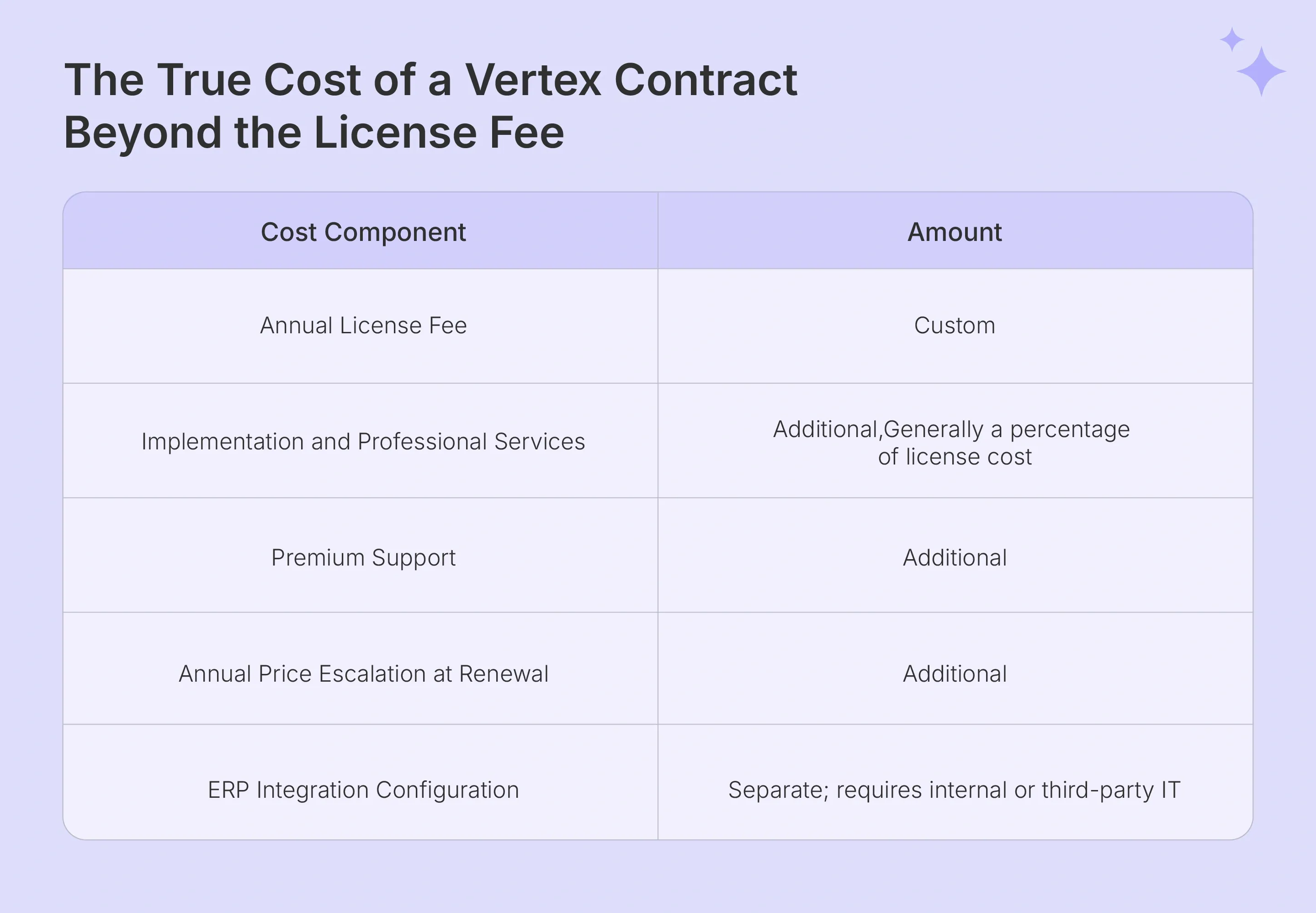
Understanding Vertex pricing requires looking beyond the license fee because the published rate is only the starting point for what a business pays.
No Published Rates and Revenue-Based Cost Structure
Vertex's approach to pricing introduces opacity at every stage of the buying process, from initial research through to annual renewal.
- Vertex does not publish pricing on its website; all quotes require a direct sales engagement before any figure is disclosed to a prospective customer.
- Vertex pricing is based on overall customer revenue rather than transaction volume or the number of states a business files in. This means costs grow automatically as revenue grows.
- Several reviews note that revenue-based fees rise automatically with business growth without any corresponding improvement in platform capabilities or compliance support delivered.
- The flexible pricing model that Vertex presents during sales conversations is structured around revenue tiers rather than usage metrics like API calls, queries, or tokens. This makes it fundamentally different from consumption-based platforms that charge based on actual activity.
- For cloud storage and compute engine pricing on GCP, cost efficiency is tied to spot VMS, use discounts, and batch processing options. Vertex Inc applies no similar volume-based mechanisms to reduce total cost as a business scales.
What Businesses Actually Pay Based on Market Data
- While Vertex publishes nothing publicly, third-party procurement data provides a reliable picture of what businesses at different sizes pay.
- The median annual Vertex contract sits around $63,942 per year based on Vendr transaction data, with significant variation depending on revenue tier and product selection.
- GetApp research indicates starting Vertex costs of $5,000 or higher, confirming that the platform's price point places it firmly in the enterprise category from the outset.
- Vertex pricing varies significantly based on product selection, deployment type, and negotiated contract terms, making accurate budgeting difficult without a confirmed quote from the sales team.
- Unlike Azure or AWS infrastructure costs, where data storage, SSD usage, GPU allocation, and latency requirements each carry transparent per-unit rates, Vertex Inc's contract structure bundles costs into a single opaque annual figure.
- Businesses evaluating total cost should also factor in the management fees for ongoing platform administration. This includes configuration updates, workflow maintenance, and taxability rule changes.
Implementation Costs Are Separate and Non-Negotiable
- Professional Services Billed Separately: Implementation consulting and professional services are billed at hourly rates, entirely outside the license fee. This adds a material upfront cost before the platform goes live.
- ERP Configuration Requires Significant Resources: ERP integration with SAP or Oracle requires significant developer and IT involvement before go-live. These internal resource costs are rarely factored into initial budget projections by buyers.
- Implementation Fees Resist Negotiation: Multiple buyer reports confirm that implementation fees are harder to negotiate than the platform subscription itself. This happens even when the license fee has been successfully discounted during contract negotiations.
Contract Auto-Renewal and Annual Price Escalation
- Auto-Renewal Clauses Are Difficult to Remove: Vertex contracts include automatic renewal terms that buyers report as difficult or impossible to remove, with no forecast mechanism or exit pathway equivalent to the month-to-month flexibility offered by platforms priced on actual usage.
- Annual Uplifts Are Standard at Renewal: Annual price uplifts of 9% are standard at renewal, a figure that has no relationship to changes in API calls processed, queries handled, tokens consumed, or any other metrics that would reflect actual platform utilization by the customer.
- Missing the Renewal Window Has Consequences: Buyers who miss the renewal window report being locked into another full contract term without recourse, with no model registry or versioned contract mechanism that allows adjustments to scope or workloads mid-term.
When Does Vertex Pricing Make Sense?
Vertex delivers genuine value in a narrow set of business profiles where the platform's depth justifies its cost and operational complexity.
- Large Enterprises With Dedicated ERP Environments: Large enterprises with SAP or Oracle ERP environments and a dedicated internal tax function will find Vertex's integration depth aligned with their compliance requirements, particularly where automation of complex pipelines across multiple entities is a priority.
- Multinationals Consolidating Global Indirect Tax: Multinational businesses consolidating global VAT, GST, and US sales tax compliance under one platform benefit from Vertex's coverage, particularly where analytics, dataset management, and cross-border forecasting of indirect tax exposure are required across subsidiaries.

When Does Vertex Pricing Work Against You?
For businesses outside the narrow enterprise profile Vertex was built for, the Vertex cost model creates compounding friction across pricing, implementation, and ongoing operations.
- Mid-Market Teams Without Dedicated Tax Staff: Mid-market and growing businesses without a dedicated tax team face an ongoing operational burden that makes compliance harder after implementation, with no managed machine learning equivalent that reduces the human workload automatically over time as the platform matures.
- Fast-Growing Businesses Penalized by Revenue-Based Fees: Companies whose revenue is growing fast face a structural penalty in the Vertex pricing model, since costs scale with revenue rather than actual usage or filing complexity, with no batch discount, spot VMS equivalent, or cost efficiency mechanism to offset growth-linked fee increases.
- Teams Needing Predictable Monthly Compliance Costs: Businesses that need predictable monthly compliance costs denominated in clear USD figures rather than revenue-linked percentages will find Vertex pricing difficult to budget across a planning horizon, particularly when management fees and implementation analytics are factored into the total cost projection.
- Finance Teams Wanting External Compliance Ownership: Finance teams wanting compliance fully managed externally will find that both Vertex Cloud and on-premise deployments require your team to remain the primary operator, with no feature store of pre-built compliance decisions that removes the need for ongoing internal configuration and tensorboard-style monitoring of output accuracy.
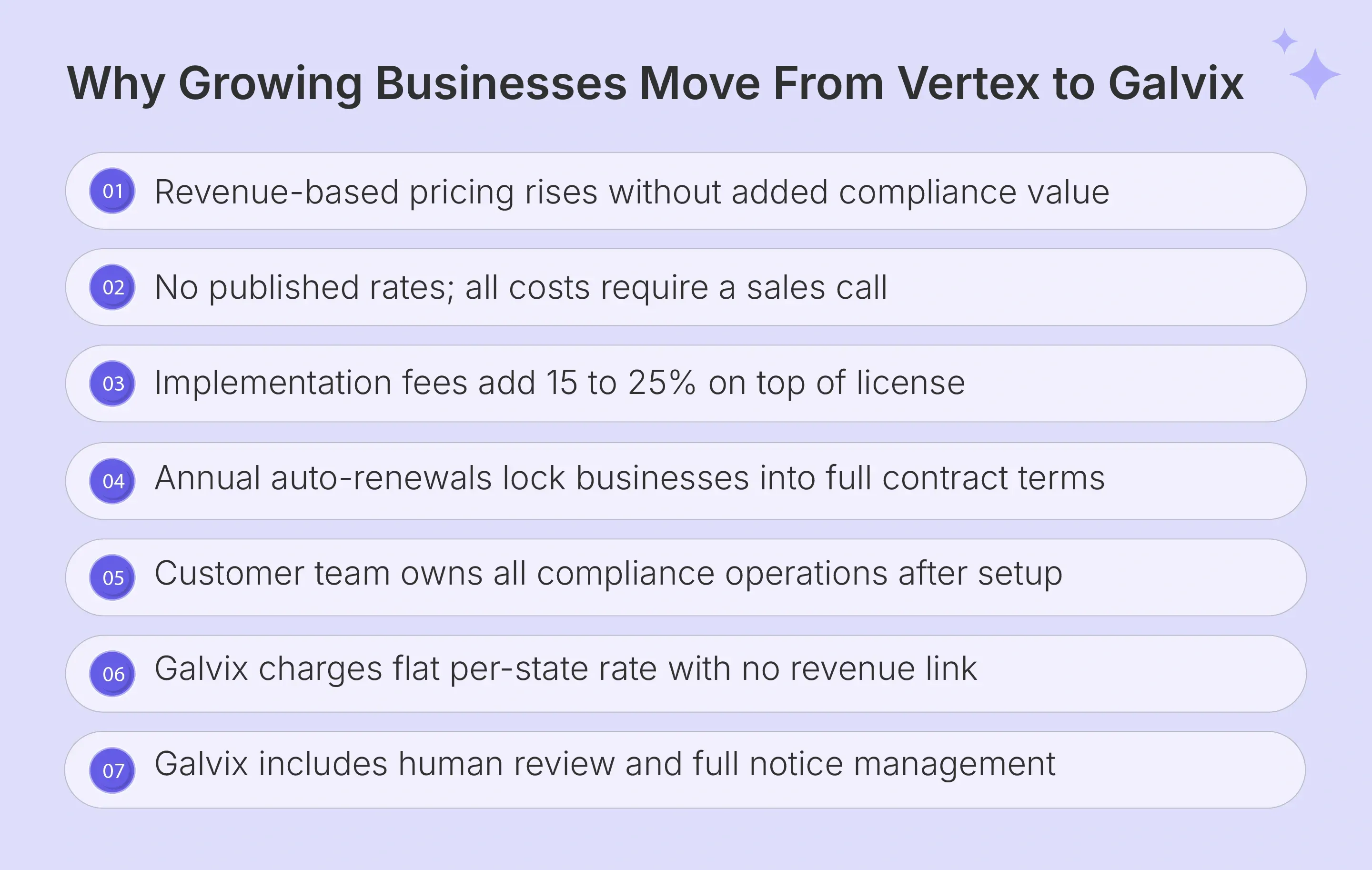
Why Is Galvix a Stronger Alternative to Vertex?
Vertex assumes that the business deploying it has both the internal resources to run an enterprise platform and a finance team willing to permanently own compliance outcomes. For most growing businesses with lean finance teams, that assumption is where the operational burden begins, not ends.
Galvix operates on a fundamentally different model. Rather than a platform your team configures, monitors, and operates, Galvix acts as a dedicated compliance team that handles setup, nexus tracking, state registrations, monthly filing, and all state correspondence on your behalf. Costs are flat and predictable regardless of revenue growth.
Here is what our sales tax software delivers that Vertex does not, covering the gaps that make Vertex pricing so consequential for businesses without a dedicated internal tax function:
- Every return is reviewed by a named human tax specialist before it is submitted to any state revenue authority, preventing errors that self-service platforms pass through without flagging to the customer. This review step is included in Galvix's standard service at no additional cost.
- Independent reconciliation against billing data is performed as a standard step before every filing. Invoiced amounts are cross-checked against transaction records before any return is approved for submission. Vertex requires your team to perform this reconciliation internally or leave it unverified before filing.
- Full management of all state correspondence, including audit inquiries, discrepancy notices, and rate changes, is handled by the Galvix team directly on your behalf. Your finance team receives dashboard updates rather than state letters that require internal drafting and response under compliance deadlines.
- Proactive nexus alerts at 75%, 85%, and 95% of threshold give your team time to act before a new filing obligation is formally triggered. Vertex provides Nexus monitoring as a platform feature that your team must actively monitor, rather than a managed service that acts on your behalf.
- Flat per-state pricing at $60 to $75 per state per month covers filing, notice management, exemption certificate management, permit maintenance, and a dedicated account manager. In Galvix pricing, there is no revenue-based fees, no implementation costs, and no annual contract lock-in.
- No revenue-based pricing, no implementation fees, and no annual contract lock-in apply at any Galvix tier, which directly addresses the three cost structures that make Vertex pricing unpredictable for mid-market businesses.
It is also worth noting that Galvix's flexible pricing model carries no data storage fees, no GPU or NVIDIA infrastructure overhead, no audio processing charges, no Imageen or Gemini API consumption costs, and no cache or SSD provisioning requirements. The compliance cost your finance team sees each month is the per-state rate, and nothing more.
Here is a direct comparison showing where Galvix fills the gaps that make Vertex cost-prohibitive for growing businesses:
| Feature | Vertex | Galvix |
|---|---|---|
| Pricing Model | Revenue-percentage; custom quote only | $0 platform fee; $60 to $75 per state per month |
| Pricing Transparency | No published rates; sales call required | Publicly available starting rate |
| Implementation Cost | Separate; 15 to 25% of license cost | Included; Galvix manages end-to-end |
| Human Return Review | No | Yes, every return |
| Who Operates Compliance | Customer's internal team | Galvix dedicated compliance team |
| State Notice Management | Customer manages independently | Fully managed by Galvix team |
| Annual Price Escalation | 5 to 9% at renewal | No annual escalation |
| Contract | Annual with auto-renewal | Month-to-month; no lock-in |
| Best For | Large enterprises with ERP environments | SMBs and mid-market businesses wanting full compliance management |
Schedule a personalized Galvix demo and see what fully managed US compliance looks like for your specific business.
Frequently Asked Questions
Is Vertex Free to Use?
Vertex does not offer a free plan or trial at any tier. All Vertex pricing requires a custom quote obtained through a direct sales engagement, and access is granted only after a contract is executed. Galvix, by contrast, offers a 30-day free trial with no credit card required, allowing businesses to evaluate fully managed compliance before committing.
What Is the Difference Between Vertex and Avalara?
Both Vertex and Avalara are enterprise-grade platforms with custom pricing that requires a sales call before disclosure. Vertex uses a revenue-percentage pricing model while Avalara uses transaction-volume tiers with modular per-product fees. Neither platform provides human review before filing or manages state correspondence on the customer's behalf, which is the shared gap that Galvix addresses through its managed service model.
What Does Vertex Sales Tax Do?
Vertex calculates sales tax in real time across 19,000-plus jurisdictions, integrates with SAP, Oracle, and NetSuite ERP systems, and supports exemption certificate management and return filing through add-on modules. The vertex cloud deployment option covers standard indirect tax workflows for mid-market businesses. All platform operations, including monitoring, configuration, and state correspondence, remain the responsibility of the customer's internal team.
How Does Vertex Handle Tax-Inclusive Pricing?
Vertex supports tax-inclusive pricing through its tax determination engine by back-calculating the tax portion from a gross amount at the point of transaction. This configuration requires setup within the connected ERP or billing system and is managed by the customer's internal tax or IT team. Businesses without dedicated technical resources to configure and maintain this setup should factor that requirement into their evaluation of Vertex pricing against managed alternatives.