
An exemption certificate explains why you did not collect sales tax on an otherwise taxable transaction and supports that decision during review. When documentation is missing or unsuitable, your business may owe the uncollected amount, penalties, interest, and additional administrative costs.
Multi-state growth introduces different forms, identification numbers, collection deadlines, blanket certificates, and renewal requirements across exempt customer relationships. A document accepted in one jurisdiction may fail when the delivery location, purchaser type, exemption purpose, or claimed product use changes.
This guide explains what is an exemption certificate along with key aspects like eligibility, state differences, verification limits, lifecycle controls, and audit exposure. We will also discuss key findings of Galvix research related to exemption certificates covering all 50 states and the District of Columbia.

What Is a Sales Tax Exemption Certificate?
A sales tax exemption certificate is documentation that a qualifying purchaser gives you when tax should not apply to a purchase. The document records the purchaser, exemption reason, covered transaction, and information required by the state where the sale is sourced.
Businesses searching what is sales tax exemption certificate need to understand its several critical aspects as well. The document creates the evidence trail supporting tax-free treatment, although it does not automatically establish eligibility or replace transaction-level review.
A tax exemption certificate provides a legal mechanism for documenting exempt sales rather than automatic approval from a tax authority. Its value depends on specific rules, complete information, timely collection, and consistent links between the document and transaction.
These records form a core component of the United States taxation system because sellers must support untaxed transactions during state reviews.
How an Exemption Certificate Protects the Seller
A properly completed exemption certificate supports your reason for leaving tax uncollected, although protection depends on state law and reasonable seller review.
- Review whether the claimed exemption reasonably matches the purchaser, products, sourcing state, and transaction period covered by the document.
- Missing, late, expired, or incomplete documentation may create liability for uncollected tax, penalties, interest, and additional administrative work.
- Retain each valid certificate with customer records, invoices, verification evidence, and transaction history for fast retrieval during state review.
- Good faith acceptance helps when no visible conflict suggested the purchaser, form, exemption reason, or covered items were unsuitable.
How It Differs From a Resale Certificate and Sales Tax Permit
These documents support different responsibilities, so your team should classify each record before approving tax-free treatment or customer exempt status.
| Difference | Exemption Certificate | Resale Certificate | Sales Tax Permit |
|---|---|---|---|
| Primary purpose | Supports an approved tax-free purchase | Supports inventory purchased for customer resale | Authorizes collecting and remitting transaction tax |
| Main user | Qualified purchaser claiming an allowed exemption | Retailer or wholesaler purchasing resale inventory | Seller registered with the taxing authority |
| Transaction coverage | Covers specified uses or purchaser status | Covers goods remaining inside the resale chain | Covers taxable activity within the jurisdiction |
| Common evidence | State form, approval, permit, or exemption number | Buyer-completed form or reseller permit | State-issued registration and identification number |
| Seller responsibility | Review completeness, timing, relevance, and validity | Confirm resale claim fits purchased goods | Use registration for collection and return filing |
What Are the Main Types of Sales Tax Exemptions?
Different types of exemption certificates have varying purchaser identity, intended use, transaction context, or a combination of those factors. Correct classification strengthens audit defensibility because the form should explain why the buyer, item, purchase, or statutory purpose qualifies under state law.
Understanding the most common types of exemption certificates also prevents teams from using resale documentation for unrelated exemptions requiring separate certificates.
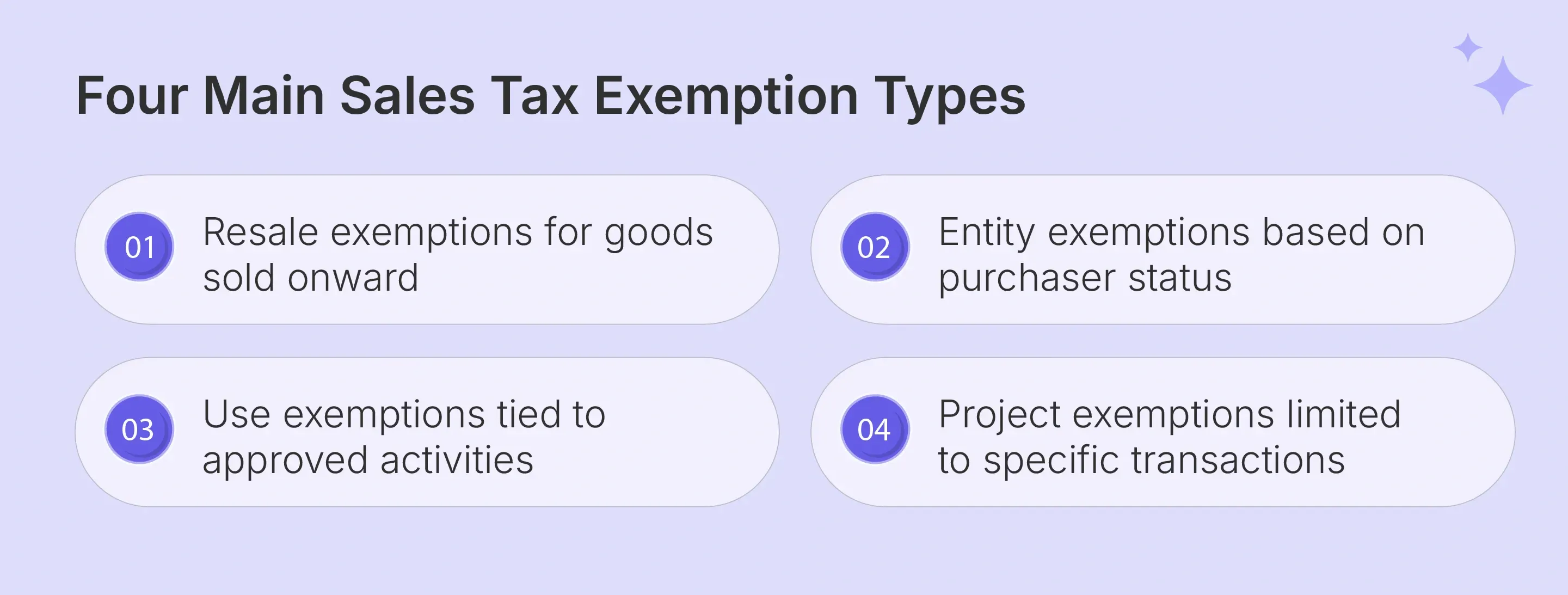
Resale Exemptions
A resale exemption applies when a buyer purchases tangible personal property for resale to another customer rather than consuming it internally. The buyer provides a resale certificate, which documents that the tax obligation should move forward to the final consumer.
States may instead issue reseller permits, annual certificates, multipurpose forms, or registration-number requirements. If inventory is withdrawn for internal use, the purchaser may owe use tax because those goods no longer remain within the resale chain.
Entity-Based Exemptions
Entity-based exemptions depend on who the purchaser is rather than how every item will be used. An exempt organization may include qualifying nonprofits, educational institutions, government entities, or another body recognized under state law.
Federal recognition under the Internal Revenue Code does not automatically establish state tax exemption. Some states require an exemption number or certificate of exemption, while others request approval letters, purchase orders, or official documents issued by a government agency.
Use-Based Exemptions
Use-based exemptions depend on how purchased property supports an approved activity. Common examples include manufacturing equipment, research materials, agricultural machinery, livestock feed, contractor purchases, direct pay permits, qualifying utilities, and pollution-control equipment.
Eligibility may depend on whether an item enters the manufacturing process, becomes part of the final product, or serves another qualified use. Manufacturer’s exemption certificates should therefore describe the property and operational purpose instead of relying on a generic resale claim.
Potential cost savings should never replace eligibility review. A completed form cannot support equipment, materials, or utilities that fall outside the statutory exemption.
Transaction-Based and Project-Specific Exemptions
Some exemptions apply only to a defined project, contract, location, purchaser relationship, or direct-payment arrangement. Construction contracts, federal government purchases, diplomatic transactions, and work for local government agencies may require project-specific documentation.
Every exemption certificate should be reviewed against the covered transaction because approval for one project may not extend elsewhere. A contractor cannot assume the same document supports unrelated customers, locations, contracts, or purchases of items.
Who Can Use an Exemption Certificate?
A purchaser may use an exemption certificate when buyer status, intended use, or transaction circumstances satisfy the governing state law. Eligibility does not transfer automatically between jurisdictions, so you should confirm the exemption reason before issuing, accepting, or renewing documentation.
Resellers and Wholesalers
Resellers and wholesalers use exemption documentation when purchased inventory remains within the resale chain until another taxable or exempt transaction occurs.
- Retailers may document exempt purchases when inventory will be resold through stores, marketplaces, wholesale channels, or online sales.
- Wholesalers can use resale documentation when products remain in commercial inventory and are not consumed within their own business operations.
- Inventory removed for internal or personal use may create consumer use tax obligations because resale treatment no longer reflects actual use.
- States may require local registration, accept qualifying out-of-state numbers, or prescribe another identification number for destination-state transactions.
- Purchasers should confirm whether Streamlined Sales Tax (SST), MTC documentation, or the destination-state form supports the planned resale exemption certificate.
Nonprofit and Government Organizations
Qualifying nonprofits may receive sales tax exemption for approved purchases when state law recognizes their purpose and purchasing activity. Government buyers may use purchase orders, approval documents, exemption numbers, or forms prescribed by local governments and state authorities.
Federal income tax recognition does not automatically establish state exemption eligibility. The organization may need separate state approval, while purchases must serve exempt purposes rather than private activities outside the approved mission.
Manufacturers and Industry-Specific Buyers
Different industries may receive full or partial relief for machinery, production inputs, utilities, research equipment, agricultural supplies, transportation property, or other approved uses. Eligibility often depends on where equipment operates and how directly it supports production.
A resale form may not support property consumed during manufacturing. Manufacturers should use the prescribed document, including manufacturer’s exemption certificates, and retain usage evidence linking each purchase with the qualified activity.
Direct Pay and Other Exempt Purchasers
Some purchasers use special authorization instead of ordinary resale documentation because their liability depends on permits, projects, or statutory buyer classifications.
- Direct-payment holders may purchase without vendor-collected tax and report the applicable amount directly through their own filing process.
- Contractors, schools, tribal purchasers, and diplomatic buyers may require purpose-specific documentation linked to their legal relationship or approved activity.
- Purchasers should avoid resale forms when another exemption provides the legitimate means for receiving tax-free treatment under applicable state law.
Also Read: 12 Best Sales Tax Software for US Businesses To Try in 2026
How Do Businesses Get the Correct Exemption Certificate?
You should identify the legal exemption and documentation required by the sourcing state before removing tax from any customer account.
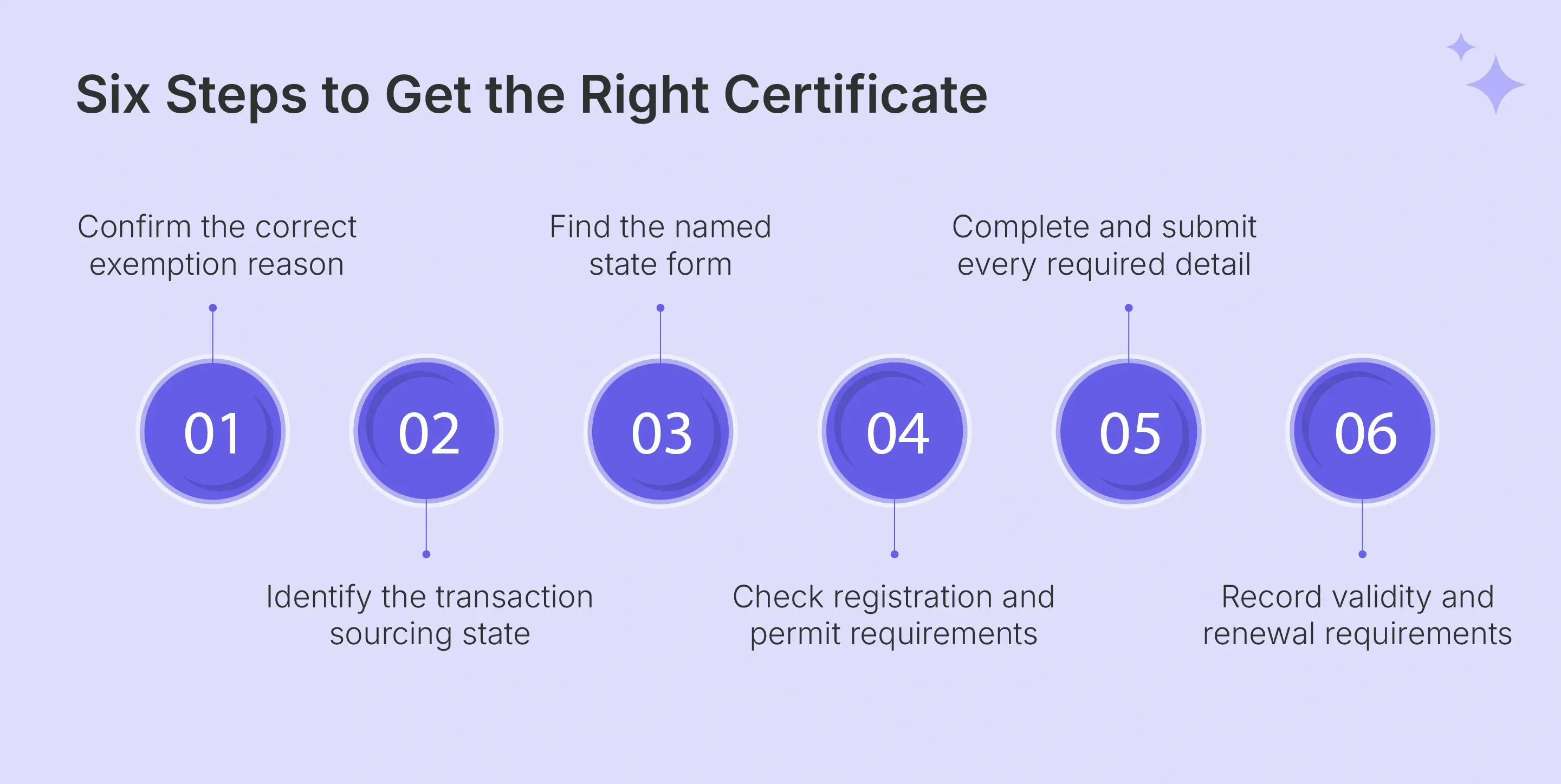
Step 1: Confirm the Exemption Reason
Determine whether the purchase qualifies for resale, manufacturing, agriculture, government use, exempt-entity treatment, direct payment, or another state-authorized category. The reason should describe the actual purchaser and transaction instead of relying on a broad statement about the customer’s industry.
Step 2: Identify the Sourcing State
Confirm where the transaction is legally sourced because the delivery location often controls the required form and applicable tax authority. Documentation accepted for one billing address may not support goods delivered elsewhere, especially when local sales rules or home-rule jurisdictions apply.
Step 3: Find the Named State Form
Use the exact form number and official title wherever the department of revenue prescribes a document. Texas uses Form 01-339, New York State uses ST-120 for resale, California uses CDTFA-230, and North Carolina uses E-595E for qualifying claims.
Step 4: Check Whether Registration Is Required
Some resale claims require an in-state permit, while others accept home-state registration, SST documentation, MTC forms, or another approved number. Confirm the specific requirements before the time of sale because registration approval may take longer than completing the certificate.
Step 5: Complete and Submit the Document
Enter the purchaser's name, seller details, address, exemption reason, registration number, purchase description, signature, and completion date. Submit the form before tax-free treatment begins whenever possible, then retain evidence showing when the seller received and reviewed it.
Step 6: Record the Validity and Renewal Rule
Store the validity rule with each document because renewal periods differ by state, certificate type, buyer category, and exemption program. Some records expire annually, several follow fixed terms, and others continue until revoked or material customer information changes.
What Information Makes an Exemption Certificate Valid?
A valid document identifies both parties, states the exemption basis, and includes every element required by the sourcing jurisdiction. Most forms request purchaser information, seller details, registration numbers, purchase coverage, an authorized signature, and the completion date.
Purchaser and Seller Information
The purchaser’s legal name, address, registration details, and exemption number should match state records and the customer account. Seller information should identify the business making the exempt sale and remain consistent with invoices, contracts, state registrations, and transaction records.
Differences in names, addresses, ownership, or registration status deserve review before approval. These inconsistencies may indicate an outdated document, incorrect customer mapping, another purchaser, or an unsupported exemption.
Exemption Reason and Identification Numbers
The stated reason must match the customer and purchase. A reseller should describe inventory intended for resale, while a manufacturer should identify qualifying production use under the relevant exemption.
Nonprofits and government buyers may need state-issued numbers, approval documents, purchase orders, or prescribed forms. A federal number should replace a state identifier only when the jurisdiction expressly allows that approach.
Signature, Date, and Purchase Coverage
The purchaser or authorized representative should sign and date the document wherever the state requires certification. A single-use document covers one purchase, while blanket certificates may support recurring transactions within an established customer relationship.
You should obtain updated documentation after changes to ownership, address, registration, exemption purpose, or covered product. These events can end reliance even when the form shows no fixed expiration date.
Also Read: Sales Tax Compliance Checklist for SaaS Businesses
Sales Tax Exemption Certificate by State
State requirements change the document, validity period, online check, and review priority. You should confirm every requirement through the official state source before approving exempt treatment.
| State | Primary Resale or Exemption Route | General Validity | Online Verification Scope | What Businesses Should Check |
|---|---|---|---|---|
| California | CDTFA-230 for resale and purpose-specific forms | Until revoked or information changes | Permit or account verification only | Match form, transaction, and intended use |
| New York | ST-120, ST-121, and ST-119.1 | Until information or circumstances change | Vendor registration lookup only | Use exemption-specific forms within required timing |
| Texas | Form 01-339 for resale and exemption | No stated general expiration | Permit and exempt-entity lookup | Confirm buyer information and purchase relevance |
| Florida | DR-13 and DR-14 certificates | DR-13 expires every December 31 | Broad certificate-level status lookup | Confirm the current calendar-year certificate |
| Georgia | ST-5, ST-4, and ST-5M | Until revoked, with program exceptions | Registration lookup rather than certificate validation | Apply full SST member requirements correctly |
| Illinois | CRT-61, ST-587, and E-number records | No fixed expiration with periodic refresh | Business and entity-status checks | Separate registration status from certificate validity |
| Washington | State-issued Reseller Permit and approved forms | Four years, or two years for some businesses | Broad permit and business-status lookup | Confirm current permit and purchaser identity |
| New Mexico | Type 2 and other NTTC documents | Current series continues until revoked | No public certificate lookup | Match NTTC type with claimed deduction |
| North Carolina | E-595E Streamlined Certificate of Exemption | No fixed general expiration | Registration and exemption-number lookups | Confirm reason and retain supporting evidence |
When Should Sellers Collect and Validate Exemption Certificates?
Here are the different situations where sellers must collect and validate exemption certificates:
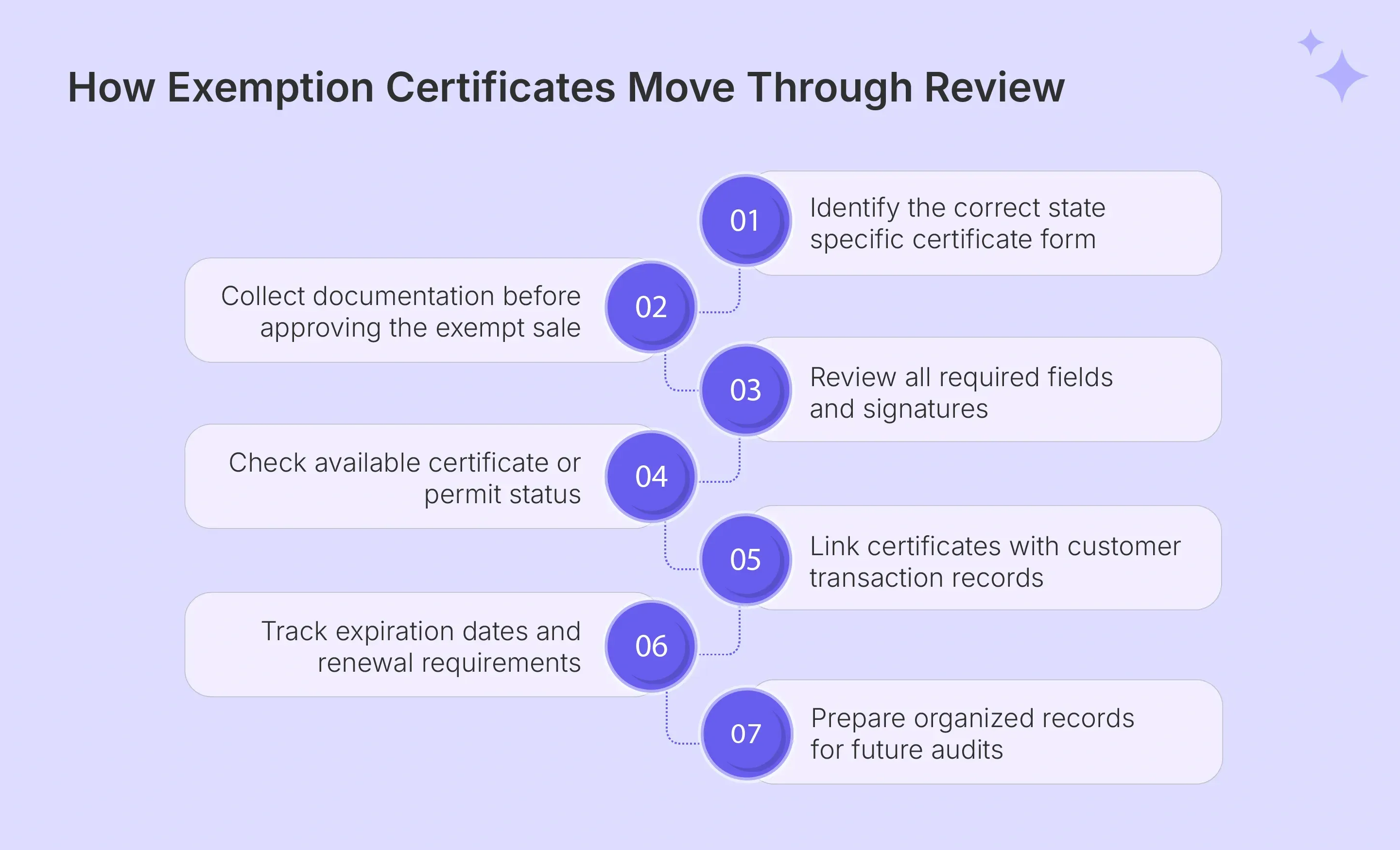
- Obtain the correct form during onboarding or before billing, then record its receipt date, covered account, and applicable transaction period.
- Confirm the exemption reason reasonably fits the purchaser and goods, then escalate obvious conflicts or unrelated claims before removing tax.
- Review names, addresses, signatures, dates, identification numbers, coverage language, and the current official form version before customer approval.
- Record whether a public tool checks the certificate, entity number, reseller permit, tax registration, or another limited status.
- Keep tax applied until acceptable documentation arrives, then replace expired records before processing additional transactions under exempt treatment.
- Use blanket documentation only where permitted and confirm whether late collection or cure rules support earlier tax-free transactions.
What Happens When an Exemption Certificate Expires?
When a document expires, stop relying on it for future transactions unless the state expressly permits continued use. Request an updated form, current permit, renewed approval, or replacement state document before processing another exempt purchase.
Early reminders reduce billing delays and financial burdens for both parties. When tax was paid before renewed documentation arrived, a refund of sales tax may require a separate purchaser or seller claim.
How to Renew an Expired Exemption Certificate
Renewal may require a newly completed form, current identification number, renewed entity approval, or state-issued replacement document. The process depends on the exemption category and state rules rather than one national timeline.
Track the expiration date and renewal requirement separately. Send reminders early, review the replacement, and retain tax until valid documentation supports renewed treatment.
What Happens When a Permit Remains Active but the Certificate Expires?
An active permit does not extend an expired certificate because registration and exemption documentation serve different purposes. The seller should obtain the required replacement before processing further tax-free transactions.
Many state tools confirm only permits or registrations rather than the certificate itself. This distinction prevents a successful lookup from creating false assurance that the exemption remains valid.
What Does the Exemption Certificate Lifecycle Include?
Certificate management is a continuous control process in which each stage should connect customer eligibility to transactions and preserve evidence.
| Lifecycle Stage | Business Requirement | Risk if Missed |
|---|---|---|
| Collection | Obtain the correct form before exempt treatment | Tax may be removed without supporting evidence |
| Validation | Review fields, eligibility, dates, and identification | Incomplete documentation may fail during audit |
| Customer Mapping | Link document with entity and transactions | Auditors may not trace the claimed exemption |
| Renewal Monitoring | Track expiration and customer information changes | Future transactions may rely on outdated records |
| Audit Preparation | Maintain searchable documents and transaction history | Teams may rebuild evidence under audit pressure |
How Do Exemption Certificates Fit into Multi-State Sales Tax Compliance?
Each new jurisdiction can affect registrations, form selection, renewal periods, sales tax return reporting, notices, and audit standards. Your document process should therefore connect with wider sales tax compliance controls.
Nexus and Exempt Sales Still Need Coordination
Sales Tax Nexus can exist even when many customers make tax-free purchases. You still need to identify registration duties, taxable revenue, supported exemptions, reporting requirements, and customer documentation across every active state. Customer records should align with nexus data and tax settings. This coordination reduces conflicting treatment between billing platforms, accounting systems, marketplaces, and state filings.
Returns Need Accurate Exempt Sales Reporting
Sales tax returns may require gross revenue, taxable revenue, exempt sales, and deduction categories. Reporting gaps arise when finance teams cannot connect untaxed transactions with the documents supporting them. A reliable process links every customer and certificate with the relevant state, exemption reason, transaction period, and reported amount. This structure improves reconciliation and reduces corrections after returns are filed.
Notices and Audits Often Test Exempt Transactions
Auditors focus on untaxed transactions because unsupported exemptions can increase assessed liability. Your team should retrieve documents quickly, match sampled invoices, and explain the treatment applied. The importance of these documents becomes clear when audit teams request evidence across several years. Searchable records reduce response time and preserve a consistent review history.

What Exemption Certificate Mistakes Create Audit Exposure?
Certificate weaknesses often remain hidden until an auditor samples untaxed transactions. Here are common exemption certificate mistakes that can create audit exposure:
- A resale form may not support manufacturing, nonprofit, government, or project exemptions requiring another purpose-specific document under state law.
- Missing signatures, dates, registration numbers, or exemption reasons can weaken records and increase assessment risk during a detailed state audit.
- Documents stored without customer or invoice links may not support sampled transactions across ecommerce, ERP, point-of-sale, and billing systems.
- An active permit may be mistaken for proof that the submitted form, claimed exemption, and underlying purchase remain valid.
- Teams may mark records verified without documenting whether they checked required fields, certificate status, entity approval, permit, or registration.
Home-state numbers, MTC forms, SST documents, and destination-state certificates may receive different treatment under applicable out-of-state rules.
Why Complexity and Financial Exposure Should Be Assessed Separately
Administrative complexity reflects the effort required to identify forms, collect certificates, review details, track renewals, and connect records with transactions. Financial exposure measures what happens when documentation fails, including tax, penalties, interest, local rates, and the audit period involved.
These risks do not always move together. Washington, for example, uses a state-issued reseller permit that simplifies administration, although rejected documentation can still create significant exposure. Businesses should therefore assess operational burden and potential liability as separate parts of their certificate strategy.
How Galvix Helps Reduce These Audit Gaps
Galvix brings exemption certificate collection, review, renewal tracking, account mapping, and audit preparation into one managed workflow for businesses. Here is how we help:
- Specialists review submitted certificates for missing, expired, or inconsistent information.
- Available state tools support certificate, permit, or registration status checks.
- Renewal monitoring keeps customer documentation current across active exempt accounts.
- Organized records connect certificates with customers, transactions, and audit evidence.
How Can Galvix Simplify Exemption Certificate Management?
At Galvix, we provide exemption certificate management as a modular paid solution within our broader sales tax compliance service. Our team collects certificates from exempt customers, reviews submitted records, associates them with customer accounts, monitors their expiration, and follows up on renewed documentation before existing certificates expire.
This managed approach reduces the need for finance teams to maintain spreadsheets, search email attachments, or rebuild records after an audit begins. We provide an audit-ready package that links certificate documentation to the customer information required to support exempt transactions.
Exemption management can also connect with our services for nexus monitoring, tax determination, state registrations, expert-prepared returns, and notice management. Customers select the modules they need, while pricing for exemption certificate management scales with the number of exempt customers.
Here is how Galvix compares with a manual certificate management approach:
| Area | Manual Certificate Management | Galvix |
|---|---|---|
| Collection | Sales or finance teams chase customers | Galvix manages structured collection and follow-up |
| Validation | Fields receive manual or inconsistent review | Specialists review certificates before organized storage |
| Renewal Tracking | Teams use spreadsheets and calendar reminders | Expirations trigger customer follow-up and replacement |
| Audit Records | Documents are assembled after an inquiry | Customers receive an organized audit-ready package |
| Wider Compliance | Separate providers manage related obligations | Optional modules operate through one service relationship |
Book a Galvix demo today to know how to bring your exemption records into one managed workflow before missing documents become expensive audit findings.
Frequently Asked Questions
Who can use a sales tax exemption certificate?
A purchaser can use one when buyer status, intended use, or transaction circumstances qualify under the sourcing state’s law. Resellers, exempt entities, manufacturers, agricultural buyers, contractors, and direct-payment holders may qualify. The purchaser must provide the correct form, identification, and reason supporting the claimed exemption.
Do sales tax exemption certificates expire?
Expiration depends on the jurisdiction and document type. Some certificates renew annually, others remain valid for fixed multi-year periods, and many continue until revoked. You should replace documentation after changes to ownership, registration, address, purchasing, or exemption status, even when no printed expiration appears.
Can one exemption certificate cover multiple states?
A multistate document may cover qualifying purchases in several participating jurisdictions, although acceptance remains conditional. SST and MTC forms do not create universal coverage. Each state may require identification, exemption reasons, registrations, or supplementary forms before the seller can approve tax-free treatment.
What information makes an exemption certificate valid?
A complete document should identify the purchaser and seller, explain the exemption, provide required identification, describe purchase coverage, and include authorization details. The form must also apply in the sourcing state and reasonably match the transaction. Completeness alone cannot establish that every purchase qualifies.
When should a seller collect an exemption certificate?
Collect the document before or at the time of sale whenever possible. Early collection gives your team time to review required fields, registration information, exemption relevance, and available state checks. When documentation arrives later, confirm whether state cure rules support earlier untaxed transactions.
What happens if an exemption certificate is missing during an audit?
The auditor may treat the transaction as taxable when supporting documentation is unavailable or unacceptable. The seller can face uncollected tax, interest, penalties, and retrieval costs. Available relief depends on state law, collection timing, purchaser eligibility, and whether later documentation can cure the deficiency.
How does Galvix manage sales tax exemption certificates?
Galvix collects customer documents, reviews submitted information, associates records with accounts, tracks renewal requirements, and organizes audit-ready evidence. You can combine this modular service with nexus monitoring, registrations, tax determination, return preparation, and notice management, while paying according to selected services and relevant work volume.