
Businesses with an Idaho seller’s permit generally file Form 850, the Sales and Use Tax Return, through the Idaho State Tax Commission’s Taxpayer Access Point (TAP). Most retailers file monthly, although the Commission can assign quarterly, semi-annual, or annual schedules based on the account.
The Idaho sales tax return is shorter than many state returns because TAP performs most of the arithmetic. You enter total sales, non-taxable sales, and cost of items subject to use tax. TAP then calculates net taxable sales, total taxable, the 6% tax, and the amount due.
That makes non-taxable sales the number that deserves the closest review. If the deduction is supported, the taxable base is correctly reduced. If the figure is wrong, TAP can still produce a balanced-looking return because it does not validate whether the underlying transaction qualified.
This blog covers how to file Idaho sales tax online, prepare Form 850 data, use Idaho TAP, handle exemptions, make payments, and retain proof of filing. It also explains how Galvix can manage Idaho sales tax returns alongside recurring filings across other states.

What Makes an Idaho Sales Tax Return Different?
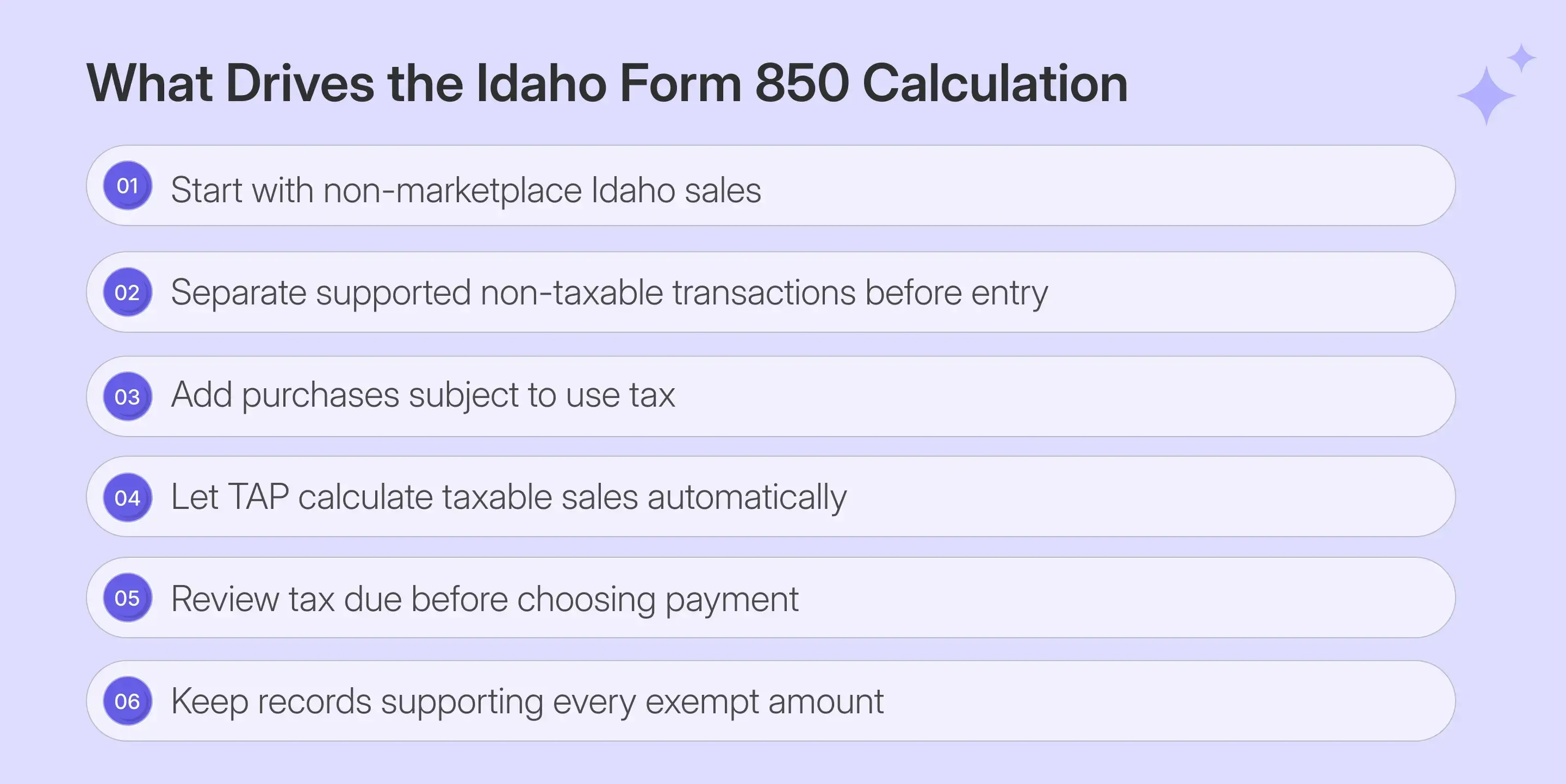
An Idaho sales tax return places less emphasis on manual tax arithmetic, and more on the figures entered before calculation. The seller supplies three core amounts, while TAP calculates the taxable base and tax due. Accurate classification therefore matters more than working out the 6% calculation yourself.
TAP Calculates Most Form 850 Fields
The filing process separates the values the seller knows from those the portal can derive. This makes Form 850 relatively short, although fewer editable fields do not reduce the need for reliable source data.
| Form 850 Field | Who Provides It |
|---|---|
| Total sales | Seller |
| Nontaxable sales | Seller |
| Net taxable sales | TAP calculates |
| Cost of items subject to use tax | Seller |
| Total taxable | TAP calculates |
| Tax due | TAP calculates |
| Penalty and interest | TAP calculates |
| Total due | TAP calculates |
There is no separate Calculate button in the observed sales tax filing workflow. As you change the seller-entered figures, the grey calculated fields update immediately. TAP therefore handles the calculation, while your business remains responsible for the numbers that feed it.
Non-taxable Sales Control the Taxable Base
Non-taxable sales can include supported resale transactions, qualifying exempt purchases, certain exempt products, and sales delivered outside Idaho. Idaho tax laws require clear records explaining why tax was not charged when an exemption applies.
You should be able to connect each deduction with the customer and transaction that supports it. Certain prescription medications or medical products can qualify for exemption under specific rules, while nonprofit organizations are not automatically exempt from every Idaho purchase or sale.
TAP does not decide whether your non-taxable sales figure is legally correct. It applies the correct rate to the taxable base derived from your entries, so unsupported deductions can still produce a mathematically complete return with the wrong tax.
Local Idaho Taxes Stay Outside Form 850
The state sales tax rate is 6%, and Form 850 does not contain a general city or county allocation. Idaho’s use tax rate is also 6%.
Some resort cities impose separate local sales taxes, while Travel and Convention and certain auditorium district taxes use separate reporting routes. Those obligations should not be mixed into Form 850 simply because they relate to the same underlying sale.
Who Must File Idaho Sales Tax Returns?
Businesses making taxable Idaho retail sales generally need a seller’s permit and must file returns according to their assigned schedule. Out-of-state businesses can also create an obligation through physical presence, economic nexus, or qualifying referral activity. Registration and filing obligations should be reviewed separately.
Idaho Retailers and Remote Sellers
The Idaho sales tax filing requirements depend first on whether the business is considered a retailer in the state. Common situations include:
- Idaho retailers regularly selling taxable products or qualifying services.
- Businesses creating a physical connection through Idaho activities.
- Remote sellers exceeding the state economic sales threshold.
- Sellers using qualifying Idaho referral arrangements for customer acquisition.
Economic Nexus Can Trigger Idaho Registration
A remote seller without physical presence crosses Idaho’s economic threshold when Idaho sales exceed $100,000 during the current or previous calendar year. Marketplace transactions count toward that test even when the facilitator handles collection.
Once the threshold is crossed, the seller may need sales tax registration, collection from Idaho buyers, and recurring returns. Businesses can track their Idaho sales tax nexus position before another registration creates an ongoing filing obligation.
New businesses use Idaho Business Registration when applying for applicable tax permits. The application can require an Employer Identification Number, ownership information, addresses, and other contact details. Online applications can take around 10 to 15 business days for the permit to arrive.
Ownership changes also matter. A new owner cannot continue using the previous owner’s seller’s permit, while some business name changes may require a separate permit number and registration application.
Filing Frequency Depends on the Assigned Schedule
Your filing frequency is assigned rather than freely selected. Most retailers file monthly, while lower-volume businesses can receive a different schedule based on their activity and tax liability.
| Schedule | General Idaho Treatment |
|---|---|
| Monthly | Most retailers |
| Quarterly | Less than $750 tax per quarter |
| Semiannual | Certain low-volume distributors or wholesalers |
| Annual | Certain qualifying low-volume accounts |
Monthly returns and payment are normally due by the 20th of the following month. If that date falls on a weekend or holiday, the due date moves to the next workday. The same principle applies when tracking the Idaho sales tax filing deadline shown in TAP.
A registered seller must still file when no sales occurred. Current Idaho guidance states that reporting $0 in sales for 12 consecutive months can result in permit cancellation, so zero activity should not be treated as permission to ignore a filing period.
For businesses operating across multiple jurisdictions, state-level sales tax rules can differ in thresholds, sales tax rates, filing calendars, and local reporting requirements. Idaho’s Form 850 approach should therefore remain separate from the filing logic used elsewhere.
What Should You Prepare Before You File Idaho Sales Tax Online?
Before you file Idaho sales tax online, reconcile the information TAP cannot determine independently. Your source records should already separate direct activity, marketplace transactions, non-taxable sales, qualifying business-use purchases, exemption support, the correct tax period, and payment details before you open Form 850.
| Prepare | Why It Matters |
|---|---|
| TAP access | Opens the registered tax account |
| Idaho direct sales | Establishes Total sales |
| Marketplace activity | Prevents duplicate reporting |
| Nontaxable sales | Determines taxable sales |
| Use-tax purchases | Adds qualifying business-use amounts |
| Exemption records | Supports untaxed transactions |
| Bank information | Supports ACH payment |
Idaho instructs sellers not to report sales made through registered marketplace facilitators that already report those transactions. Keep written verification from the marketplace because those transactions can still count toward nexus even though the marketplace sales stay off your own Form 850.
This distinction is critical when reconciling gross sales or gross receipts from ecommerce systems. The figure entered as Total sales should represent the Idaho activity that belongs on your own return, rather than blindly matching a platform’s complete top-line sales report.
Idaho also has no statewide sales tax holidays scheduled for 2026. Ordinary taxable goods therefore remain subject to the normal rules unless a standing product, purchaser, or use-based exemption applies.
Use Tax Enters the Same Form 850
Form 850 includes the cost of items subject to use tax when the business uses goods in Idaho without having paid the required tax. Idaho applies the same 6% rate to sales and use tax.
For example, a business owner may buy equipment from an out-of-state supplier without Idaho tax and later use that equipment internally. Enter the qualifying cost on Form 850 so TAP can add it to the taxable base and calculate the appropriate tax.
How Do You File Idaho Sales Tax Online Through TAP?
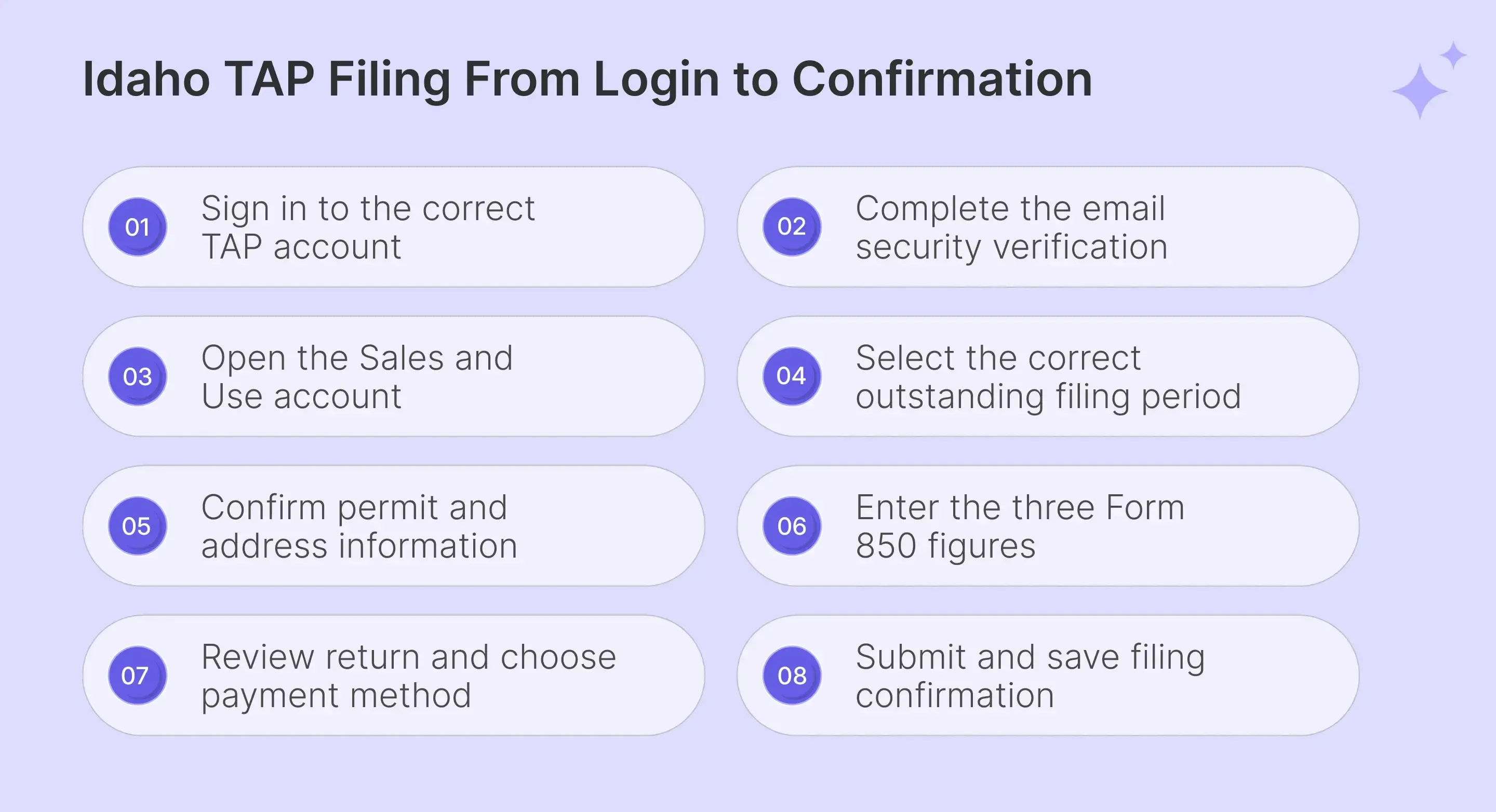
To file Idaho sales tax online, sign in to TAP, complete security verification, open the correct account, select the outstanding filing period, confirm permit details, enter the three Form 850 figures, review the calculated return, choose payment handling, and continue until the portal confirms submission.
Here is how to file sales tax in Idaho online:
Step 1: Sign In to Idaho TAP
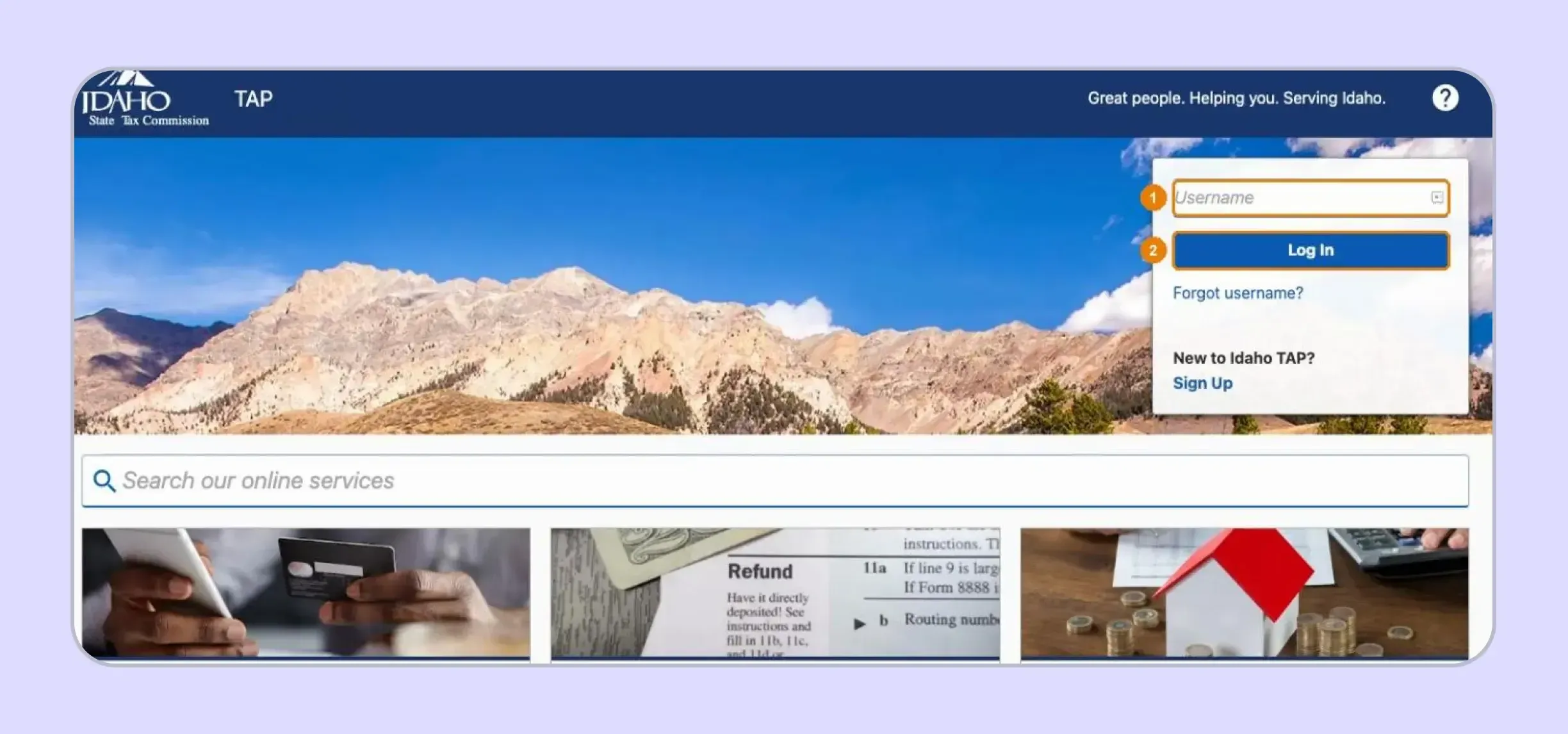
Open the Idaho State Tax Commission’s TAP page and enter the username associated with the registered account. Select Log In to continue.
Your TAP username is separate from an Idaho sales tax permit number or email address. If access already exists, use the recovery option rather than creating another registration that is disconnected from the filing history.
Step 2: Complete the Security Verification
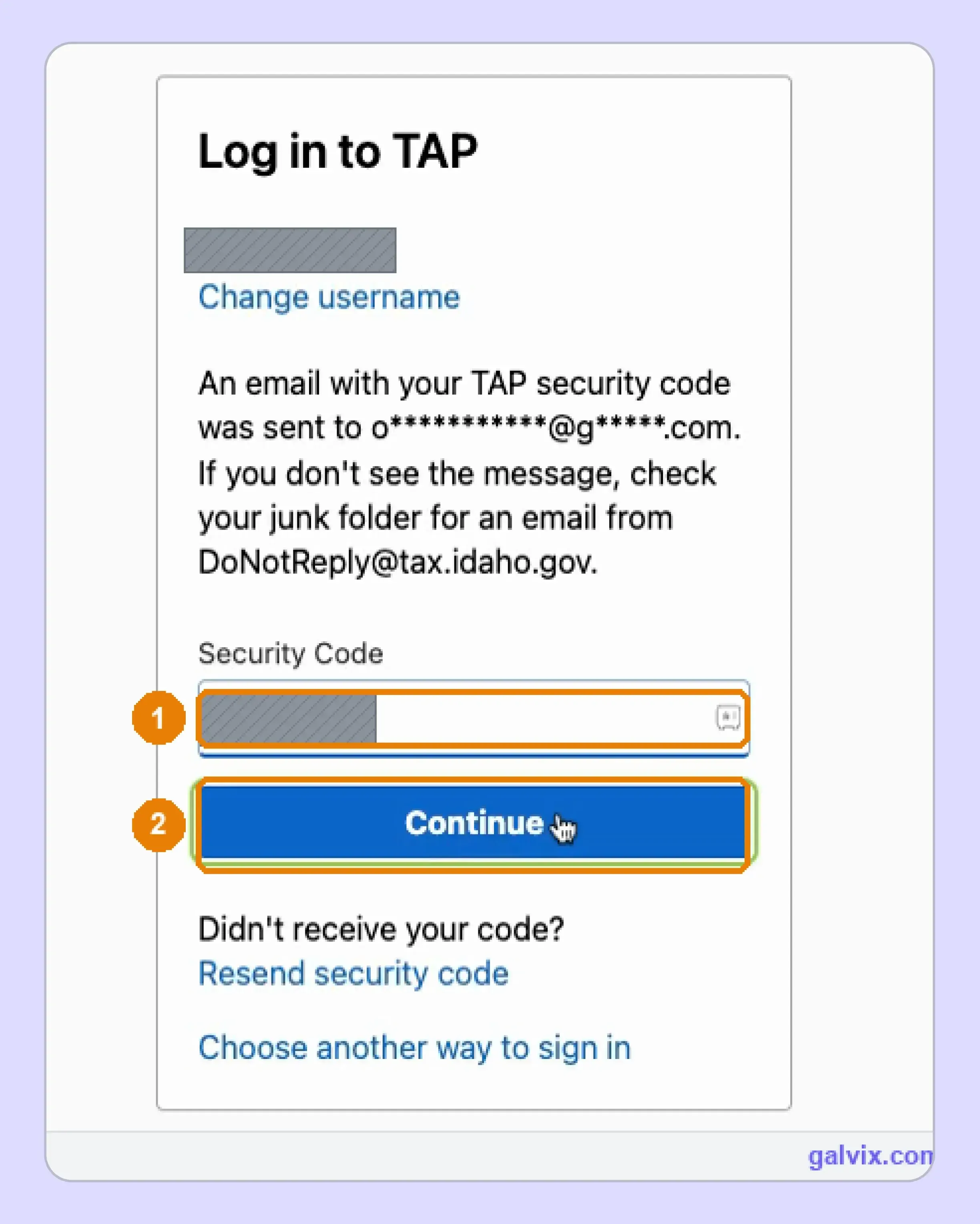
TAP first sends a one-time security code to the email connected with the account. Enter the code and select Continue. The password step appears afterward on a separate verification screen.
The security code appears before the password request. Anyone responsible for ID sales tax filing therefore needs live access to the account inbox before beginning the return, especially when finance staff and account owners are different people.
Step 3: Open the Sales and Use Tax Account
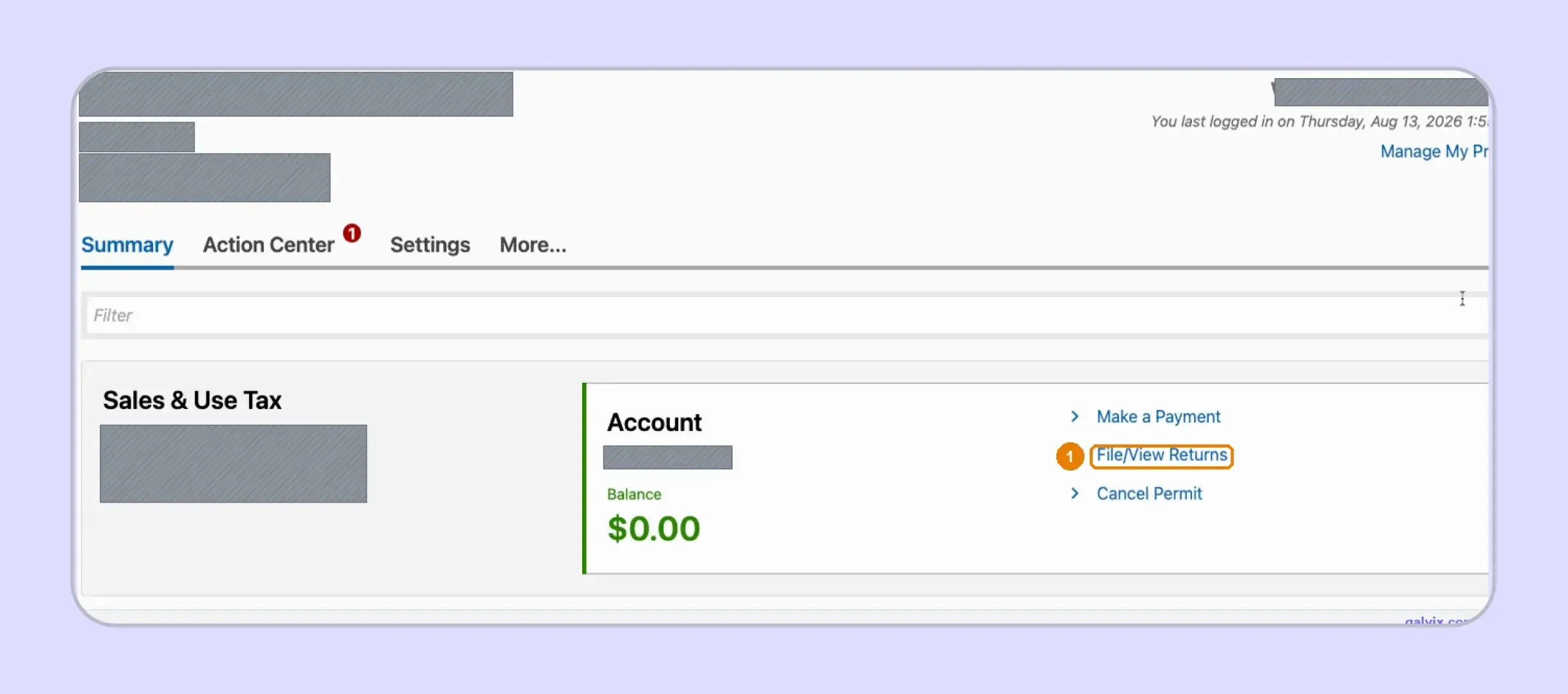
After login, confirm the correct business appears on the account home before moving further. One user can have access to several accounts, so check the account information first.
Under Sales & Use Tax, select File/View Returns. The separate Make a Payment link handles an existing balance and does not start the return workflow.
Step 4: Select the Correct Filing Period
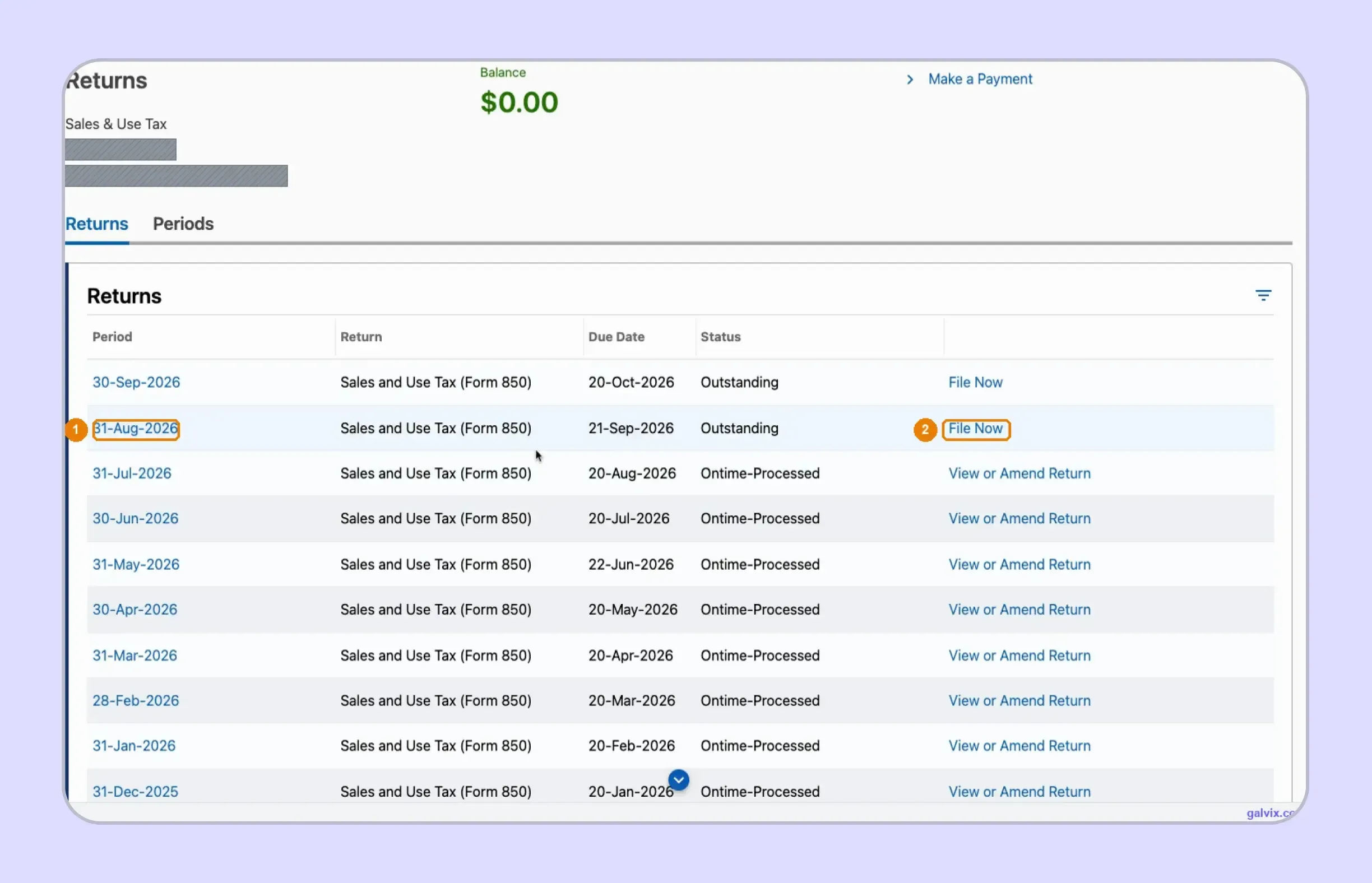
The Returns page lists each period with its Form 850 label, due date, status, and available action. Outstanding periods show File Now, while processed periods provide View or Amend Return.
Select the exact period you intend to file rather than assuming the first row is correct. Several periods can remain open simultaneously.
Compare both the period-ending date and the sales tax filing deadline before selecting File Now. In the captured return, the August period was due September 21 because September 20 fell on a Sunday.
Step 5: Confirm Permit and Address Information
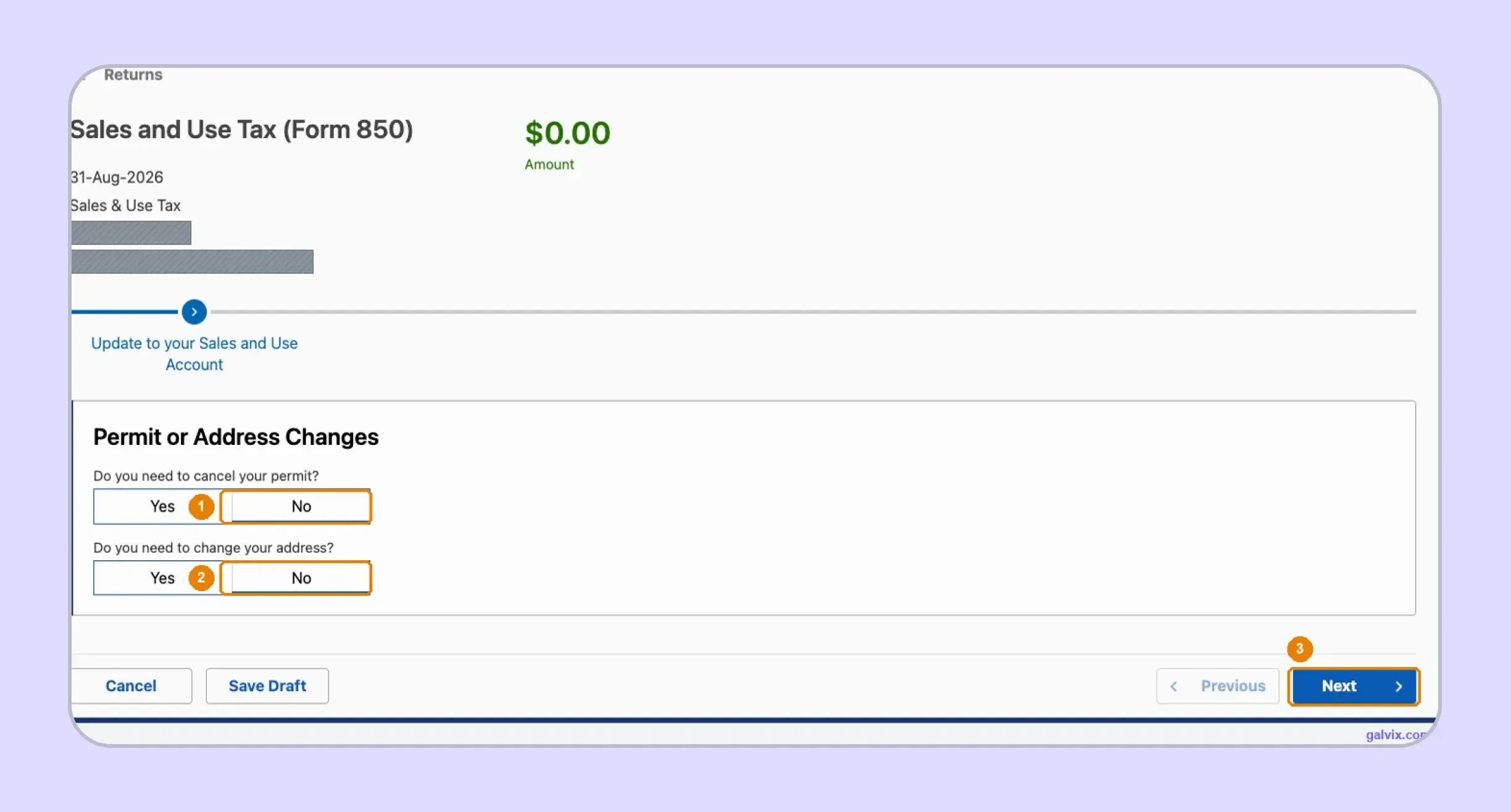
The Form 850 workflow opens with Permit or Address Changes rather than tax figures. Confirm whether the permit needs to be canceled and whether the registered mailing address has changed.
If neither applies, select No for both questions and continue. Save Draft stores an unfinished return, although it does not submit anything to the state tax commission.
Step 6: Enter the Three Form 850 Figures
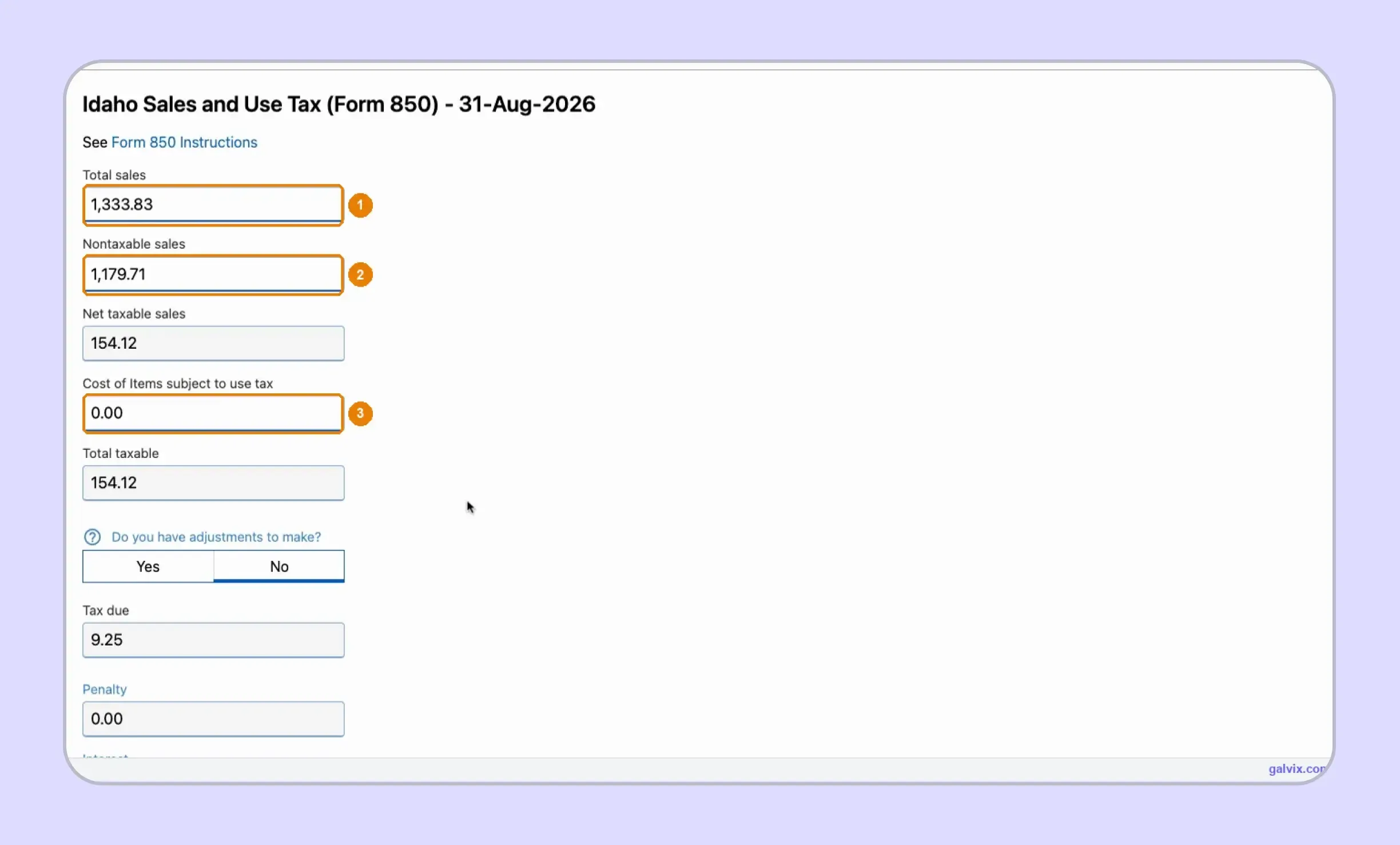
Businesses researching how to fill out sales and use tax return in Idaho need to focus on three editable fields: Total sales, Non-taxable sales, and Cost of Items subject to use tax. Every other main calculation is generated by TAP.
As you enter those figures, TAP calculates net taxable sales, total taxable, the amount of sales tax, penalties or interest charges where applicable, and Total due. There is no separate Calculate button in the observed return.
Nontaxable sales directly changes the taxable base. TAP does not verify whether the underlying deduction is supported, so reconcile every exemption before the number reaches Form 850.
Step 7: Review the Return and Choose Payment
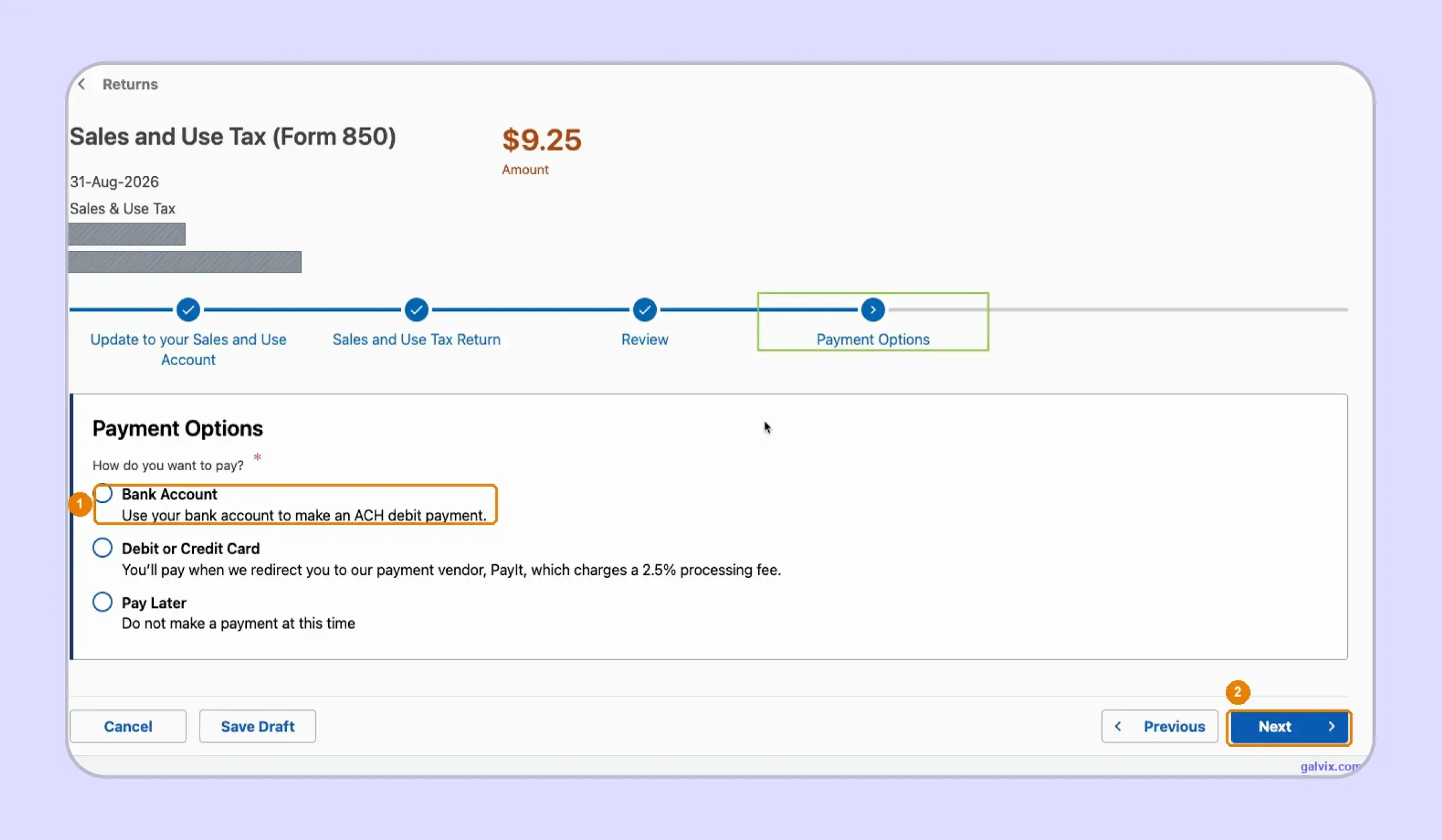
After the read-only Review screen, TAP moves to Payment Options. Businesses researching how to pay sales tax in Idaho can choose Bank Account, Debit or Credit Card, or Pay Later.
Bank Account uses ACH debit. Card payments route through PayIt, and the captured portal displays a 2.5% processing fee. Pay Later separates filing from payment, so the balance must still be paid by the applicable deadline.
Step 8: Enter Payment Details and Submit the Return
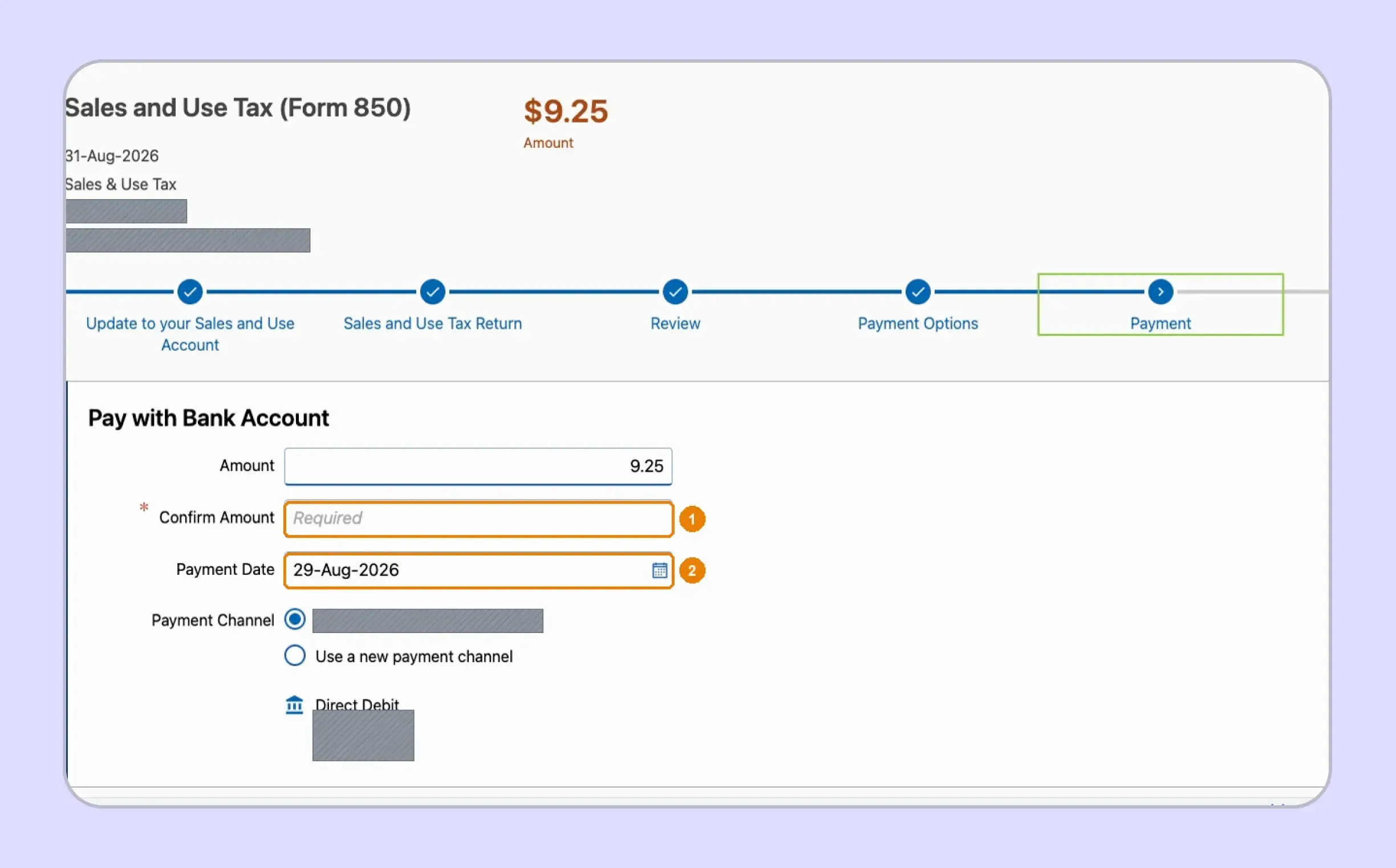
If you choose bank account payment, TAP prefills the amount and asks you to re-enter the Confirm Amount. Review the Payment Date and selected payment channel before continuing.
The Payment Date can default to the filing date rather than the payment deadline. Change it if necessary, then continue until the final submission produces a confirmation number.
Reaching Payment does not mean you have filed. A return saved as a draft or left on this screen remains incomplete. Only the confirmation number proves submission, so save it with any separate payment confirmation.
How Do Exemptions Affect the Idaho Sales Tax Return?
Exempt transactions affect Form 850 because supported amounts can be included in the non-taxable sales figure, thereby reducing taxable sales. Before using an exemption, connect the buyer to the transaction, the required documentation, and the qualifying reason. A certificate supports the record, but it does not exempt every customer purchase.
Idaho Uses Form ST 101 for Many Exemptions
Form ST-101 is Idaho’s primary Sales Tax Resale or Exemption Certificate for many qualifying purchases. A buyer purchasing inventory for resale can complete the relevant section, while the seller keeps the document and avoids charging tax on future purchases that remain within its permitted scope.
For qualifying purchases involving an out-of-state business and an Idaho-registered retailer, the Uniform Sales and Use Tax Certificate Multijurisdiction may be used instead of ST-101. A resale certificate should remain connected with the buyer and the transactions it is intended to support.
Certificate Status Does Not Establish Every Exemption
Holding a completed certificate provides the seller with documentation of the claimed treatment. The seller still needs to determine whether the buyer and transaction meet the exemption conditions. Idaho can bill sellers or buyers when records do not adequately explain why tax was not collected.
Across several jurisdictions, a consistent sales tax exemption certificate process helps keep collection, verification, customer mapping, and transaction eligibility separate. That distinction matters when different tax authorities require different forms or supporting evidence.
Before non-taxable sales reduce Form 850, the Galvix Sales Tax Exemption Certificate Tool can help identify Idaho’s certificate route, available verification method, and seller action points. It supports certificate review without treating a successful lookup as proof that every transaction qualifies for tax-free treatment.

How Does Galvix Help With Idaho Sales Tax Filing?
Galvix manages recurring filing as a service, so your team does not need to prepare each return or operate every state portal independently. Galvix reconciles transaction records, prepares returns, completes specialist review, sends the figures for approval, and files approved returns according to each registered state’s schedule.
For Idaho, that workflow can separate direct transactions from facilitator activity, reconcile total sales, review non-taxable sales, identify purchases subject to use tax, and connect exemption support with Form 850. This addresses the part of Idaho sales tax filing that TAP calculates from your inputs without validating the underlying classification.
When transaction records come from multiple systems, supported sales tax integrations can bring ecommerce, accounting, payment, and ERP records into a single return workflow. Businesses using BigCommerce sales tax integration or Shopify sales tax integration can keep source transactions connected with return preparation instead of rebuilding filing files each period. Galvix also supports API connections and CSV or XLSX uploads for other systems.
As your footprint grows, comprehensive sales tax nexus monitoring can connect economic and physical exposure with future registrations and filing deadlines. Exemption management, tax determination, notices, and return filing can sit within the same sales tax compliance relationship. Galvix uses modular pricing, so you select only the services you need, and the exact pricing reflects the workload associated with each module.
What Can Galvix Manage for Idaho Sellers?
As transaction volume grows, recurring compliance requires more than completing a single sales tax return. Galvix can manage the operational work while keeping your finance team involved in review and approval.
- Reconcile sales: Prepare clean data before return creation.
- Separate channels: Keep facilitator and direct activity distinct.
- Review exemptions: Connect non-taxable sales with supporting records.
- Track obligations: Monitor nexus and upcoming registrations.
- Manage filing: Handle returns, notices, and confirmations.
This approach becomes useful when Idaho sits beside states with different forms, sales tax rates, and sourcing models. Your team can maintain one managed workflow even when each state’s underlying return still follows its own rules.
Book a Galvix demo to review Idaho and multistate filing before recurring reconciliation and portal work expands further.
Frequently Asked Questions
Can I file an Idaho Form 850 on paper?
Yes. Idaho allows paper filing, although regular sellers can file through TAP. The Tax Commission states that a paper copy can be printed from the Letters panel in your TAP account and should be preprinted for the correct period, account, and owner. For most businesses deciding how to file ID sales tax, TAP keeps filing history and payment activity together in the registered account.
How do I amend an Idaho sales tax return after filing?
Open File/View Returns in TAP, locate the affected tax return, and select View or Amend Return for that period. The captured workflow shows this action beside already processed returns. Do not prepare another original return for the same period. Reconcile the corrected figures first so the amendment reports the correct amount.
Can an authorized representative file Form 850 through TAP?
A representative needs appropriate access to the relevant TAP account before filing. The observed login also requires access to the email address that receives the one-time security code, followed by the account password. Businesses should therefore confirm portal access and internal authorization before the Idaho sales tax filing deadline rather than resolving credentials on the final day.
How long should Idaho sales tax records and exemption certificates be kept?
Idaho requires businesses to maintain adequate records supporting sales and exemption treatment. The exact retention period can depend on the record and circumstances, so businesses should confirm current requirements with the Idaho State Tax Commission when setting their retention policy. For exempt sales, keep the supporting certificate and transaction records together, as the Commission may question why tax was not collected.
Can I change an ACH payment date after scheduling it?
The observed TAP payment screen lets you set the Payment Date before final submission. It defaults to the date the return is prepared, so review it before continuing. If a payment has already been scheduled, confirm available changes through TAP or the Commission rather than assuming the date can still be edited.
What should I do if my Idaho business closes during a filing period?
When closing, report the final filing period and follow Idaho’s process for cancelling the seller’s permit. The Form 850 workflow specifically asks whether you need to cancel the permit before the tax-entry screen. An Idaho sales tax permit should not simply be left open after taxable operations end.
When does Idaho require a separate Travel and Convention tax return?
The Travel and Convention tax is separate from Form 850 and applies to qualifying lodging activity. The Idaho State Tax Commission lists Travel and Convention permits separately from ordinary seller’s permits, so affected businesses should not combine that liability with their standard return. This distinction is important when determining how to file sales tax return in Idaho for businesses operating lodging or accommodation activities.