
California and Colorado are changing how they tax software and SaaS from January 1, 2027. Both states are moving away from older delivery-based rules and bringing many remotely accessed or electronically delivered software products into the sales tax base. Colorado’s HB26-1223 repeals the downloaded software exemption for software available for repeated sale and license, while California’s SB 122 brings digital products, including remotely accessed prewritten software, into taxable tangible personal property.
For SaaS companies, this taxability update affects nexus review, registration timing, billing configuration, customer location data, exemption handling, contract language, invoicing, use tax exposure, and return preparation. Many teams that previously treated California and Colorado as lower-friction SaaS states now need to rebuild their compliance process before the effective date.
Companies operating across several jurisdictions already know that sales tax by state can vary significantly. These two changes make the difference more visible because California has introduced detailed sourcing and purchaser rules, while Colorado adds another layer to an already complex local tax environment.
This blog explains the SaaS sales tax changes in Colorado and California, what becomes taxable in 2027, and where exemptions may matter. We will also discuss how Galvix helps software businesses prepare for these changes.

What Are the Key SaaS Sales Tax Changes in California and Colorado for 2027?
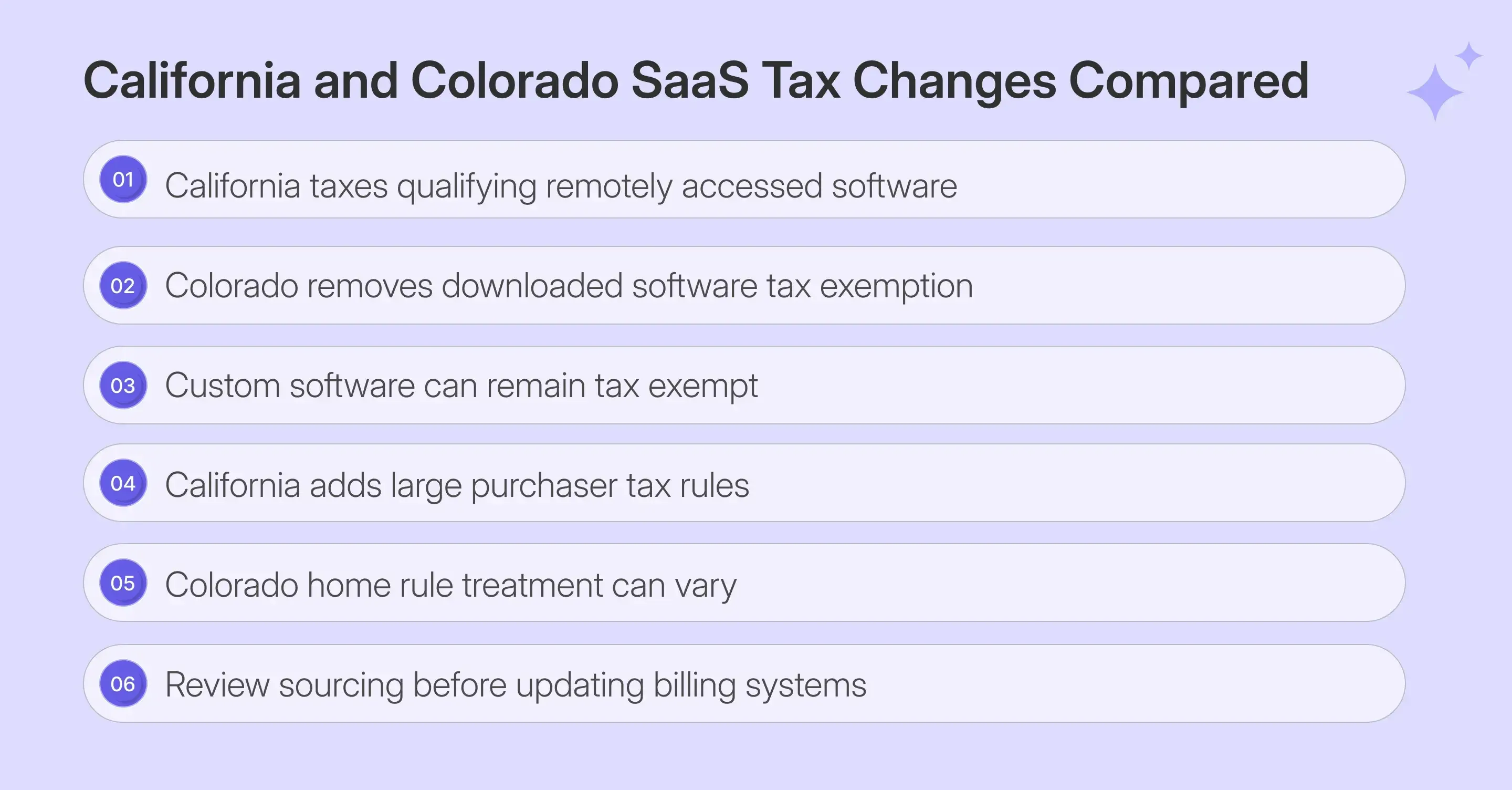
The SaaS sales tax changes in Colorado and California start on the same date, although the underlying rules differ. California creates a broader digital-product framework with new sourcing and purchaser provisions. Colorado removes an existing software exemption while retaining specific exclusions for custom software and qualifying negotiated agreements.
California's New SaaS Tax Rule
California Governor Gavin Newsom signed SB 122 on June 29, 2026. As of January 1, 2027, prewritten software transferred electronically or accessed remotely is subject to California’s taxable digital-product rules.
For SaaS sellers, the following parts of the new law deserve particular attention:
- Prewritten software accessed remotely becomes taxable as of January 1, 2027, bringing many SaaS subscriptions into California’s sales and use tax system.
- Custom software prepared to a customer's special order remains outside the taxable prewritten-software treatment under the revised rules.
- Digital infrastructure is excluded when a qualifying cloud service allows users to create, deploy, scale, or run their own software.
- Several digital categories also remain excluded, including digital books, audio works, audiovisual works, visual works, games, and qualifying digital assets.
- Large purchasers face a separate rule once their purchases of electronically delivered or remotely accessed digital products from a single retailer exceed $5 million.
In 2027, California shifts use-tax responsibility to qualifying purchasers once purchases from a single retailer exceed $5 million. From 2028, that threshold can be measured using either the current or previous calendar year. Businesses that fall under this rule must obtain a direct payment permit and take a more active role in tracking vendor-level software purchases.
California also introduces more detailed sourcing rules for digital sales. Sellers should rely on customer address information, with billing details taking priority when several addresses are available. Remote use can also influence use-tax treatment, especially for distributed teams. As the effective date approaches, SaaS companies should keep reviewing state guidance on sourcing, bundled products, contracts, and transition rules.
Colorado's New SaaS Tax Rule
Colorado's governor signed HB 26-1223 on June 4, 2026, expanding the definition of taxable computer software to include delivery by download, app, or remote internet access.
The Colorado SaaS sales tax change for 2027 works differently. HB26-1223 repeals the state exemption for downloaded software, making software available for resale or license taxable as tangible personal property from January 1, 2027.
The following aspects of the Colorado rule deserve attention:
- Software available for resale or licensing becomes subject to state sales and use tax, regardless of the delivery method.
- Software developed for a particular user remains exempt, preserving Colorado’s treatment of qualifying custom software.
- Software governed by a qualifying negotiated license agreement can also remain exempt under the enacted legislation.
- Standard or substantially non-negotiable agreements do not meet the statutory definition of a negotiated license created during the legislative process.
The negotiated-license exception requires careful contract review because Colorado requires that the agreement be individually bargained and signed by authorized representatives. Standard click-through terms or largely non-negotiable agreements do not qualify. SaaS companies relying on this exemption should confirm that their contracts clearly meet the statutory requirements before applying exempt treatment.
Colorado adds another layer through home-rule jurisdictions, where local tax treatment can differ from the state. Cities such as Boulder and Denver already address SaaS in their own rules. The Colorado sales tax rules provide broader context on rates, nexus, filing requirements, and the complexity of local compliance.
How Do California and Colorado SaaS Tax Changes Compare?
The SaaS sales tax changes in Colorado and California affect many of the same software businesses, although the rules work differently. The following comparison covers the main points SaaS sellers and buyers should review:
| Area | California SB 122 | Colorado HB26-1223 |
|---|---|---|
| Signed | June 29, 2026 | June 4, 2026 |
| Effective date | January 1, 2027 | January 1, 2027 |
| Main change | Prewritten software can be taxable when delivered physically, electronically, or remotely | Repeals the downloaded-software exemption for software available for repeated sale or license |
| Custom software | Remains outside taxable prewritten software when statutory conditions apply | Software developed for a particular user remains exempt |
| Other key exclusions | Digital infrastructure and specified digital content categories | Qualifying negotiated license agreements |
| Large purchaser rule | Purchaser responsibility begins above the $5 million retailer-specific threshold | No equivalent provision in HB26-1223 |
| Local complexity | State and local framework is relatively more uniform | Self-collecting home-rule cities may apply separate local rules |
| Sourcing consideration | Detailed digital-product address and remote-use rules apply | Existing destination sourcing remains relevant to taxable retail sales |
| Estimated revenue impact | Administration estimated about $450 million General Fund impact for the half-year, rising to about $900 million annually | Fiscal analysis estimated $44.4 million in FY 2026-27 and $92.2 million in FY 2027-28 |
| Economic nexus | Existing $500,000 California threshold remains relevant | Existing $100,000 Colorado retail-sales threshold remains relevant |
For businesses comparing these requirements with those in other markets, the broader California sales tax guide provides useful context on nexus, registration, and current state compliance rules.
Which Businesses Are Most Affected by the California and Colorado SaaS Sales Tax Changes?
SaaS vendors, enterprise software buyers, multi-state companies, and businesses approaching nexus thresholds need the closest review. The amount of work depends on what you sell, where customers use it, how contracts are structured, and whether existing tax systems can support the new treatment.
The SaaS sales tax changes in Colorado and California become critical when a business previously treated remotely accessed software as outside the state sales tax base.
- SaaS and cloud software vendors: Subscription businesses selling prewritten software into either state should review every product before January. A product marketed as a platform, application, or subscription can still fall within a taxable software definition based on what customers receive.
- Software purchasers and enterprise buyers: California buyers need particular attention because the $5 million single-retailer threshold can shift use-tax responsibility to the purchaser. Colorado purchasers should examine whether enterprise agreements satisfy the negotiated-license requirements rather than relying solely on the contract size.
- Multi-state software companies: Businesses already registered in both states may avoid a new registration project, although their billing and filing logic still needs to be updated. The software sales tax changes in Colorado and California can affect tax codes, customer addresses, invoice lines, exemption treatment, and return reconciliation.
- Companies approaching nexus: New taxability does not remove the separate nexus question. California’s remote-seller threshold is more than $500,000 in qualifying California sales, while Colorado applies a $100,000 retail-sales economic nexus standard.
A SaaS business should therefore review its wider sales tax nexus position before deciding when registration and collection must begin. Colorado deserves an additional location-level check. A company below a state economic threshold can still have obligations due to physical presence, while local home-rule requirements may require separate analysis.
The SaaS sales tax changes in Colorado and California also impact finance teams that use multiple billing channels. Tax rules applied correctly on one platform can still fail when direct invoices or another commerce system uses different customer location or product data.
Which Software Transactions Remain Exempt Under the New California and Colorado SaaS Tax Rules?
Several software and digital transactions remain outside the expanded tax base when statutory requirements are met. Businesses should review product design, customer use, agreement terms, and supporting records before applying an exemption because California and Colorado use different definitions.
- Custom Software: Both states continue to exempt qualifying software developed for a specific customer or user. California can also exempt separately stated custom modifications made to existing prewritten software when statutory conditions are met. Sellers should keep development scopes and contracts that support the customer-specific nature of the work.
- California Digital Infrastructure: California excludes qualifying digital infrastructure from its definition of a taxable digital product. This can include specified cloud services that enable customers to create, deploy, scale, or run their own software without managing the underlying infrastructure. Sellers should compare the actual service against the statutory definition before applying this exclusion.
- California Digital Content: California excludes specified digital content, including books, audio works, audiovisual works, video games, digital visual works, and qualifying digital assets. These exclusions show why SaaS taxability by state depends heavily on product classification. Similar delivery methods can receive different treatment based on what the customer receives.
- California Out-of-State Use: California provides relief in specified situations involving digital products acquired or retained for use solely outside the state. This can matter for enterprise customers whose employees access software from several locations. Sellers should maintain reliable address and usage records that support the treatment applied to each transaction.
- Colorado Negotiated License Agreements: Colorado retains an exemption for software covered by a qualifying negotiated license agreement. The agreement must be individually bargained and signed by authorized representatives rather than offered through standard or largely non-negotiable terms. Sellers relying on this exemption should keep the contract as supporting evidence.
Exempt customers also create a separate documentation requirement. The sales tax exemption certificate guide explains why certificate collection, registration lookup, and transaction eligibility should remain separate controls.
The SaaS sales tax changes in Colorado and California make this distinction critical, as sellers may now have taxable products sold to customers who claim exempt treatment.
How Should SaaS Companies Prepare for the 2027 Sales Tax Changes in California and Colorado?
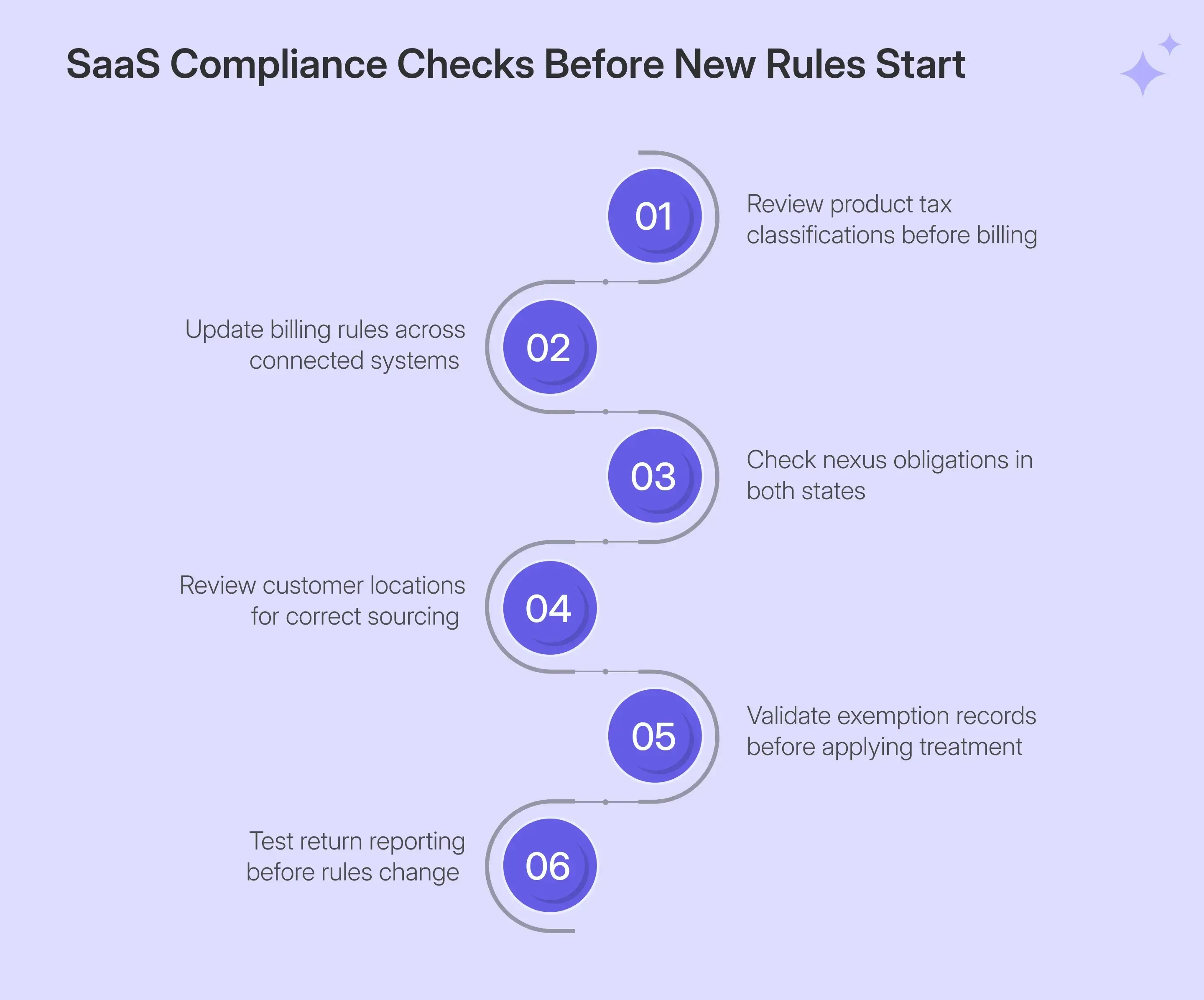
SaaS companies should prepare across product classification, billing, contracts, nexus, exemptions, and return reporting before January. These SaaS sales tax changes affect the entire compliance process, so changing a single tax rate or billing setting will rarely address all requirements.
Review Product and Service Offerings
Start by listing every subscription, application, hosted platform, implementation service, and enterprise package sold into California or Colorado. Classify each offering under the relevant state definition instead of applying one tax treatment across the entire product catalog. Reviewing sales tax by state can also help teams see where software treatment differs across jurisdictions.
Update Tax Determination Systems
Review how tax is calculated across subscription billing, accounting systems, direct invoices, and other sales channels before the effective date. Galvix supports multiple sales tax integrations that help businesses connect transaction data with wider compliance workflows. The same product and customer should receive consistent treatment wherever the transaction enters your finance process.
Review Customer Location Data
California’s new sourcing hierarchy makes reliable customer location information more important for remotely accessed software and digital products. Billing details can influence sourcing when multiple addresses are available, while user location may matter when remote access spans multiple states. The broader California sales tax rules provide useful context when reviewing sourcing and customer-location requirements.
Evaluate Contracts and Invoice Language
Review how agreements describe prewritten software, infrastructure services, custom development, implementation work, maintenance, and negotiated licenses before applying tax treatment. Colorado requires qualifying negotiated licenses to meet specific statutory conditions, so contract language needs careful review. The Colorado sales tax rules can provide additional context on state requirements and the complexity of local compliance.
Check Nexus and Registration Status
A newly taxable product creates collection responsibility only when the seller also has nexus and a related registration obligation. Review your wider sales tax nexus position before January, then confirm whether existing registrations cover affected sales. Colorado sellers should also consider whether home-rule jurisdictions create separate registration or reporting requirements.
Revisit Exemption Records
Once previously untaxed software becomes taxable, exemption records become more important because exempt treatment now needs stronger supporting documentation. Confirm which certificates are available, whether they remain current, and whether they support reporting the transaction as exempt. The sales tax exemption certificate guide explains why the review of certificates and transaction eligibility should remain separate controls.
Test Return Reporting Before January
Run sample transactions through billing, accounting, and return preparation before the new rules begin affecting live customer invoices. Confirm that product classification, customer sourcing, exemption treatment, and collected tax remain consistent throughout the workflow. Using connected data through Galvix integrations can also make it easier to identify mismatches before filing begins.
Model Buyer Side Use Tax
Large California buyers should identify vendors whose qualifying digital-product purchases could approach the $5 million threshold during the relevant measurement period. Once the rule applies, the purchaser may need to self-assess the use tax rather than rely on the vendor to collect it. Finance teams should prepare accounts payable and tax accrual processes before that responsibility shifts.
These steps give businesses time to resolve gaps before the SaaS sales tax changes in Colorado and California begin affecting live invoices, reporting, and customer billing.

How Does Galvix Help SaaS Companies Prepare for California and Colorado Sales Tax Changes?
Galvix links changes in software taxability to the subsequent compliance work. SaaS companies can manage nexus tracking, registrations, tax determination, return preparation, exemption certificates, and state notices without rebuilding separate internal workflows each time a state changes its treatment.
The SaaS sales tax changes in Colorado and California show why this connection matters. A change in taxability can affect invoices first, then flow into collected tax, returns, exemptions, registrations, and state correspondence.
Galvix works with transaction data from supported systems and can also accept CSV or XLSX uploads when a native connection is unavailable. That gives software businesses a practical way to consolidate data across multiple sales channels before filing.
What Does Galvix Manage for SaaS Companies?
For SaaS businesses operating across several states, Galvix connects the work related to a taxability change rather than treating each requirement as a separate project.
- Product taxability monitoring: Galvix reviews product taxability as part of the compliance workflow, helping businesses account for state changes when products or delivery methods receive new treatment.
- Nexus monitoring: Economic and physical nexus exposure can be monitored across all 50 states, helping teams identify when registration and collection requirements may arise. Galvix also supports proactive threshold monitoring across connected channels.
- Registration support: When a new obligation is identified, the Galvix team can handle state registration work and portal setup rather than leaving finance teams to complete each application separately.
- Exemption certificate management: Galvix can collect, review, store, track expiration dates, and maintain supporting certificate records for exempt customers. The certificate still needs to support the relevant customer and transaction under the applicable state rule.
- Return preparation and filing: Galvix prepares returns from reconciled transaction data, presents them for customer approval, and files them according to the required schedule. A named compliance manager remains responsible for the account workflow.
This streamlined process becomes useful when the SaaS sales tax changes in Colorado and California start affecting recurring subscription invoices. Teams can identify an issue at the taxability stage rather than discovering it several filing periods later.
Galvix pricing follows the same modular approach. Businesses pay only for the services they use, and each module is priced based on the workload that drives the service.
The Galvix pricing structure explains those dimensions. Returns scale with filing volume, tax determination with transaction volume, exemption management with exempt customers, and other services use their own workload factors.
Book a Galvix demo to review your readiness in California and Colorado before the new software tax rules begin affecting customer invoices.
Frequently Asked Questions
Is SaaS taxable in California from 2027?
Yes, many SaaS products will be subject to California sales tax effective January 1, 2027. SB 122 defines qualifying prewritten software accessed remotely as a digital product subject to sales and use tax. Custom software, digital infrastructure, and several specified digital-content categories can remain outside the new taxable definition.
Is SaaS taxable in Colorado from 2027?
Yes, Colorado expands taxation of software beginning January 1, 2027. HB26-1223 repeals the downloaded-software exemption for software available for repeated sale or license. Qualifying software developed for a particular user and software covered by a negotiated license agreement can remain exempt under the enacted rule.
What changed under California SB 122?
California SB 122 makes qualifying prewritten software taxable regardless of whether it is delivered physically, transferred electronically, or accessed remotely. It also introduces digital-product sourcing rules and a large-purchaser provision that can shift use-tax responsibility when qualifying purchases from one retailer exceed $5 million during the applicable measurement period.
What changed under Colorado HB26-1223?
Colorado HB26-1223 repeals the state exemption that previously protected many downloaded-software transactions. Starting January 1, 2027, software available for resale or licensing is taxable tangible personal property unless a statutory exception applies, such as qualifying custom software or a negotiated license agreement.
Does California tax all software from 2027?
No. California’s new rules cover qualifying prewritten software, including many remotely accessed SaaS products. Custom software remains outside the taxable prewritten-software treatment, while digital infrastructure and specified digital categories are excluded from the digital-product definition. Each offering should be classified using its actual functionality and contract terms.
Does Colorado tax custom software?
Colorado continues to exempt software developed for use by a particular user. A separate exemption can apply to software governed by a qualifying negotiated license agreement. Standard, form, or substantially non-negotiable agreements do not satisfy Colorado’s negotiated-license requirements simply because both parties electronically accept the contract.
How should SaaS companies prepare for the 2027 changes?
SaaS companies should classify products, review customer sourcing, update tax systems, check nexus, review contracts, and confirm exemption records before January. They should then test the full billing-to-return workflow to ensure collected tax reaches the correct state and local reporting process once the new rules become effective.
Do exemption certificates apply to SaaS sales?
Yes, exemption certificates can matter when a taxable SaaS transaction involves a buyer that qualifies for an applicable exemption. The presence of a certificate alone does not establish every transaction as exempt. Sellers should confirm the certificate, registration status, and transaction eligibility separately before reducing taxable sales reported to the state.
Do SaaS sellers need to register in California and Colorado?
Registration depends on nexus, not on software taxability alone. California currently applies a $500,000 remote-seller threshold for qualifying sales, while Colorado uses a $100,000 retail-sales threshold and recognizes physical nexus. Colorado home-rule jurisdictions can add separate local registration considerations.
How does Galvix help with SaaS sales tax compliance?
Galvix helps SaaS businesses connect product taxability with nexus monitoring, registrations, exemption management, return preparation, and notice handling. Its modular model lets businesses choose the services they need, while pricing reflects the workload associated with each selected module rather than a single all-inclusive platform package.