

For the last two years, filing sales tax through Shopify has been fairly simple for stores using its automated filing service. Shopify calculated tax at checkout and filed the returns for you. The tax payments were handled as well, so there was little for you to do between filing periods.
That changes after your final Shopify return. Shopify Tax will continue to calculate tax at checkout, but someone else must handle the filing. You now have several options, from filing yourself to using a team to handle your returns.
The right Shopify automated filing alternative depends on how many states you file in and how complicated your sales records are. A store filing quarterly in two states may manage its own returns. However, if you file in 15 states and receive orders through Amazon or wholesale channels, you may need a provider that checks the figures before filing. This blog compares six Shopify filing alternatives and explains which businesses each one may suit.

Can You Keep Shopify Tax With a New Filing Provider?
Yes. You can keep Shopify Tax for checkout calculations and sales reports while another service handles your returns. There is no need to move your Shopify store or replace its tax engine. What you need to plan for is who will check the figures, submit returns, and pay the dues.
Before choosing a provider, find out how it will receive your Shopify sales records and whether it can include orders from other platforms. You should also understand who reviews each return, how you approve it, and who responds if a state questions the figures.
If you want to understand what Shopify will continue handling, our analysis on ending of Shopify automated filing discusses the changes in detail.
What Should You Look for in a Shopify Tax Filing Alternative?
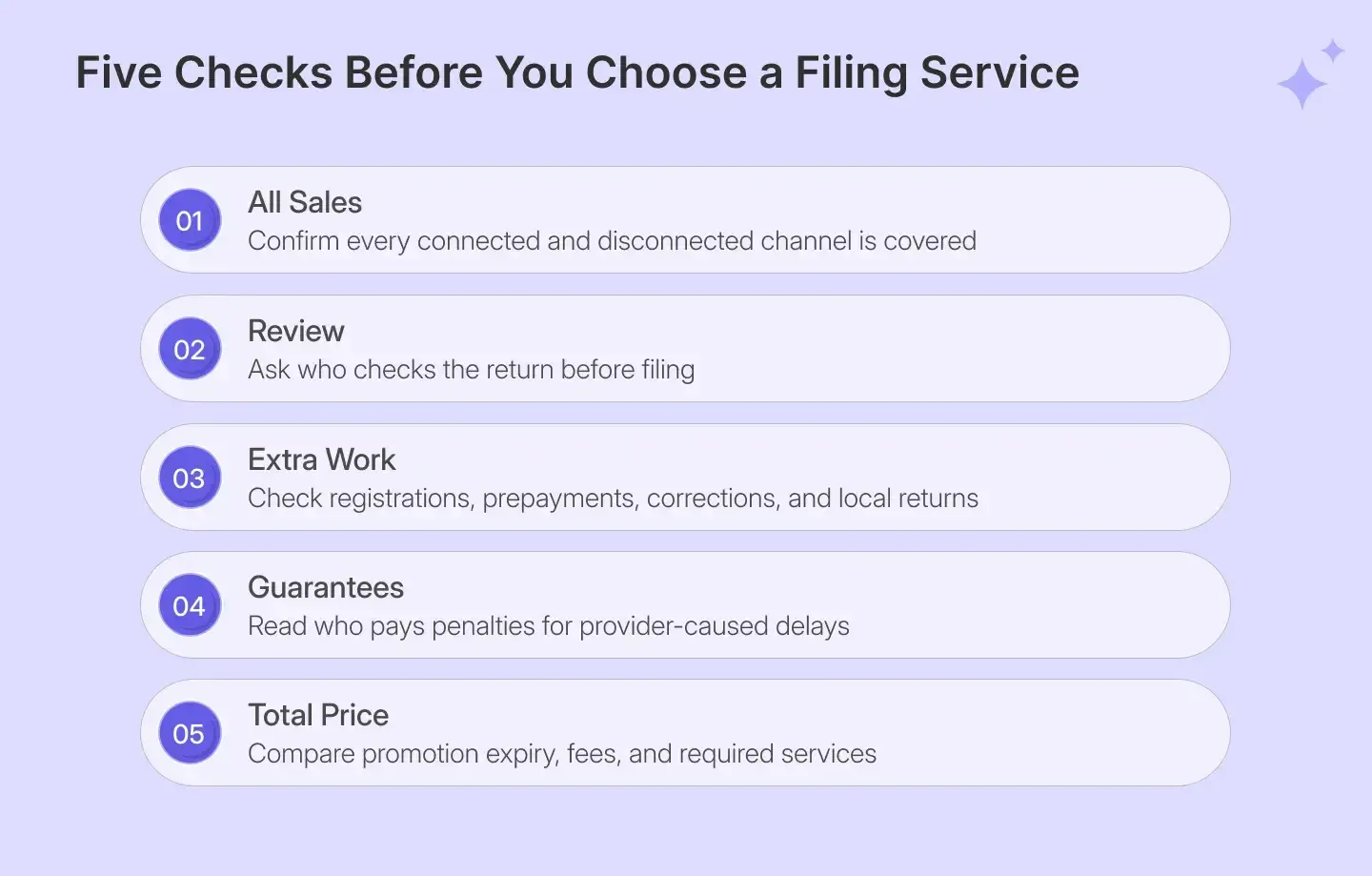
A good replacement should handle the returns Shopify previously filed while accounting for any additional sales tax responsibilities. Before choosing a service, check these five factors:
- Who reviews the return? Ask whether a tax expert checks the figures before filing and whether you can approve them.
- What sales are included? Check Shopify orders, marketplace transactions, wholesale invoices, refunds, and other sales channels.
- Who handles state requirements? Ask about registrations, local returns, tax prepayments, amendments, and exemption certificate management.
- Who answers state notices? Understand the available customer support and who is responsible for penalties for late filing.
- What will you pay? Compare the pricing structure, filing frequency, registration fees, and charges for extra work.
As your store grows, you may also need nexus monitoring. Economic nexus can arise when annual sales cross a state's sales threshold. Physical nexus may come from having a warehouse or other physical presence in that state. Nexus tracking helps you monitor economic nexus thresholds as sales volume increases in new states, so registrations and tax compliance are not missed.
Also, sales tax software and filing services do different jobs. For example, Stripe Tax can handle tax calculation, but that does not mean it files returns. Still, you need someone to file returns and pay the tax owed. The right Shopify automated filing alternative for your store depends on your tax obligations and the level of work the provider will handle.
6 Shopify Automated Filing Alternatives
You can file directly with each state, use a service that automates much of the process, or work with tax experts who manage the returns. The six options below cover these different approaches, starting with stores that have simpler filing needs.
1. File Sales Tax Returns Yourself
If you file only a few quarterly sales tax returns, handling them yourself could help you save on filing fees. Shopify Tax will continue providing sales reports, which you can use to prepare each state's return. You can then submit it through the state portal and pay the tax owed.
However, preparing a return involves checking more than the total sales shown in Shopify. You also need to account for refunds, tax-free orders, and marketplace sales where required. Each state has its own deadlines, and some require a return even when you have made no sales.
As your store grows, filing can take more time because you may need to include sales from other platforms. Opening another store or keeping inventory in a different state can also create additional reporting requirements. You will need to manage these filings and answer questions from state tax authorities.
Keep copies of your returns and payment confirmations so you can find them whenever needed. Our state filing guides explain the steps for different states
2. TaxCloud for Stores That Want Filing Automation
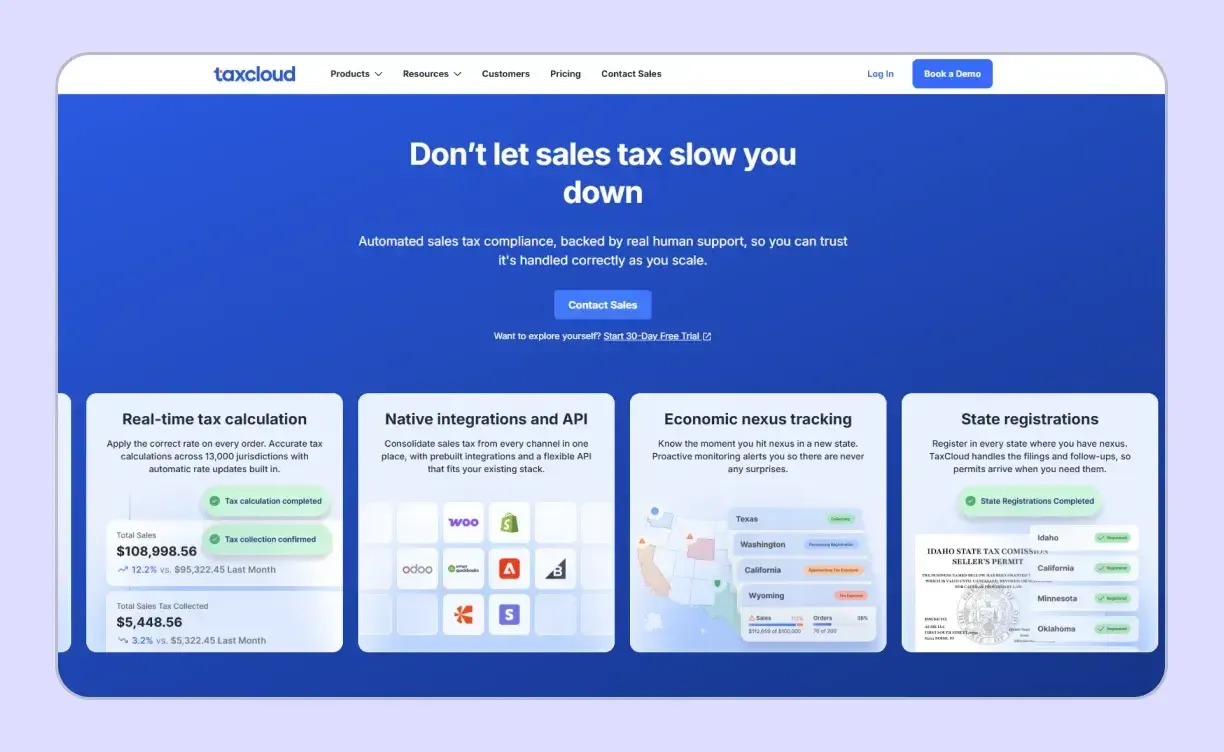
If preparing returns takes too much time, TaxCloud offers sales tax automation for online sellers. It connects Shopify with other ecommerce platforms and can use supported marketplace or accounting data. This feature reduces the information you need to prepare separately for each filing period.
Under its Shopify switching offer, TaxCloud charges $30 per filing and waives the Starter plan subscription fee. The offer runs through December 31, 2026, and includes help moving from Shopify. Outside that promotion, regular subscription pricing depends on the services and returns you need.
TaxCloud is approved as a certified service provider under the Streamlined Sales Tax (SST) program. This program is run by participating US states, which approve providers that meet their requirements for tax calculation and filing.
Because TaxCloud is an approved provider, eligible businesses can receive free registration and filing services in up to 24 participating SST states. However, eligibility depends on each state's rules, including whether your business has a physical presence there.
If you sell through Shopify and Amazon, TaxCloud can include relevant marketplace sales when those orders flow into Shopify. It also supports QuickBooks Online and other business systems, helping you consolidate sales information for filing.
TaxCloud offers a 30-day free trial, but the trial does not include filing returns. To use its filing service, you need to sign up for a paid plan or its Shopify switching offer. This allows TaxCloud to prepare and submit returns according to your filing schedule.
3. Kintsugi for Stores That Want Nexus Alerts and Filing
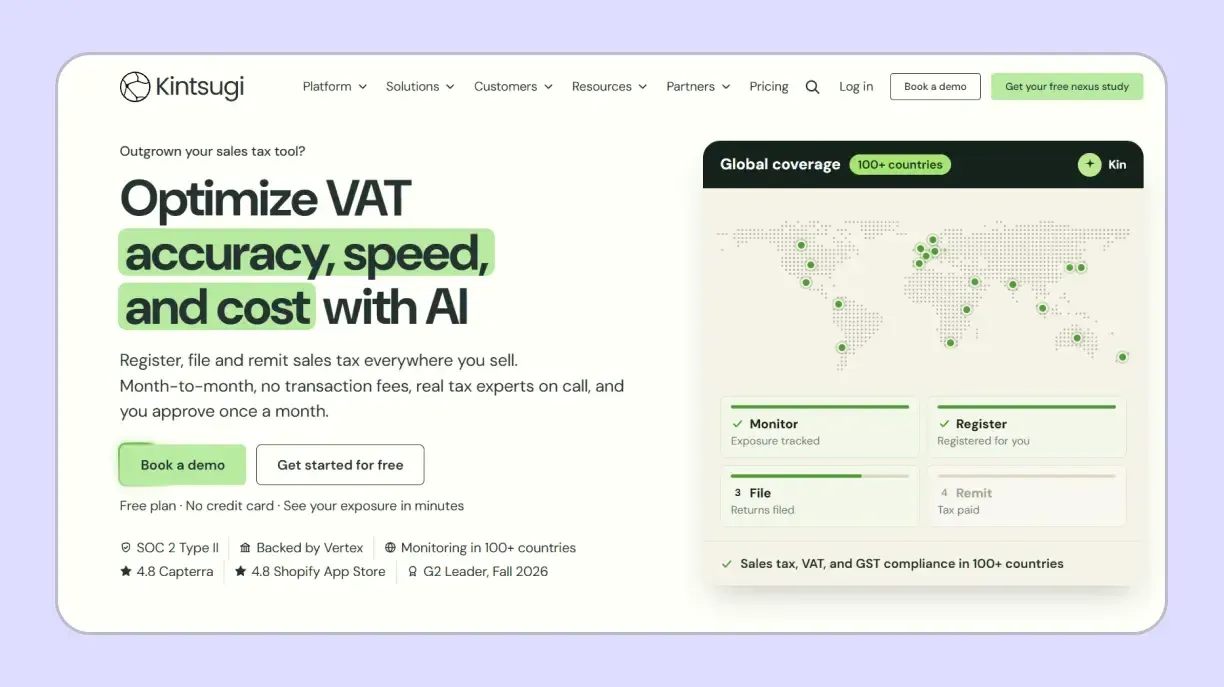
As your Shopify store grows, you may have to register for sales tax in new states. Kintsugi's sales tax platform offers free nexus monitoring across US states and other countries. When it identifies a possible obligation, you still need to confirm whether registration is required.
If a state requires registration, Kintsugi's Starter plan begins at $75 per filing or registration. It includes automated filing, payments, refunds, amendments, and basic exemption certificate management for eligible transactions. You also get a virtual mailbox to collect notices from states about your tax returns.
If you receive a notice from a state about an earlier return, Kintsugi's virtual mailbox can help you receive it. However, someone still needs to review the letter and respond to the state's questions. If the return contains an error, you may also need help correcting it.
Kintsugi offers dedicated account support and its filing guarantee through the Premium plan, which uses custom pricing. You should compare these services with the Starter plan to understand what help you will receive if a filing problem arises.
Its global tax compliance features may be useful for SaaS businesses, SaaS companies, and large enterprises. If your Shopify store files in only a few states, those additional services may be unnecessary. Choose your plan based on who will handle registrations, filing issues, and notices when they arise.
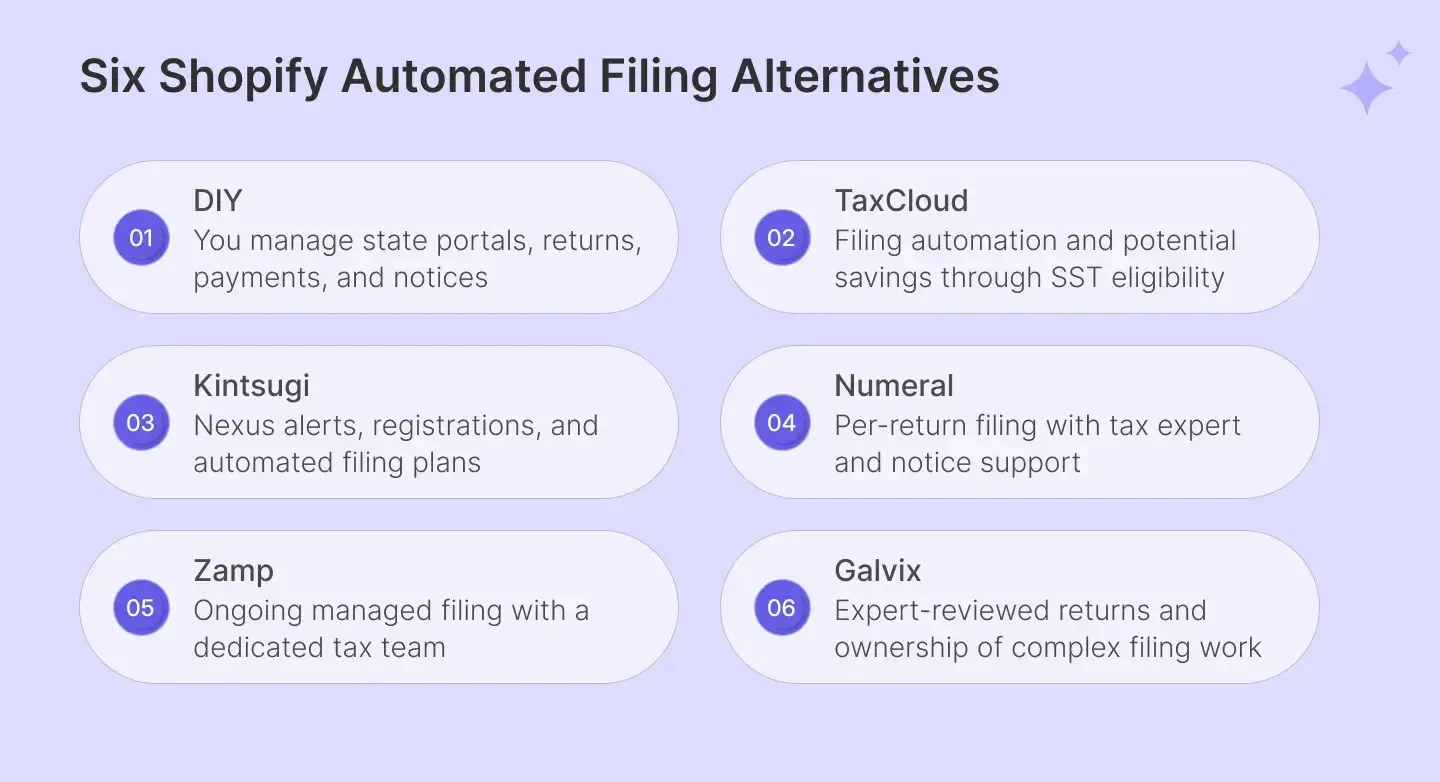
4. Numeral for Stores That Prefer Paying per Return
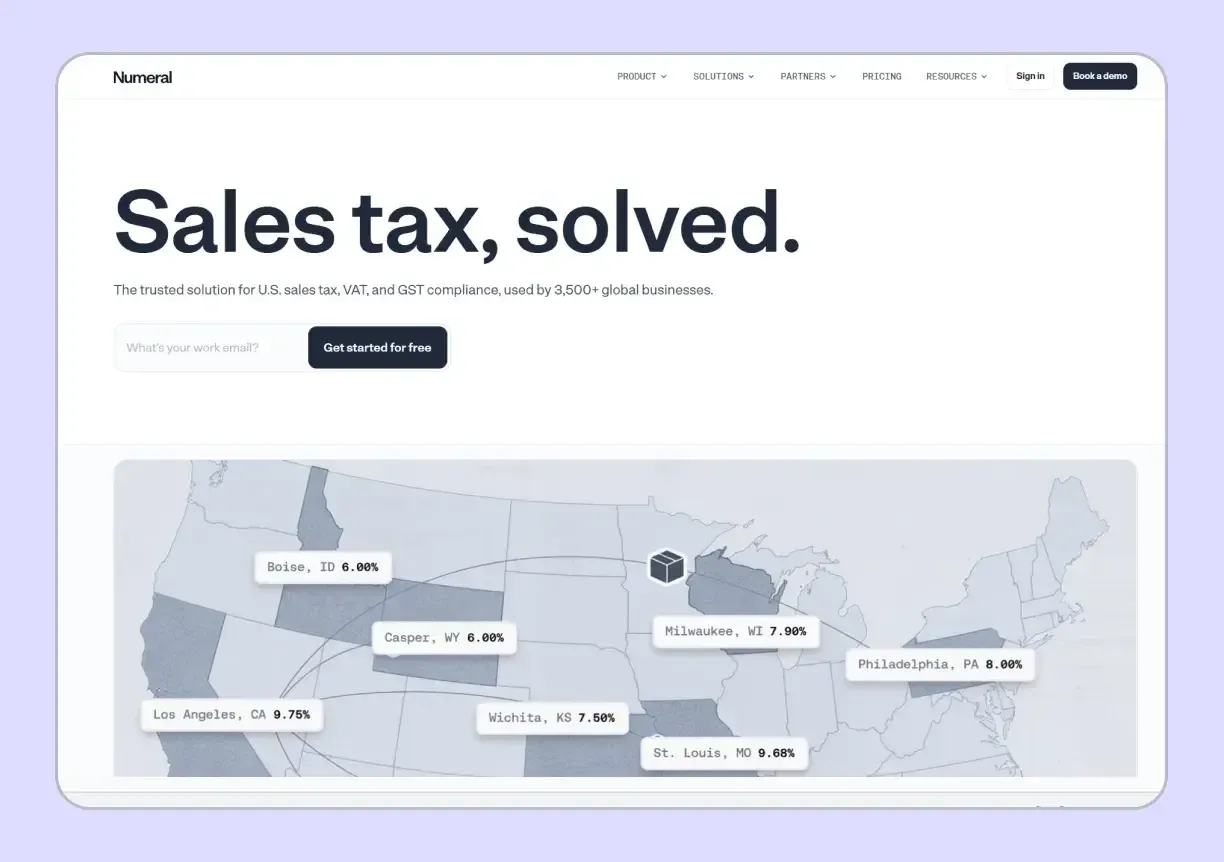
If you file sales tax quarterly in several states, Numeral lets you pay for each return. It connects with Shopify, Stripe, and Amazon to bring sales records into the filing process. Its service also covers nexus monitoring, registrations, payments, and support with state notices.
With Numeral's Shopify offer, you pay $50 per return for 12 months, instead of the usual $75. If you need to register in another state, the standard charge is $150 per registration. Numeral also offers a free nexus study to help identify where registration may be required.
The company also offers an on-time filing guarantee, although you must meet certain conditions. These include providing complete sales records, approving returns on time, and maintaining sufficient funds for payments.
While these services cover regular filings, you should also check what happens when something needs to be corrected. For example, amending an earlier return or resolving a notice regarding a Shopify-filed return may incur additional fees. Confirming these charges beforehand will help you understand the total cost of switching to Numeral.
5. Zamp for Stores That Want an Ongoing Tax Team
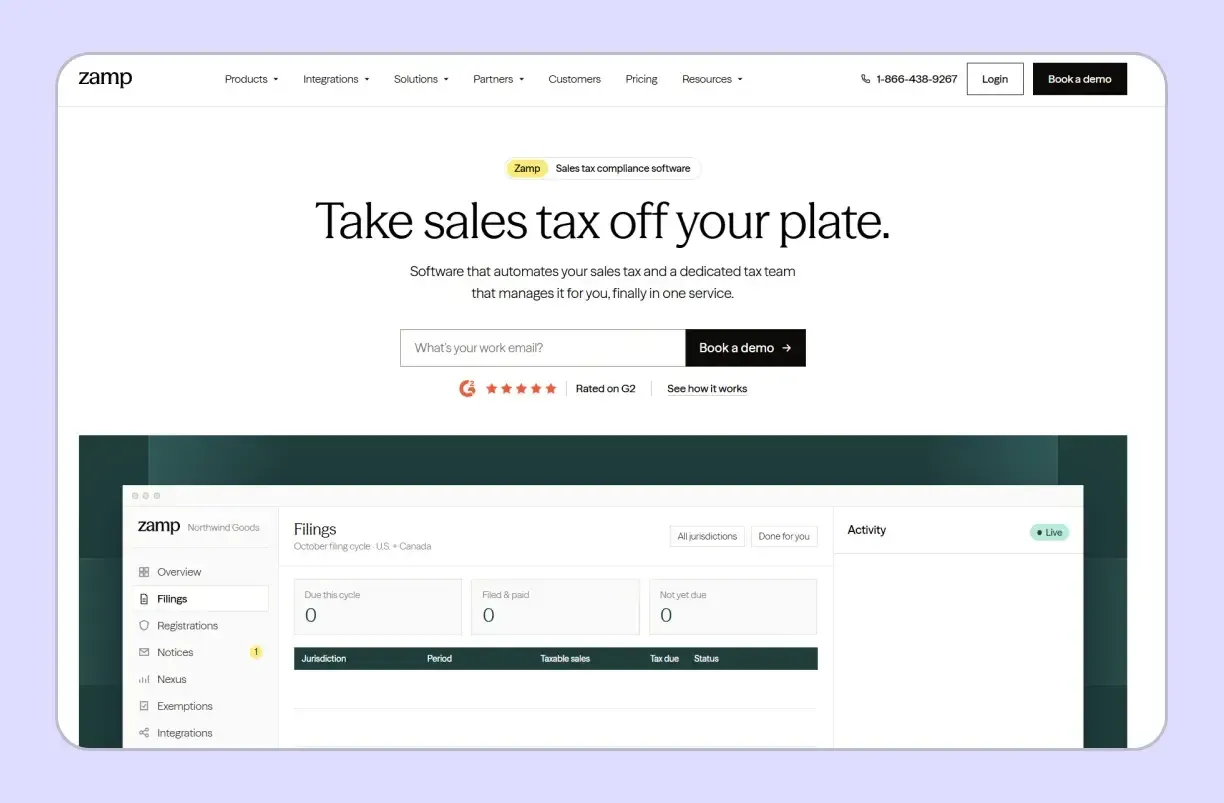
If you prefer having tax specialists manage your filings, Zamp offers a managed service for Shopify merchants. Its team handles registrations, state and local returns, payments, and notices throughout the year. When you switch from Shopify, Zamp also helps with setup and importing your previous filing records.
Under its Shopify switching offer, you get three free months if you sign up by January 31, 2027. After that, Zamp charges $45–$65 per state each month, regardless of your regular filing frequency. This can be useful if you file monthly and want ongoing support.
To prepare your returns, Zamp can work with refunds, marketplace sales, and transactions from subscription apps. It also supports nexus tracking, API connections, and sales tax calculations. If you already use another tax engine, check how Zamp will collect that information for filing.
Before choosing Zamp, confirm which services are covered by the monthly fee, including separate local returns. You should also understand who reviews each return and when you need to approve it. Zamp offers filing and accuracy guarantees, but they come with conditions you should review before signing up.
6. Galvix for Stores With More Complicated Returns

When your Shopify store files in 10 or more states, preparing accurate returns takes more work. Refunds may sit in one app, while wholesale orders are recorded in your accounting system. Different states may also require advance payments or separate local returns, each with its own deadline.
At Galvix, we take responsibility for bringing those records together and preparing your returns for filing. Our tax experts reconcile the sales figures and review every return before it reaches the state. You approve each return or choose automatic approval, while we handle filing and payment.
Our responsibility continues after filing, as states may later question the reported figures or payments. We handle notices about returns we filed without charging an additional notice-resolution fee. If our delay causes penalties or interest, we cover them when approvals and payment funds were available on time.
Before taking over, we confirm which sales sources and filing requirements your business needs us to handle. This includes checking whether local returns, prepayments, or amendments require additional work beyond regular filings. Our modular pricing structure lets us quote these services separately, so you know what is included.
If you are switching from Shopify, our Shopify filing offer is $39 per state or local return through 2027. Sign up by January 2027 for free setup, filing history import, and a 12-month health check in your top three states. There is no contract requirement.
How Much Do Shopify Filing Alternatives Cost for 10 and 25 States?
It is easier to compare prices when all services are assigned the same filing workload. Suppose your business files monthly in three states and quarterly in seven. That comes to 64 annual returns across 10 states. At 25 states, eight monthly and 17 quarterly, that means 164 annual returns.
The figures below use each provider's published Shopify offer where applicable. They are examples, not quotes for your business.
| Filing Option | 10 States: 64 Returns | 25 States: 164 Returns |
|---|---|---|
| File yourself | $0 provider fees | $0 provider fees |
| TaxCloud Shopify offer | $1,920 | $4,920 |
| Kintsugi Starter | From $4,800 | From $12,300 |
| Numeral Shopify offer | $3,200 | $8,200 |
| Zamp Shopify offer | $4,050–$5,850 | $10,125–$14,625 |
| Galvix Shopify offer | $2,496 | $6,396 |
These illustrative figures use published November 2026 rates.

Which Shopify Filing Service Fits Your Business?
The right Shopify automated filing alternative differs for a store filing four returns a year and one filing dozens every month. Start with how many returns need attention, where the sales come from, and what you still want to manage yourself.
You File in a Few States
If you sell through one store and file quarterly in only two or three US states, direct filing may be possible. You can also compare TaxCloud, Kintsugi, Numeral, and Zamp if you want help with those returns. Find out what each service will file and whether you still have to check and approve the figures.
You File in 10 or More States
A growing store may have different due dates, local tax rules, and periods with no sales that still require a return. A managed service can take this recurring work off your schedule. Galvix, Numeral, and Zamp all offer forms of managed support. Ask who reviews each return, who handles notices, and how approvals work.
Your Shopify Store Has Multiple Sales Channels
You may sell products through Shopify, send wholesale invoices using QuickBooks Online, and receive subscription payments through Stripe. Your filing provider needs to bring these sales together before preparing your returns. If you also sell on Amazon, some states may require you to report those sales even when Amazon collects the tax.
Check whether the provider can include sales from all these platforms and whether API access or ERP integrations cost extra. You should also ask how refunds and tax-free orders are handled, so your returns include the correct sales figures.
How Galvix Manages Your Shopify Sales Tax Filing
Switching from Shopify means finding someone who can handle your future sales tax returns without missing any deadlines. At Galvix, we first check which returns Shopify will file and confirm when we need to take over. We also review your filing records before starting the work.
Once we take over, our tax experts prepare and review every return using your sales records. You can approve each return or choose automatic approval, while we handle filing and payment. If a state sends a notice about a return we filed, our team handles it.
If you sell on multiple platforms or need separate local returns, we check those requirements in advance. We explain which services are included in the Shopify offer and which will cost extra. Book a free call with our team to discuss your filing requirements and plan the switch.
FAQs
What Is the Best Sales Tax Filing Service for Shopify?
There is no single best service for every Shopify business. If you have only a few quarterly returns, paying per filing or filing yourself may work. If you have many states and complex sales, compare expert reviews, reporting coverage, state notices, and who is responsible for delays.
Does Shopify Still Have Automated Sales Tax?
Shopify Tax will continue sales tax calculations at checkout and provide reports. What ends is Shopify's automated return preparation, filing, and remittance service after the final eligible periods. You can keep Shopify Tax and use another provider for the returns.
Does Shopify Handle Sales Tax Filings After 2026?
Shopify completes final eligible filings in 2027 for the last periods it covers. Most end with December 2026 sales. New York quarterly filings are an exception and include January and February 2027. You need another filing arrangement for later periods.
Which Shopify Tax Automation Tool Is Best for Small Businesses?
If you run a small Shopify store and file in only a few states, TaxCloud or Numeral may suit your needs. TaxCloud offers automated filing, while Numeral provides expert-reviewed returns with per-return pricing. Kintsugi is another option if you also need nexus monitoring as your business grows. The best option depends on how often you file and how much of the work you want the provider to handle.