
A state sales tax exemption certificate explains why a seller did not collect tax on an otherwise taxable transaction. The purchaser supplies the document, while the seller reviews and retains it. Missing, incomplete, or unsuitable evidence can leave the seller responsible for tax, interest, penalties, and avoidable audit work.
The United States has no single document covering every type of exemption across different states. Each jurisdiction establishes its own rules for forms, registration numbers, renewal periods, verification methods, and future purchases involving resellers, manufacturers, government agencies, or other exempt customers.
This guide helps businesses identify the relevant sales tax exemption certificate by state, understand what can be checked online, compare renewal and out-of-state requirements, and navigate the complete jurisdiction directory. It also explains how Galvix manages certificate collection, review, renewal follow-up, audit documentation, and related sales tax obligations.

What Is a State Sales Tax Exemption Certificate?
A state sales tax exemption certificate documents why a qualifying purchaser can complete an exempt sale without seller-collected tax. The correct exemption certificate form depends on the sourcing jurisdiction, purchaser identity, intended use, purchased goods, and the type of exemption permitted under state law.
Exemption Certificates and Resale Certificates Serve Different Purposes
Highlight:
Exemption Certificate: Documentation supporting a non-resale exemption, such as nonprofit, government, manufacturing, agricultural, direct-pay, or another state-authorized purchase.
Resale Certificate: A buyer’s statement that goods are purchased for resale rather than business or personal use, allowing the seller to exclude tax from the qualifying purchase.
These records support different legal and operational purposes, so businesses should classify them correctly before approving any exempt tax treatment.
- A state sales tax exemption certificate can support manufacturing, agriculture, government use, direct payment, or another state-authorized sales tax exemption.
- A resale certificate supports taxable goods purchased for resale rather than consumption by the purchasing type of business.
- A sales tax permit authorizes collection and filing, while a certificate explains why tax was excluded from one transaction.
- A reseller permit or exempt-entity number may support eligibility without replacing additional requirements for transaction documentation.
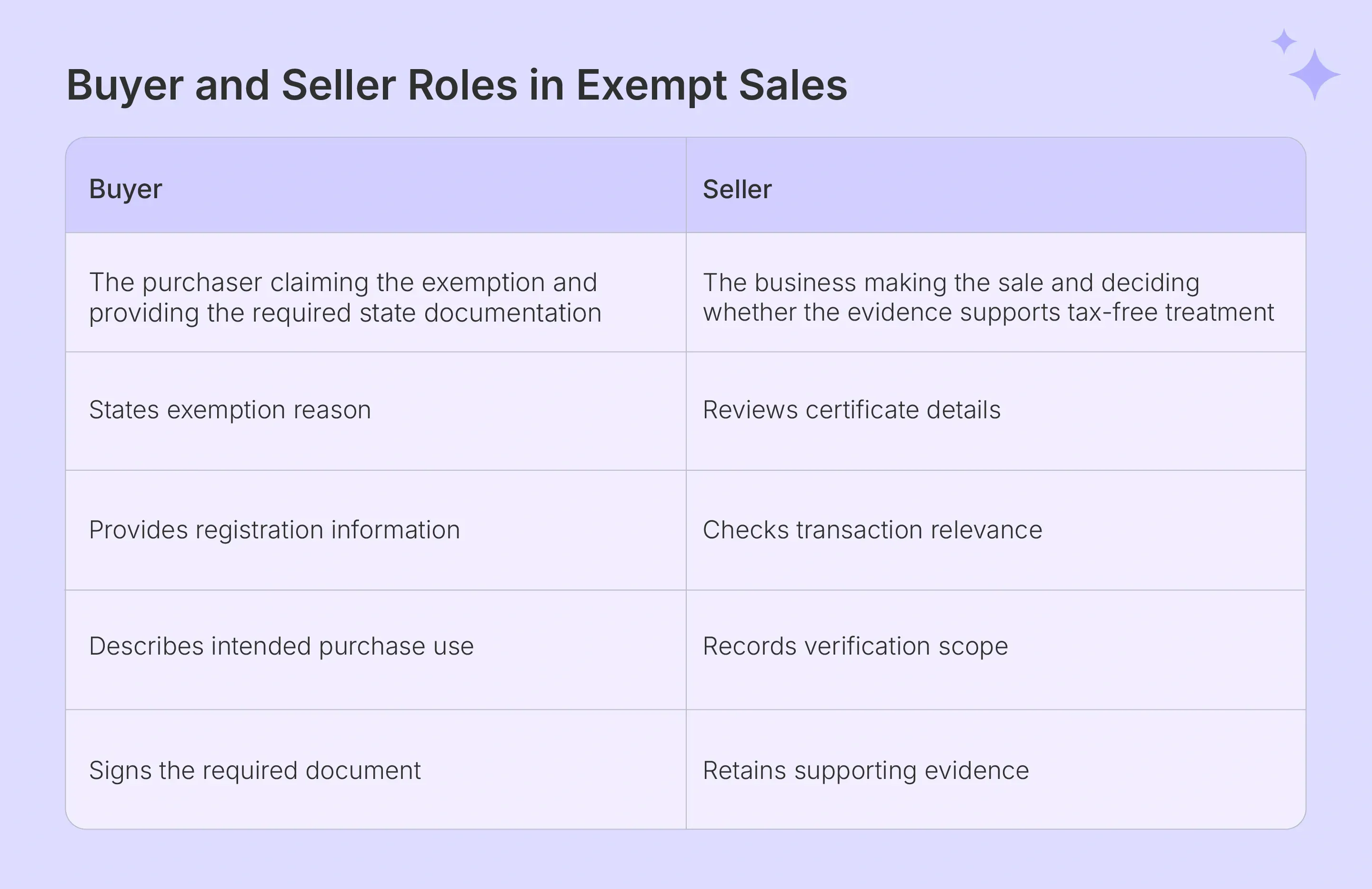
Buyers and Sellers Carry Different Responsibilities
The purchaser provides accurate supporting information, while the seller decides whether that evidence reasonably supports the proposed tax-free treatment.
- Buyers should provide the required form, identification number, exemption reason, signature, and description of goods requested by the jurisdiction.
- Sellers should review documentation before approving exempt transactions and retain records for examination by the relevant state tax authority.
- The claimed exemption should align with the purchaser’s name, business activities, purchased products, and stated purpose.
- Federal recognition does not automatically establish tax exemption for nonprofits, educational institutions, or other exempt entities across every state.
- A successful lookup does not establish transaction eligibility when the certificate contains incorrect information or conflicts with the purchase.
Also Read: 12 Best Sales Tax Software for the US
Why Do Exemption Certificate Rules Vary by State?
Every jurisdiction controls its own exemption categories, accepted evidence, registration standards, validity rules, and verification methods. A properly completed state sales tax exemption certificate accepted for resale may still fail when another state requires separate certificates, local registration, or purpose-specific evidence for the same transaction.
States Use Different Forms for Different Exemptions
States may prescribe different documents for resale, manufacturing, agriculture, contractors, government entities, and other industry-specific purchases. California uses CDTFA-230 for resale while maintaining purpose-specific forms for manufacturing and agricultural transactions.
New York also uses separate forms for resale, exempt use, nonprofit purchasers, government buyers, and project-based claims. This approach requires sellers to match each state sales tax exemption certificate with the purchaser and transaction rather than relying on one generic form.
Identification and Verification Requirements Differ
Many documents request a state registration number, exemption ID, permit reference, seller’s name, or other purchaser information. Some states accept home-state registration, while others require local registration before approving the resale exemption.
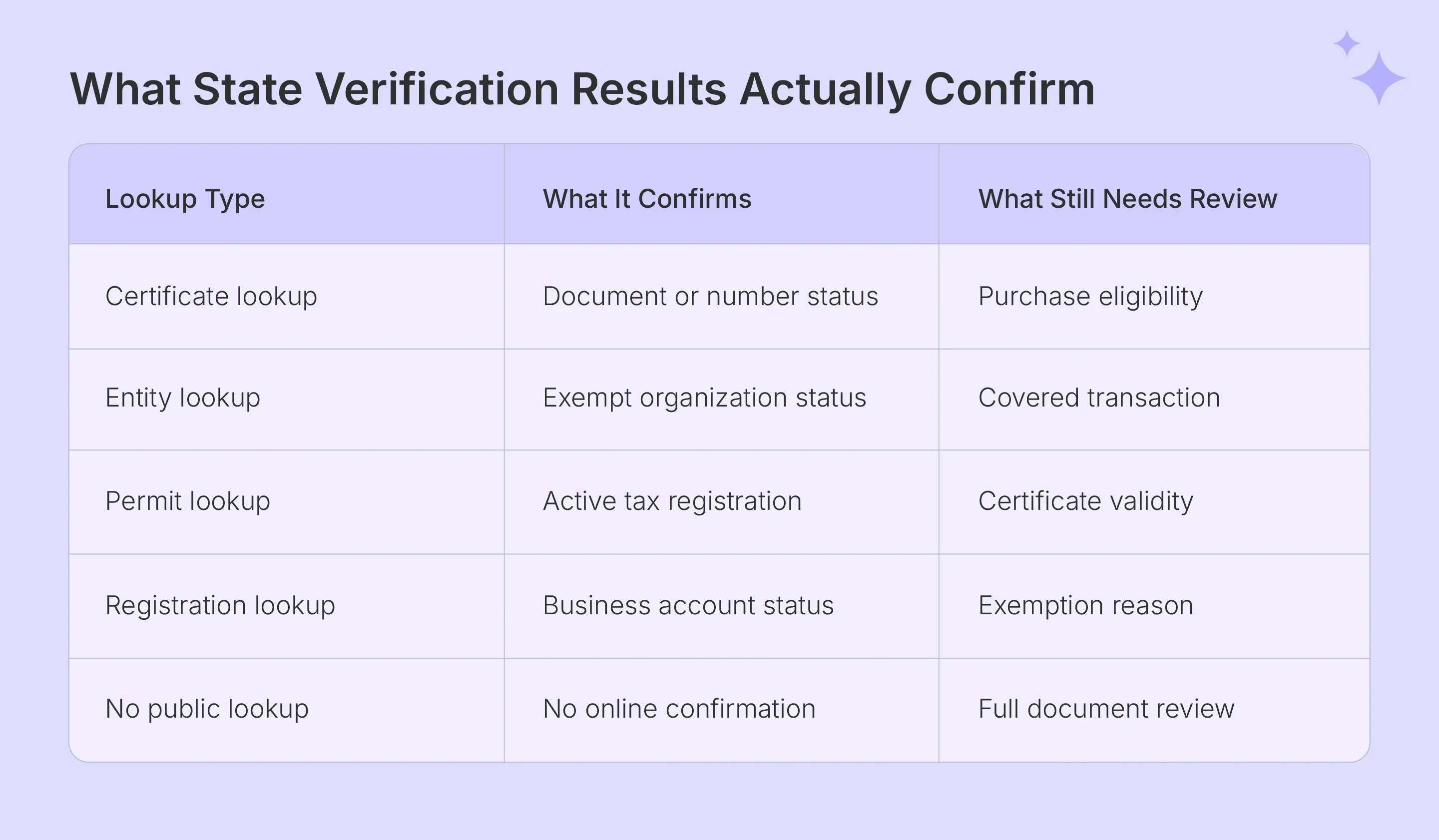
A permit check confirms that an account exists or remains active. It does not prove that the tax exemption certificate is complete, applicable, or connected with the transaction being reviewed.
Validity and Renewal Periods Are Not Uniform
Some certificates expire annually, while others follow a fixed expiration period or remain effective until revoked. A document may also become unusable when ownership, registration, address, purchasing activity, or exemption circumstances change.
Businesses should track validity at the document level because one state may apply different timelines across its certificate categories. Renewal should occur before the end of the period supporting future exempt purchases.
Online Verification Capabilities Differ
Several jurisdictions provide certificate-level, reseller-permit, or exempt-entity lookups. Others confirm only registration status, while many provide no relevant public verification process.
Sellers should record what the lookup confirmed, when it occurred, and which official source produced the result. One universal “verified” label can obscure the difference between account status and a valid exemption certificate.
Out-of-State Acceptance Is Often Conditional
A state may accept home-state registration, an MTC certificate, an SST certificate, or its own destination-state form. Each route follows specific requirements concerning the purchaser, delivery location, product, and claimed exemption.
Acceptance should never be reduced to a simple yes-or-no field. The state’s tax authority may require additional evidence, local registration, or another certificate of exemption before recognizing the transaction.
Which Multistate Exemption Certificate Can Businesses Use?
Multistate documents reduce repeated paperwork when buyers make exempt purchases across participating jurisdictions. They do not create universal coverage because every state retains its own rules concerning identification, registration, purchaser eligibility, and the permitted types of sales.
Streamlined Sales Tax Exemption Certificate
The Streamlined Sales Tax certificate supports qualifying transactions across 24 participating jurisdictions. The group includes 23 full member states, while Tennessee remains the only associate member under the current program structure.
Buyers must still select the correct exemption reason and provide the information required by each participating state. Streamlined membership does not mean every registration number, product category, or exemption request receives identical treatment.
MTC Uniform Sales and Use Tax Resale Certificate
The Multistate Tax Commission developed a uniform document that 36 states indicate can support qualifying resale transactions. The form also covers certain ingredients or components incorporated into products intended for resale.
Acceptance remains subject to state instructions and limitations. Businesses should use the current form, confirm registration conditions, and contact the relevant department of revenue when eligibility remains uncertain.
When a State-Specific Certificate Is Still Required
Multistate documentation cannot replace every certificate required for manufacturing, agriculture, nonprofit use, contractors, direct-pay arrangements, or state government purchases. Purpose-specific forms often contain questions addressing the exact statutory conditions behind the exemption.
Raw materials, machinery, livestock feed, and contractor purchases may follow separate qualification tests. Sellers should use the state-specific document whenever the jurisdiction requires one for that transaction or purchaser category.
Also Read: 2026 Guide to Navigating SaaS Sales Tax
What Can Sellers Verify Online in Each State?
Online verification should be recorded as a separate control rather than a universal certificate status. Galvix’s July 2026 research groups the 46 sales-tax jurisdictions according to whether official tools confirm certificates, entities, permits, registrations, or no public result.
| Verification Category | Jurisdictions | What the Result Generally Means |
|---|---|---|
| Broad certificate-level status lookup | 7 | The state offers wider lookup coverage across resale and entity certificate or permit categories, although outputs differ by jurisdiction. |
| Partial certificate or entity verification | 6 | The tool may confirm a resale document, entity exemption, or account number without covering every exemption category. |
| Permit, license, or registration only | 17 | The result confirms an active account or registration without validating the submitted sales tax exemption certificate. |
| No relevant public online lookup | 16 | Sellers may need document review, state contact, or good-faith acceptance supported by the jurisdiction’s specific requirements. |
Even certificate-level lookup does not establish that the buyer, product, intended use, transaction date, or claimed exemption qualifies under applicable law.
Which Renewal Patterns Require Different Controls?
Online verification answers only one part of the compliance question. Businesses must also understand how long each document remains effective and what event triggers replacement. A state may use different renewal rules for resale, entity, manufacturing, or agricultural certificates.
Galvix research shows four broad renewal patterns that require different tracking methods.
| Renewal Pattern | State Examples | What Businesses Should Track |
|---|---|---|
| Annual or short-cycle certificates | Alabama STE-1, District of Columbia OTR-368, Florida DR-13, and Louisiana resale documentation | Send renewal requests before the next certificate period begins and keep tax applied when updated documentation remains unavailable. |
| Fixed multi-year validity | Connecticut three-year blanket certificates, Iowa three-year certificates, Michigan four-year blanket certificates, and Washington two-year or four-year permits | Record the exact expiration date instead of applying one standard renewal date across every customer. |
| Effective until revoked or changed | California, Georgia, Minnesota, and Texas use continuing validity for common certificate routes | Monitor ownership, registration, address, business activity, and exemption-purpose changes that may end continued reliance. |
| State-issued or permit-led documentation | Maine issues resale certificates, Washington issues reseller permits, and Mississippi relies on the purchaser’s permit number | Confirm that the state-issued document or underlying permit remains active before approving future exempt transactions. |
How Do State Certificate Requirements Compare?
State requirements differ across document type, renewal method, multistate acceptance, online verification, and local administration. The regional directory below identifies the primary rules for every jurisdiction, while the table first highlights state systems that require a distinct operational approach.
Which State Systems Need Special Handling?
Several jurisdictions do not fit the standard model of a buyer completing one resale certificate and leaving it effective indefinitely. These structural differences should influence how businesses configure collection, review, and renewal workflows.
| State System | Relevant Jurisdictions | Why the Process Differs |
|---|---|---|
| No general statewide sales tax | Alaska, Delaware, Montana, New Hampshire, and Oregon | A standard state resale certificate may be unnecessary, although local taxes, selective taxes, or out-of-state purchases can still require documentation. |
| Gross receipts tax structures | Hawaii and New Mexico | Businesses use documentation supporting general excise tax or gross receipts tax treatment rather than conventional retail sales tax exemptions. |
| State-issued or permit-based resale routes | Maine, Mississippi, and Washington | The purchaser may rely on a state-issued certificate, reseller permit, or tax permit number instead of a standard buyer-created form. |
| Annual certificate cycles | Alabama, District of Columbia, Florida, and Louisiana | Businesses need scheduled renewal outreach rather than waiting for purchaser details or exemption circumstances to change. |
| Local or home-rule administration | Alaska, Colorado, and Louisiana | State-level guidance may not address every locally administered requirement, verification process, or documentation rule. |
| Purpose-specific form systems | California and New York | Resale, manufacturing, agriculture, nonprofit, contractor, and exempt-use purchases can require separate named forms. |
Northeast State Certificate Directory
Northeastern jurisdictions combine state-specific forms, multistate acceptance, fixed renewal periods, and limited online verification. Sellers should confirm every state sales tax exemption certificate against official instructions before changing customer tax settings.
| State | Relevant Certificate Guidance |
|---|---|
| Connecticut | Connecticut uses a state resale certificate and purpose-specific CERT forms. Blanket documentation remains valid for three years, while no public certificate or permit verification tool is available. |
| Maine | Maine issues resale certificates to qualifying retailers and accepts the MTC form under stated conditions. New certificates may remain valid for five years, with renewals commonly following four-year periods. |
| Massachusetts | Massachusetts uses Form ST-4 for resale and separate documentation for exempt use or organizations. Certificates remain effective until revoked, while online checks confirm registration rather than the completed form. |
| New Hampshire | New Hampshire has no general sales tax and issues no standard state resale or exemption document for ordinary retail transactions. |
| New Jersey | New Jersey uses Form ST-3, participates in SST, and accepts qualifying MTC documentation. Online tools verify business registration without confirming the completed certificate. |
| New York | New York uses ST-120 for resale and separate forms for exempt use, organizations, contractors, and government buyers. Its vendor lookup confirms registration only. |
| Pennsylvania | Pennsylvania uses Form REV-1220 and conditionally accepts MTC documentation. Certificates remain valid until circumstances change, while no real-time public certificate lookup is available. |
| Rhode Island | Rhode Island participates in SST and conditionally accepts MTC documentation. Resale certificates remain effective until revoked, while entity approvals may require periodic renewal. |
| Vermont | Vermont uses Form S-3 for resale and separate documents for agriculture, manufacturing, and contractors. Certificates remain valid until revoked, with no public online lookup. |
Southern States and District of Columbia Certificate Directory
Southern jurisdictions include annual certificates, permit-based systems, SST participants, and states offering broader certificate verification. Each state sales tax exemption certificate should be reviewed against its current form and renewal instructions.
| State | Relevant Certificate Guidance |
|---|---|
| Alabama | Alabama uses a sales tax license for resale and Form STE-1 for qualifying entities. STE-1 follows an annual renewal cycle, while My Alabama Taxes provides partial account-number verification. |
| Arkansas | Arkansas uses Form ST-391 and participates in SST. Certificates remain valid until revoked, although blanket documentation may lapse after 12 months without qualifying purchases. |
| Delaware | Delaware has no state or local retail sales tax and instead applies gross receipts tax to sellers. A standard exemption document is therefore unnecessary. |
| District of Columbia | The District uses OTR-368 for resale and separate forms for entities or contractors. Resale certificates renew annually, while the public portal offers broad certificate-level lookup. |
| Florida | Florida issues DR-13 at the end of each calendar year for the following period and DR-14 to qualifying entities. Its tool provides broad certificate-level verification. |
| Georgia | Georgia uses ST-5, ST-4, and ST-5M and remains a full SST member. Certificates remain valid until revoked, while selected programs follow separate renewal cycles. |
| Kentucky | Kentucky uses Form 51A105 and participates in SST. Certificates have no stated general expiration, while the state provides no public certificate or permit lookup. |
| Louisiana | Louisiana uses R-1064 for resale and separate purpose-specific forms. Resale documents renew annually, while LaTAP provides partial resale-certificate verification. |
| Maryland | Maryland accepts signed resale documentation containing a state registration number and issues entity certificates. Entity status can be checked online, while out-of-state resale documents are generally rejected. |
| Mississippi | Mississippi relies on the buyer’s sales tax permit number rather than a traditional resale form. Blanket certificates are unavailable, while online tools confirm permit status. |
| North Carolina | North Carolina uses E-595E, participates in SST, and accepts MTC documentation. Certificates have no fixed expiration, while online tools support registration and exemption-number checks. |
| Oklahoma | Oklahoma uses permit-based resale documentation and SST certificates. Documents commonly follow an approximate three-year cycle, while OkTAP verifies permits rather than certificates. |
| South Carolina | South Carolina uses Form ST-8A and other purpose-specific forms. Certificates have no stated expiration, while MyDORWAY verifies a retail license instead. |
| Tennessee | Tennessee issues a blanket resale certificate and remains the SST associate member. Resale documentation continues until business details change, while selected entity certificates renew every four years. |
| Texas | Texas uses Form 01-339 for resale and other exemptions. Certificates have no stated expiration, while public tools confirm permits or entity status instead. |
| Virginia | Virginia uses ST-10 for resale and separate forms for manufacturing, nonprofits, and government purchasers. Resale documentation remains valid until revoked, with no public certificate lookup. |
| West Virginia | West Virginia uses SST Form F0003 for resale and other exemptions. Documentation remains valid during an active purchasing relationship, while public online verification is unavailable. |
Midwest State Certificate Directory
Midwestern states often combine SST participation with multipurpose certificates and continuous validity. Each state sales tax exemption certificate requires accurate customer mapping because online tools frequently confirm registrations rather than completed documents.
| State | Relevant Certificate Guidance |
|---|---|
| Illinois | Illinois uses CRT-61 for resale, ST-587 for manufacturing or agriculture, and E-number records for entities. Online tools provide partial business and exempt-entity checks. |
| Indiana | Indiana uses ST-105 and participates in SST. Certificates have no fixed expiration and remain effective until circumstances change, while no public verification tool exists. |
| Iowa | Iowa uses Form 31-014a and participates in SST. Certificates remain valid for up to three years, while online searches confirm registration instead of certificate validity. |
| Kansas | Kansas uses ST-28A and other ST-28 forms while participating in SST. Resale certificates remain effective during recurring relationships, while entity documents carry separate expiry dates. |
| Michigan | Michigan uses Form 3372 and accepts MTC and SST certificates. Blanket documentation may remain valid for four years, while no public verification tool is available. |
| Minnesota | Minnesota uses Form ST3 and participates in SST. Certificates remain valid until revoked or information changes, while no public online verification is available. |
| Missouri | Missouri uses Form 149 and conditionally accepts MTC documentation. Certificates remain continuing, while online tools confirm registration rather than the document itself. |
| Nebraska | Nebraska uses Form 13 and accepts MTC and SST documentation. Blanket certificates remain valid until revoked, while no public certificate lookup is available. |
| North Dakota | North Dakota uses SFN 21950 and participates in SST. Certificates have no fixed general expiration, while online tools confirm permits rather than completed forms. |
| Ohio | Ohio uses STEC B and STEC U while participating in SST. Certificates have no stated general expiration, while public information covers vendor licenses instead. |
| South Dakota | South Dakota uses the SST Certificate of Exemption. Documentation remains effective until information changes, while no public verification tool is available. |
| Wisconsin | Wisconsin uses Form S-211 and participates in SST. Continuous certificates remain valid until revoked, while no public certificate or exemption-number lookup exists. |

Western State Certificate Directory
Western jurisdictions include states without retail sales tax, gross receipts tax systems, and state-issued reseller permits. The correct state sales tax exemption certificate depends on the jurisdiction’s distinct tax structure.
| State | Relevant Certificate Guidance |
|---|---|
| Alaska | Alaska has no statewide sales tax. Local governments and the Alaska Remote Seller Sales Tax Commission establish applicable documentation and renewal requirements. |
| Arizona | Arizona uses Form 5000A for resale and other 5000-series forms. Certificate periods may extend 48 months while remaining tied to an active TPT license. |
| California | California uses CDTFA-230 for resale and separate forms for manufacturing or agriculture. Permit lookup does not validate the completed certificate. |
| Colorado | Colorado uses DR 5002 and accepts MTC documentation. Entity certificates may have no fixed expiration, while resale authority follows the state license. |
| Hawaii | Hawaii applies general excise tax rather than conventional retail sales tax. Forms G-17, G-18, and G-19 support qualifying transactions, while online tools confirm licenses. |
| Idaho | Idaho uses ST-101 and conditionally accepts MTC documentation. Certificates remain valid until revoked, while online tools verify permits rather than completed documents. |
| Montana | Montana has no general statewide sales tax. Standard resale or exemption certificates are unnecessary, although selective taxes may still apply. |
| Nevada | Nevada uses TAX-F005 and participates in SST. Certificates remain valid until revoked, while online tools verify permits rather than submitted documents. |
| New Mexico | New Mexico uses Nontaxable Transaction Certificates for gross receipts tax deductions. The NTTC type must match the deduction, while no public lookup exists. |
| Oregon | Oregon has no general state sales tax. Oregon businesses may still need resale documentation when making qualifying purchases in other jurisdictions. |
| Utah | Utah uses TC-721 and participates in SST. Certificates remain valid until revoked, while online tools confirm registration instead of certificate validity. |
| Washington | Washington issues reseller permits rather than relying exclusively on buyer-completed forms. Permits remain valid for four years, or two years for selected businesses. |
| Wyoming | Wyoming uses the SST Certificate of Exemption. Certificates remain valid until revoked, while no public online verification tool is available. |
Also Read: Guide to California Economic Nexus Law
Why Should Complexity and Audit Exposure Be Reviewed Separately?
A simpler certificate process does not always produce lower financial exposure. Administrative complexity measures form volume, renewal effort, verification access, blanket-certificate use, out-of-state acceptance, and penalty severity. Exposure estimates what rejected documentation could cost under a defined sales scenario.
| State | Complexity Score | Illustrative Exposure per $1 Million Exempt Sales | What the Comparison Shows |
|---|---|---|---|
| North Carolina | 12.3 | $6,935 | The lowest-complexity jurisdiction still requires accurate exemption selection and supporting transaction evidence. |
| Colorado | 17.7 | $4,379 | Lower administrative burden aligns with the lowest modeled state-level exposure in the dataset. |
| Washington | 17.1 | $10,205 | A state-issued reseller permit simplifies administration, although rejected documentation can still create significant liability. |
| Louisiana | 56.3 | $9,075 | Annual processes, local administration, form requirements, and limited verification contribute to the highest complexity score. |
| Rhode Island | 42.4 | $11,480 | Higher administrative burden combines with the largest modeled exposure in the research. |
The exposure model assumes that 10% of $1 million in exempt sales is disallowed. It uses state base rates and the dataset’s penalty, interest, and audit-lookback assumptions. The figures exclude local taxes, waivers, cure rights, settlements, and other case-specific factors.
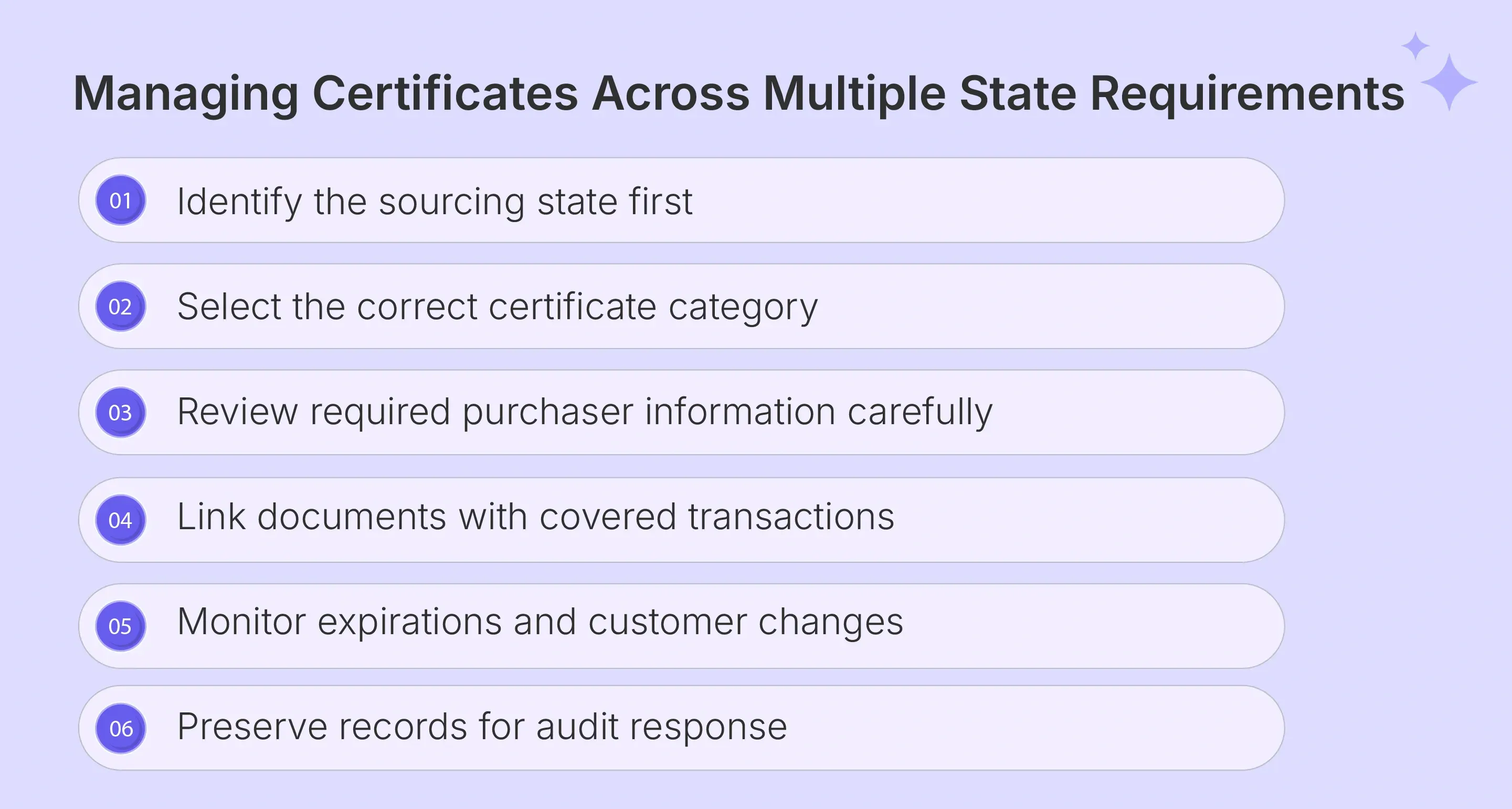
- Collect Before Approval: Request the required form before the point of sale or before approving the customer’s first tax-free invoice.
- Review State Requirements: Confirm required fields, registration numbers, exemption reasons, form acceptance, and whether documentation covers recurring or single transactions.
- Connect Records to Transactions: Match the purchaser’s name, legal entity, state, invoices, purchased products, and exemption category across connected systems.
- Monitor Changes and Renewals: Track ownership changes, permit updates, expiration dates, address revisions, and replacement triggers before the end of each validity cycle.
- Prepare for Audits: Maintain searchable evidence showing which valid certificate supported each transaction and what state verification or review occurred.
This process should also connect with sales tax nexus controls because economic nexus conditions can change registration duties. Economic nexus totals remain relevant even when a large portion of revenue involves exempt customers.
How Does Galvix Manage State Exemption Certificates?
Understanding the state requirement is the first step. Businesses must then collect the correct document, review submitted details, monitor renewal rules, connect certificates with customer records, and retrieve evidence when a state questions an exempt transaction.
Galvix consolidates these tasks through its state sales tax exemption certificate management module. Customers submit documents through a structured process, while specialists review information, organize records, identify missing details, and manage follow-up before documentation expires.
Businesses can combine certificate management with nexus monitoring, tax determination, state registrations, return preparation, and notice management. Galvix pricing remains modular, so customers select required services while exact pricing reflects each module’s work volume.
How Galvix Manages Multi-State Certificates
Galvix manages exemption certificates for tax-exempt customers, including resellers, nonprofit organizations, government entities, and other qualifying buyers. We collect each document, review whether it is completed correctly, store it with the right customer account, and follow up before expiration so records remain ready when an audit or compliance review begins.
The process follows five steps that keep certificate handling consistent across customers, jurisdictions, and renewal cycles.
- Certificate Collection: We request exemption and resale certificates from qualifying buyers through a structured process. This helps reduce inconsistent customer outreach and keep each document connected with the correct customer account from the beginning.
- Document Review: Our specialists check required fields, registration details, signatures, dates, and exemption reasons. They identify missing information or unclear claims before the certificate is accepted and stored within the customer record.
- Secure Record Storage: We store each certificate with the relevant customer account and supporting details, giving finance teams a clearer record trail when states review exempt sales or request documentation during an audit.
- Renewal Follow-Up: Our team tracks certificate-specific expiration dates and contacts customers before replacement is required. This helps prevent outdated documentation from remaining on file after the applicable validity period ends or customer circumstances change.
- Audit Preparation: We organize certificates before an audit begins, so the supporting records are easier to retrieve. The business can show which documents supported its tax-exempt customers and how those records were maintained.
Together, these steps turn a common compliance gap into a consistent process that finance teams can follow and support during reviews across states.
How Galvix Connects Certificates With Wider Compliance
State sales tax exemption certificate records influence registration decisions, return reporting, notice responses, and transaction tax settings. Galvix connects these activities through one managed sales tax compliance relationship.
| Compliance Area | How Galvix Supports It |
|---|---|
| Exemption Documentation | Collection, review, storage, renewal tracking, and audit preparation |
| Nexus Monitoring | Multi-channel exposure tracking across every active jurisdiction |
| State Registrations | Managed application preparation and portal follow-up |
| Return Preparation | Specialist-reviewed filings using connected transaction information |
| State Notices | Correspondence and inquiry management through the Galvix team |
Galvix gives growing businesses a managed process for collecting, reviewing, renewing, and retrieving state sales tax exemption certificate records. The same relationship can support registrations, returns, nexus monitoring, tax determination, and notices as the business expands.
Galvix pricing is modular, so customers pay only for the services they select. Exact pricing reflects the work volume associated with each chosen module rather than requiring every business to purchase one fixed package.
Book a demo to review certificate volume, state coverage, current gaps, and the Galvix modules required.
Frequently Asked Questions
Which sales tax exemption certificate should I use in each state?
The correct state sales tax exemption certificate depends on the sourcing state, purchaser identity, intended use, and exemption category. Review the state directory and the current instructions from the state’s tax authority before approval. Purpose-specific exemptions may require different documents from those used for ordinary resale transactions.
Can one exemption certificate be used in multiple states?
An SST or MTC document may support qualifying transactions across participating states, subject to registration and identification requirements. One form does not create universal coverage because states impose their own rules and limitations. Confirm destination-state acceptance before relying on multistate documentation for exempt purchases.
Does a nonprofit exemption apply in every state?
Federal recognition does not automatically establish state-level sales tax exemption. A nonprofit may need a separate application, exemption number, approval letter, or state-issued certificate. The purchase must also satisfy applicable restrictions because organizational status does not make every transaction tax-free.
Can a seller accept an out-of-state resale certificate?
Acceptance depends on the destination state and transaction. Some states accept home-state registration, while others require local registration, an SST document, an MTC form, or their own certificate. Sellers should review the destination jurisdiction’s current instructions before approving a resale exemption.
How should businesses validate exemption certificates by state?
Businesses should validate exemption certificates against the rules of the state where the sale is sourced. Confirm the correct form, required fields, registration numbers, exemption reason, validity period, and transaction coverage. Where available, use official state lookup tools, while recognizing that permit verification does not always validate the certificate itself.
How does Galvix manage multi-state exemption certificates?
Galvix manages structured collection, document review, renewal follow-up, customer mapping, and audit-ready storage. Businesses can also combine the service with nexus monitoring, state registrations, tax determination, return preparation, and notice management. Modular pricing reflects the services selected and the workload associated with each module.
Legal Disclaimer
This article is provided for general informational purposes and does not constitute legal, accounting, or tax advice. Sales tax forms, exemption rules, verification tools, renewal requirements, rates, and enforcement practices can change. Businesses should review current state guidance or consult a qualified tax professional before relying on any certificate, complexity score, or illustrative exposure estimate.