

Businesses can file an Alabama sales tax return through My Alabama Taxes (MAT), although the filing path depends on how the business operates. Alabama uses different routes for in-state sellers, remote sellers, marketplace facilitators, and businesses participating in the Simplified Sellers Use Tax program.
Standard sellers usually report applicable state and local obligations through MAT and ONE SPOT. Approved remote sellers can use SSUT, which applies a flat 8% rate to qualifying Alabama sales. Businesses can review current rates, nexus rules, permits, and filing requirements in the Alabama sales tax resource before selecting the appropriate return.
That distinction should be clear before AL sales tax filing begins. The return is easier to complete when marketplace activity, deductions, exemption support, payment timing, and the correct filing account have already been reconciled.
This guide explains how to file sales tax in Alabama, meet SSUT deadlines, and retain filing records. It also covers how Galvix can manage recurring Alabama and multistate filings as your compliance footprint grows.

Which Alabama Sales Tax Return Should You File?
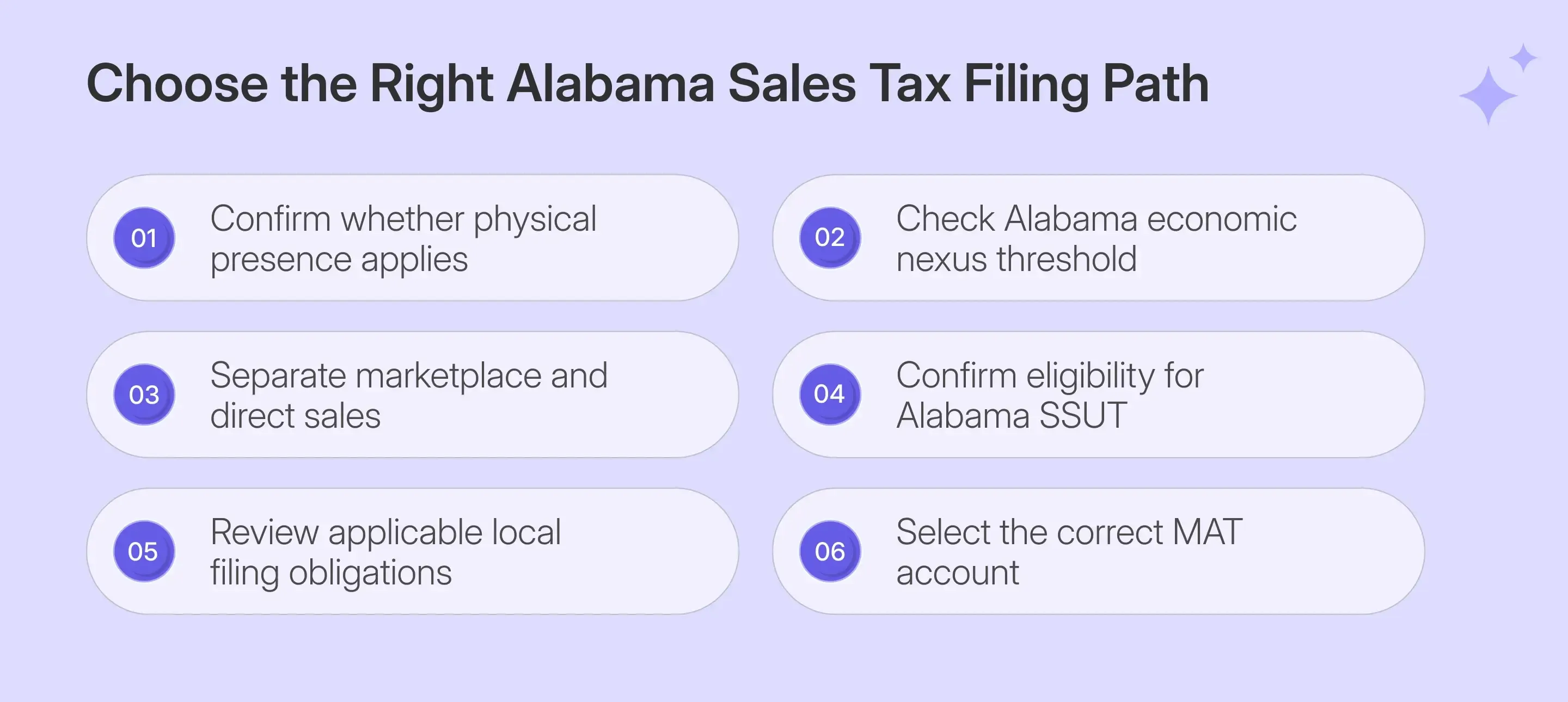
The correct Alabama sales tax return depends on where your business operates and which collection obligation applies. Standard sales tax, sellers use tax, SSUT, and marketplace-facilitator reporting have different return structures, rate treatment, and local filing requirements.
| Filing Path | Who Generally Uses It | Main Filing Difference |
|---|---|---|
| Standard sales tax | Businesses making taxable Alabama sales with in-state operations | State tax plus applicable local reporting |
| Sellers use tax | Qualifying out-of-state sellers with Alabama nexus | State and applicable local sellers use tax |
| SSUT | Approved eligible remote sellers | Flat 8% statewide rate with monthly MAT filing |
| Marketplace facilitator | Platforms collecting for third-party marketplace sellers | Facilitator reports qualifying marketplace collections |
Once you identify the filing path that applies to your business, the next step is setting up the correct Alabama tax account.
Businesses registering for Alabama sales tax first need the correct tax account in MAT. Sellers sometimes seek a sales tax permit or a general tax permit, although the registration requirement depends on the tax type and business activity. Separate state, county, or city licensing requirements can also apply.
The registration itself is completed online, and ALDOR does not charge business registration fees for creating tax accounts. Registration should still be kept separate from licensing, since an Alabama business license, privilege license, or local license may be required based on the business location and activity.
Once the correct account is identified, the business provides the required information needed to establish access. This can include the legal name, location, ownership details, FEIN, commencement date, and contact information. Existing taxpayers may also need their taxpayer ID, Sign On ID, and access code when setting up MAT access.
When Does Standard Alabama Sales Tax Filing Apply?
The standard Alabama filing generally applies to businesses that make taxable retail sales in the state outside SSUT. Alabama’s general state sales tax rate is 4%, though different rates and local obligations may apply depending on the product, transaction, and location.
- Alabama uses different rates for groceries, automobiles, manufacturing machinery, and other categories.
- Standard filing can include several types of taxes and local obligations.
- Alabama has more than 200 city and county sales taxes.
- ALDOR does not administer every local tax jurisdiction in Alabama.
- ONE SPOT supports many state-administered and local sales tax returns.
When Can Remote Sellers Use SSUT?
Eligible remote seller businesses can apply for Alabama’s SSUT program and collect a flat 8% on qualifying sales delivered into the state. The program replaces separate state and local rate calculations for transactions that are properly reported through the SSUT filing path.
- The 8% tax rate applies statewide, regardless of the Alabama location receiving the qualifying sale under the program.
- Approved participants complete electronic filing through MAT every month and follow the SSUT schedule for return submission and payment.
- An online seller should confirm eligibility because storefronts, in-state activity, or certain relationships can create affiliate nexus concerns.
How Does Alabama’s $250,000 Nexus Threshold Work?
Alabama’s economic nexus threshold generally applies when an out-of-state seller exceeds $250,000 in qualifying Alabama retail sales during the previous calendar year. The state does not currently use a separate transaction-count threshold for this test.
Marketplace activity needs separate treatment when measuring the threshold. Sales through a participating facilitator that collects and remits Alabama tax are excluded, so adopting economic nexus standards requires businesses to distinguish direct sales from facilitator-collected transactions.
A physical presence can create an Alabama obligation even when the economic threshold has not been reached. Examples include a retail store, inventory, employees, or other qualifying in-state activity related to the sale of tangible personal property.
Businesses operating through multiple channels can review the current Alabama sales tax nexus rules to distinguish among economic, physical, and marketplace-related sales tax nexus triggers.
What Data Should You Prepare For an Alabama Sales Tax Return?
Prepare the account details and reconciled transaction figures before opening MAT. A reliable Alabama sales tax return starts with the correct filing period, complete sales data, marketplace separation, supported deductions, applicable credits, and the chosen payment method.
| Record | What to Confirm |
|---|---|
| MAT access | Correct profile and account number |
| Account details | Correct type of account and tax account name |
| Filing period | Correct tax period and due date |
| Gross Alabama sales | Complete gross receipts from relevant channels |
| Marketplace sales | Facilitator-collected transactions identified separately |
| Deductions | Eligible marketplace, resale, exempt, or adjustment amounts |
| Exemption support | Documentation for qualifying untaxed transactions |
| Payment details | Bank information and intended payment method |
The status of an Alabama account can also affect the action available inside MAT. An open SSUT period displays a filing action, while a previously received return provides an amendment route instead.
Business owners should also distinguish tax collected from operating revenue during reconciliation. For bookkeeping purposes, thinking of the collector as an agent of the State of Alabama helps keep amounts awaiting remittance separate from ordinary sales receipts.
Reconcile Marketplace Sales Before Filing
Marketplace activity needs its own reconciliation because current ALDOR instructions require non-facilitator SSUT filers to include eligible marketplace transactions in total sales first. Transactions on which a participating facilitator collected Alabama tax are then included within deductions.
This treatment matters for an active Amazon seller that also accepts orders through its own website. The number of sales handled by a collecting marketplace should remain identifiable to prevent the same transaction from being double-counted against the seller’s SSUT.
Marketplace reporting is separate from the threshold calculation. Eligible facilitator sales can appear within return gross amounts and deductions while remaining excluded from the individual seller’s $250,000 economic-nexus measurement.
Check the Deadline Before You Open MAT
SSUT participants file monthly, and the return is due by the 20th day following the reporting period. If the deadline falls on a weekend or holiday, Alabama applies the next working day.
Electronic payment information must reach Alabama by 4 p.m. Central Time on or before the applicable deadline. Keeping these due dates in the filing calendar helps prevent a prepared return from becoming a late payment.
Standard filing can use a different filing frequency when the business qualifies and receives approval. Those rules depend partly on the prior tax liability and activity during the preceding calendar year.
How Do You File Sales Tax in Alabama Through My Alabama Taxes?
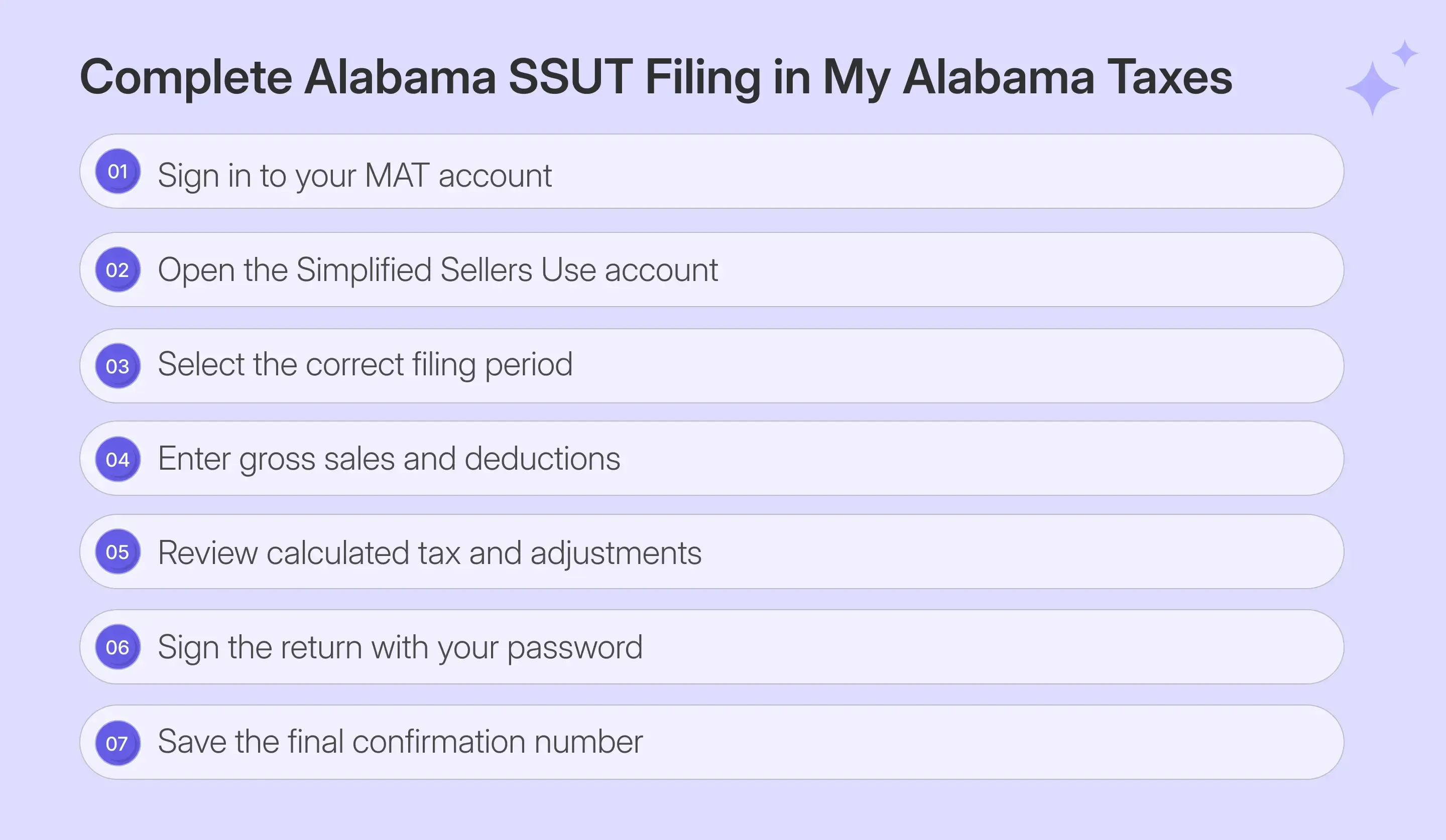
Eligible remote sellers enrolled in Alabama’s Simplified Sellers Use Tax program file monthly returns through My Alabama Taxes. Here are the steps you must follow to file Alabama sales tax online:
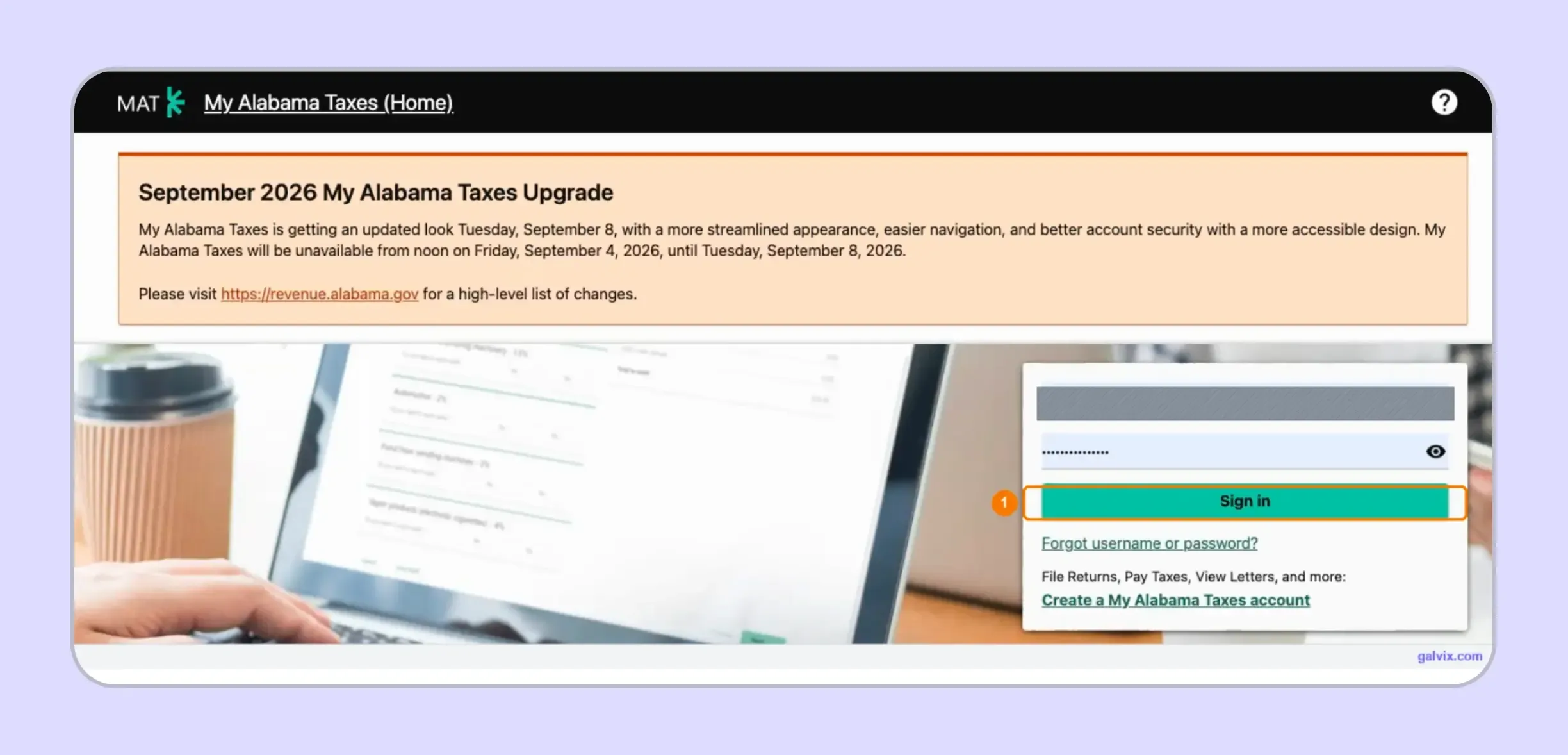
Step 1: Sign In to My Alabama Taxes
Enter the username and password attached to your MAT profile, then select Sign in. Your login identifies the profile, while the SSUT account number identifies the specific tax account that will later be used for filing.
When registering an existing taxpayer profile, MAT may request the E-file sign-on credentials provided by ALDOR. Keep the login separate from any taxpayer ID or account identifier used during account setup.
Step 2: Open the Simplified Sellers Use Account
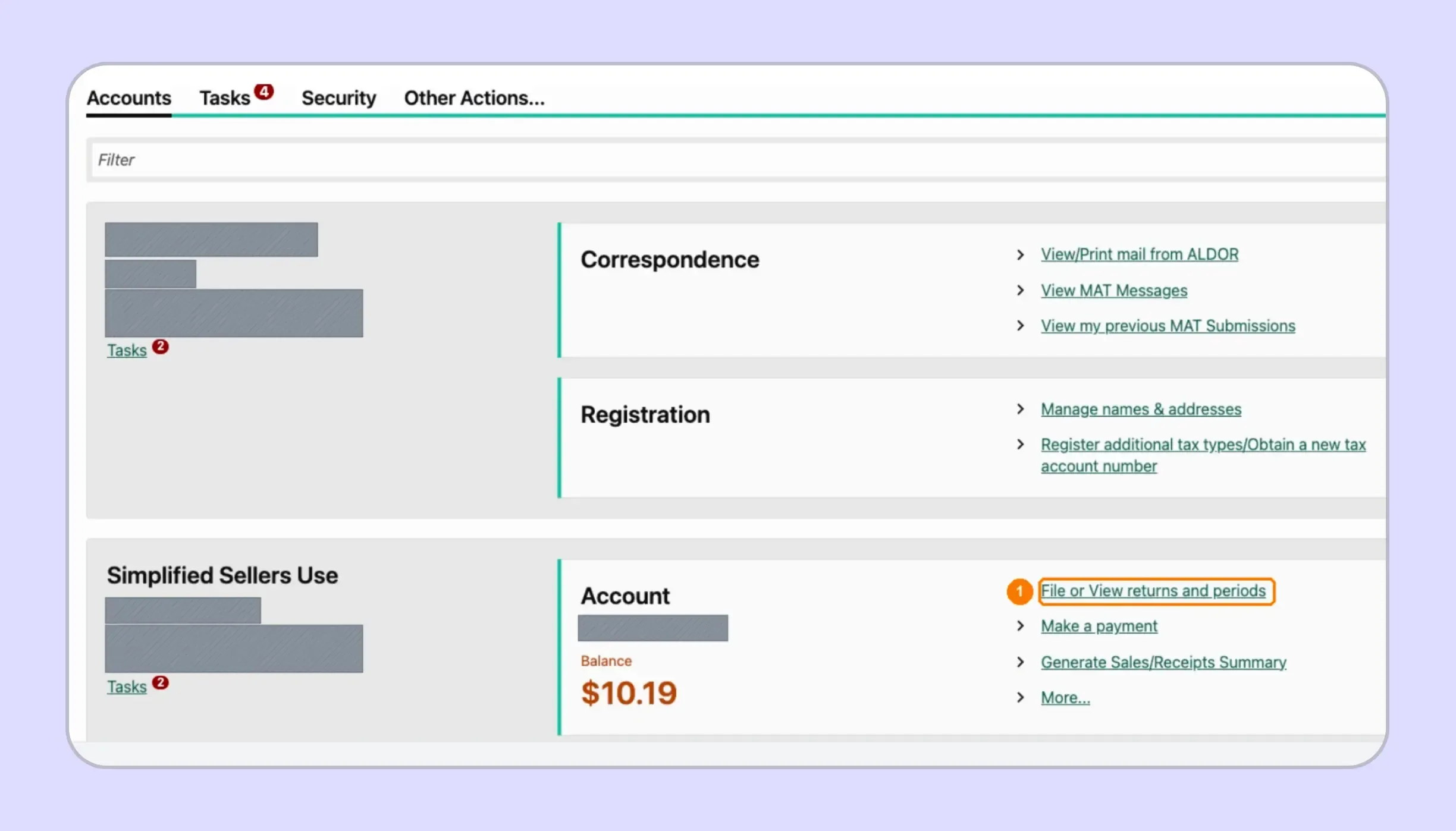
After signing in, locate the Simplified Sellers Use account and select ‘File or View returns and periods’. Confirm the business, current balance, account type, and tax account name before opening the return.
MAT can include several filing responsibilities within a single profile. Selecting an Alabama income tax return or another account will take you into a different workflow rather than the SSUT return covered here.
Confirm the business before opening its return when a single login provides access to multiple entities or account cards.
Step 3: Select the Correct Filing Period
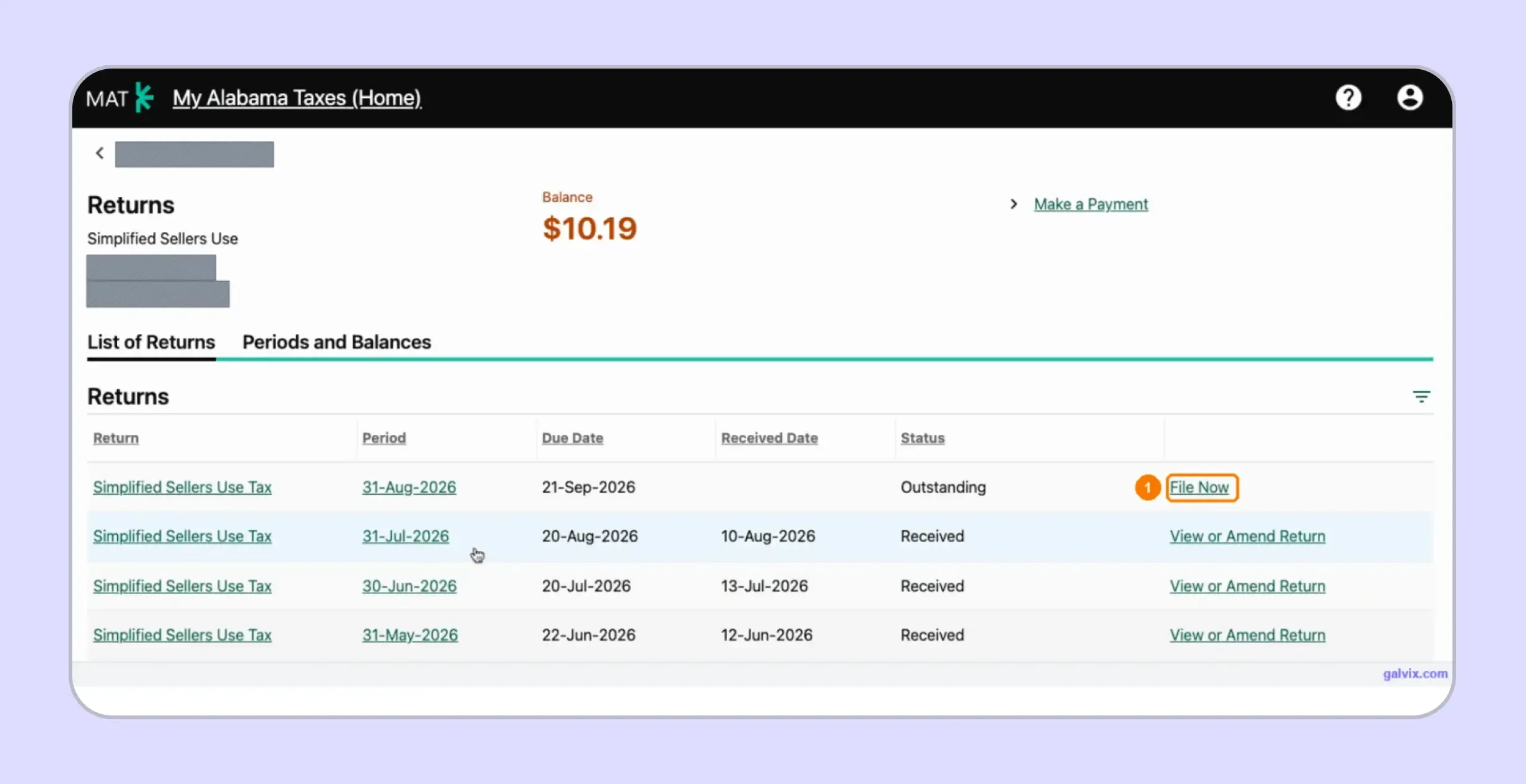
The returns list shows each tax period, due date, received date, and filing status. Choose File Now beside the outstanding period you intend to complete rather than opening an earlier return that has already been received.
Previously submitted periods display ‘View or Amend Return’, which is the route for later corrections. This distinction helps prevent the creation of a second filing when the existing Alabama sales tax return only needs an amendment.
The August 2026 example shows September 21 because September 20 fell on Sunday, demonstrating the weekend-adjusted deadline directly in MAT.
Step 4: Enter Gross Sales and Deductions
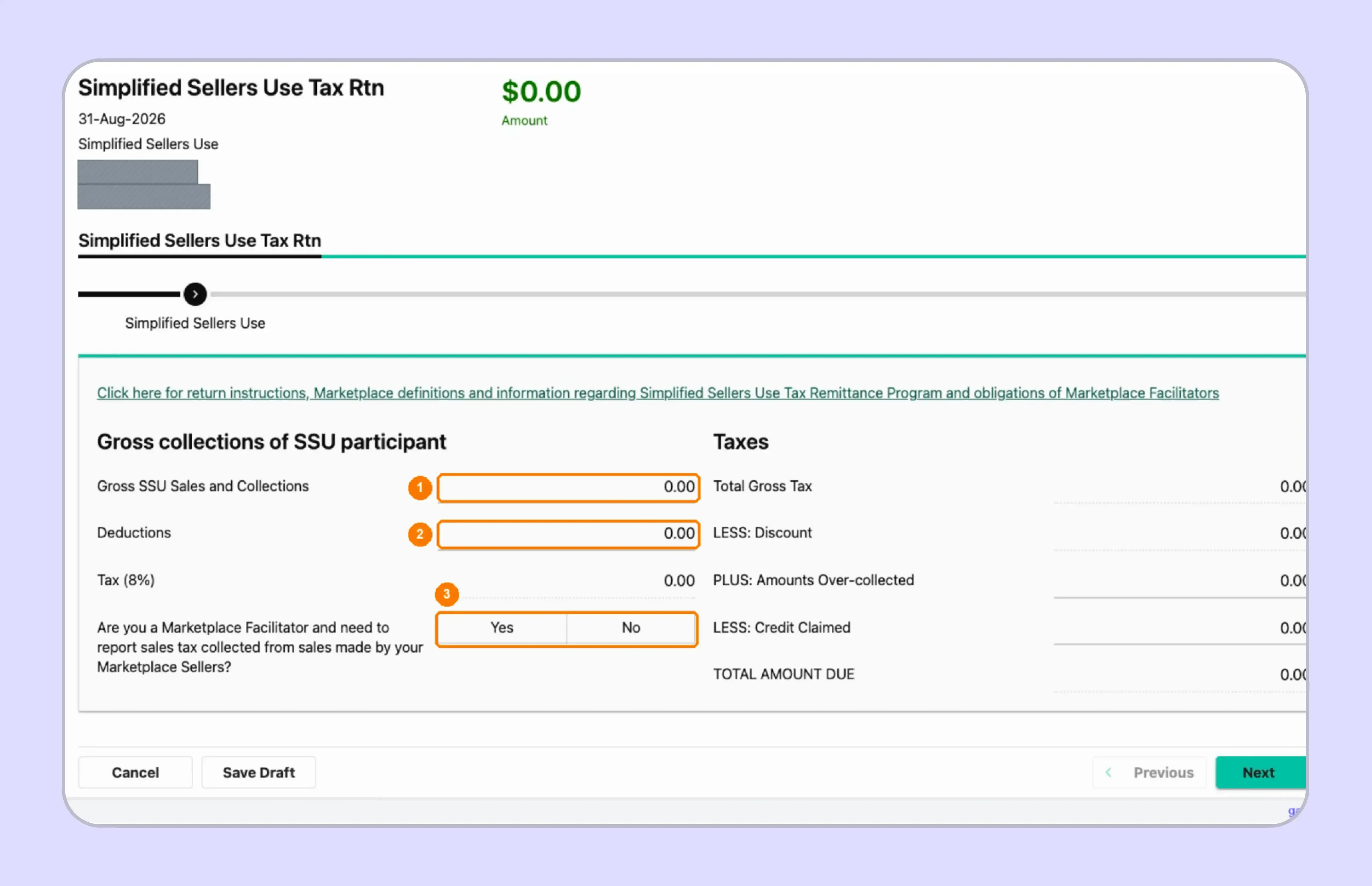
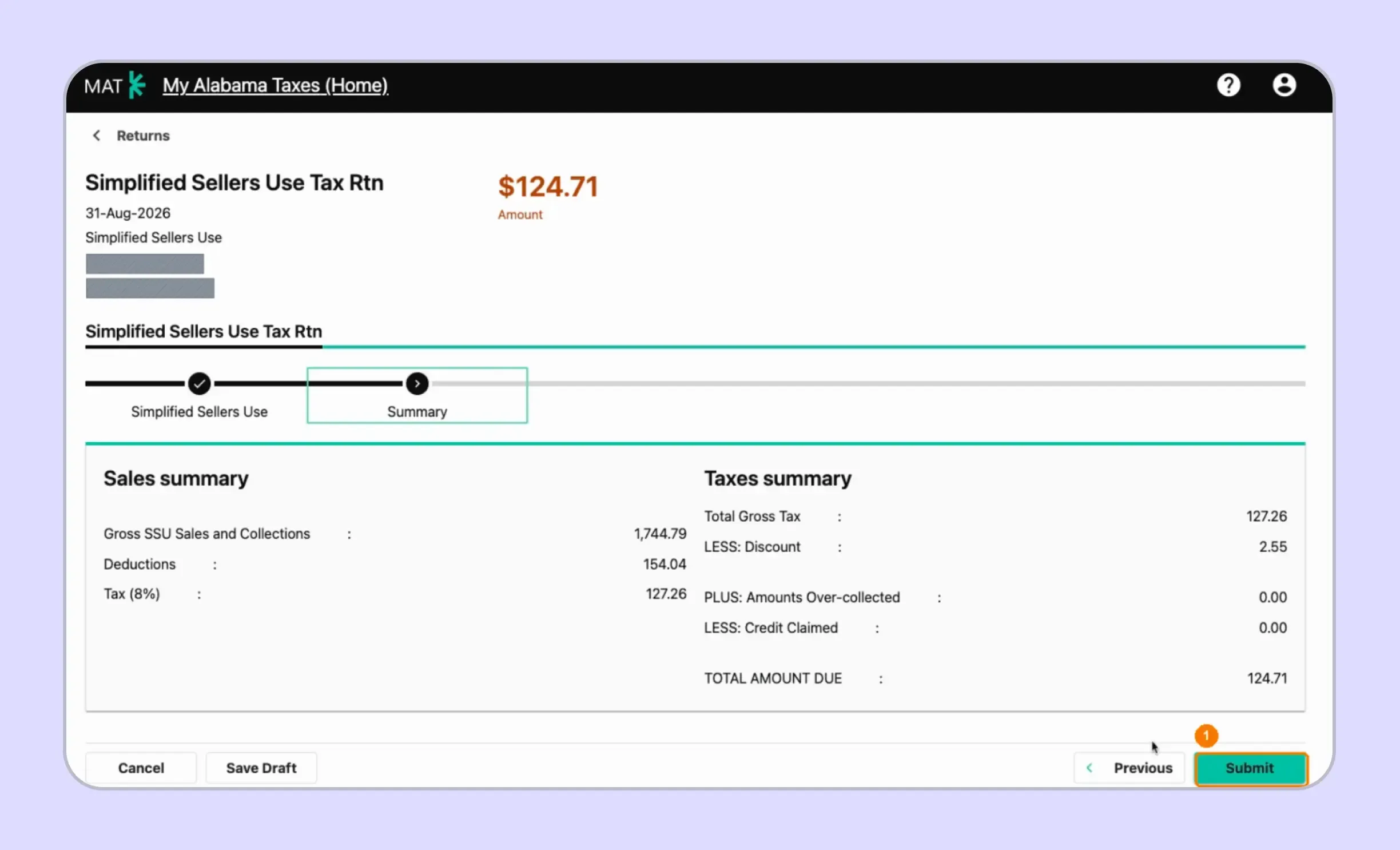
Enter Gross SSU Sales and Collections and eligible deductions, then answer the marketplace-facilitator question. MAT applies the 8% sales tax rate automatically and provides separate fields for over-collected amounts and approved credits.
Current ALDOR instructions state that a non-facilitator filer includes exempt and marketplace-facilitated sales in gross, then deducts qualifying amounts. This treatment produces the taxable base used for the SSUT calculation.
Step 5: Review the Tax and Timely Filing Discount
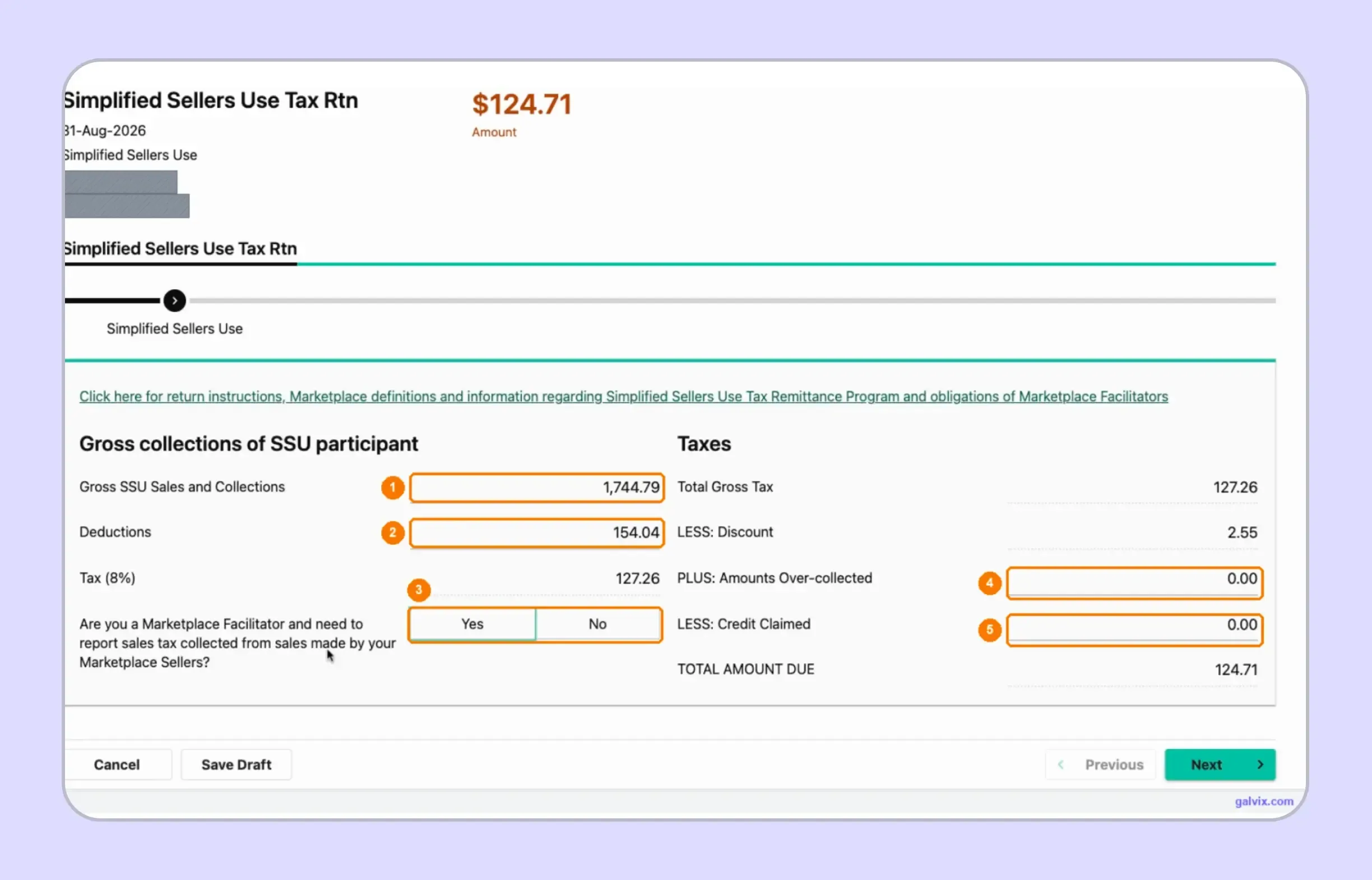
MAT calculates the 8% SSUT from the reported gross less eligible deductions. Review the calculated amount of sales tax, total gross tax, adjustments, timely discount, and final balance against your reconciled source records.
Qualifying SSUT participants can retain a 2% discount on timely collected and remitted SSUT, subject to the program’s monthly cap. The discount depends on timely reporting and payment.
A calculated number can still be wrong when the source inputs are incomplete. MAT performs the arithmetic without independently confirming whether gross sales or deductions were classified correctly.
Step 6: Sign and Submit the Return
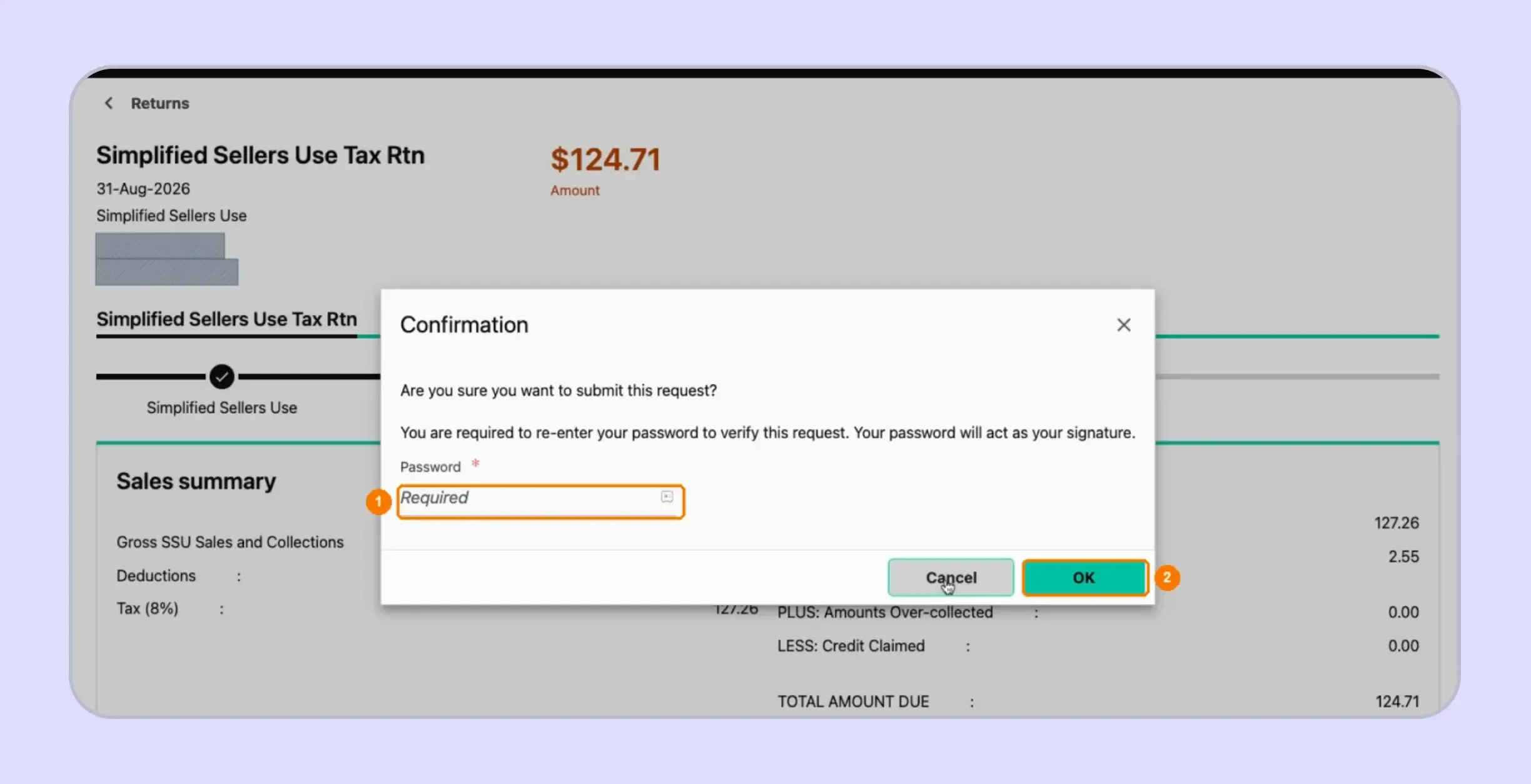
Select Submit after reviewing the summary. MAT then requires the password again and explains that re-entering it serves as the electronic signature for the filing request.
Enter the password only after the return is ready for transmission. Selecting OK completes the signature action and sends the Alabama sales tax return rather than opening another review screen.
7: Save the Filing Confirmation
After submission, MAT issues a confirmation number showing that the filing was transmitted. Save that number with the return records, since the earlier review screens do not provide equivalent evidence that the filing reached Alabama.
If a mistake appears later, return to the relevant period and choose ‘View or Amend Return’. Keep the amended filing record together with the original confirmation number and related payment evidence.
Filing evidence and payment evidence should remain separate when payment occurs afterward. Retaining both records makes later account reconciliation considerably easier.
How Is Standard Alabama Filing Different From SSUT?
Standard filing uses applicable state and local rates, while approved SSUT sellers remit one 8% statewide rate. The two paths also differ in local reporting, available filing schedules, discount treatment, and the transaction detail needed before submission.
| Area | Standard Filing | SSUT |
|---|---|---|
| General state rate | 4% for general taxable transactions | Flat 8% |
| Local obligations | City and county rates may apply | Covered within the 8% SSUT |
| Local reporting | ONE SPOT or applicable locality workflow | No separate local rate schedule |
| Filing frequency | Monthly by default with qualifying alternatives | Monthly |
| Timely discount | Standard rules apply | 2% subject to SSUT limits |
| Main return inputs | Jurisdiction-level sales and tax information | Gross SSUT sales and deductions |
The general Alabama sales tax rate is 4%, while the current state sales tax rate on food and groceries is 2%. Other categories, including automobiles and manufacturing machinery, have separate state rates.
Standard monthly filers can request quarterly status when the prior-year liability is below $2,400, semiannual status when it is below $1,200, or annual status when it is below $600. Additional activity-based qualifications also exist, and requests must follow Alabama’s timing rules.
The difference becomes crucial when businesses ask how to file AL sales tax after establishing a new obligation. SSUT simplifies locality calculations, whereas standard filing may require sales allocation across multiple jurisdictions and separate local reporting.
Alabama also administers consumer use tax on qualifying property brought into the state when the seller did not collect the applicable seller’s use tax. That obligation is separate from SSUT sales reporting.
How Do Exempt Sales Affect an Alabama Sales Tax Return?
Qualifying exemptions reduce the taxable amount reported on an Alabama sales tax return, so each deduction requires supporting documentation. Resale transactions, approved exempt entities, direct-pay arrangements, and certain exempt products can require different evidence under Alabama tax laws.
What Exemption Documentation Does Alabama Use?
Alabama uses different exemption documents depending on the purchaser, transaction, and exemption type, so businesses should match the documentation to the specific sale.
- Form ST:EX-A1: Supports certain wholesaler, manufacturer, and product-based exemptions.
- Form ST:EX-A1-SE: Applies to qualifying statutorily exempt entities in Alabama.
- Resale certificate: Supports qualifying resale transactions when properly completed and applicable.
- Sales tax exemption: Requires transaction-specific support rather than customer registration alone.
- Prescription drugs: Certain qualifying prescription drugs are exempt under Alabama rules.
- Nonprofit organizations: Exemption depends on statutory qualification, not nonprofit status alone.
Alabama also provides temporary exemptions through its sales tax holiday and severe weather preparedness holiday, with local participation varying by jurisdiction.
How Can Galvix Help With Exemption Certificates?
Certificate collection, registration verification, and transaction eligibility answer different compliance questions. A certificate may be complete and current, while the related purchase still needs review before the transaction can be treated as exempt on the return.
Businesses managing these records across states can use the sales tax exemption certificate guide to compare documentation requirements and seller responsibilities. Galvix can then support certificate collection, review, customer matching, renewal tracking, and audit-ready recordkeeping within the same workflow.
Connecting those records with return preparation helps teams avoid keeping exemption evidence in separate spreadsheets or inboxes. It also creates a more consistent process when the same customer makes exempt purchases across several registered states.
What Happens if You File or Pay Alabama Sales Tax Late?
Alabama can impose separate filing and payment penalties when required tax returns or payments miss their deadlines. SSUT participants can also lose the timely discount, increasing the cost of a late filing beyond the statutory penalty itself.
Alabama Can Apply Separate Filing and Payment Penalties
The failure-to-file penalty is generally 10% of the tax required to be paid or $50, whichever is greater. Alabama separately applies a 10% failure-to-pay penalty to delinquent tax, with interest charged at the current rate.
Even zero-activity periods still require a return once the filing obligation exists. Leaving an assigned period unfiled can therefore result in late fees and follow-up work, even when there are no underlying taxable sales.
SSUT Filers Can Also Lose Their Discount
The SSUT discount applies when the tax is properly collected and remitted on time. Missing the deadline can therefore affect both the statutory cost and the discount previously reflected in the filing calculation.
Keeping the filing process tied to a clear calendar helps teams treat preparation and remittance as one monthly workflow. That becomes particularly useful when several states have different filing deadline rules.
What Do Businesses Say About Alabama Sales Tax Filing?
Your Alabama sales tax return can be manageable once the correct filing route is known. Questions often arise earlier regarding nexus, registration, marketplace treatment, local obligations, and when a new account should remain active.
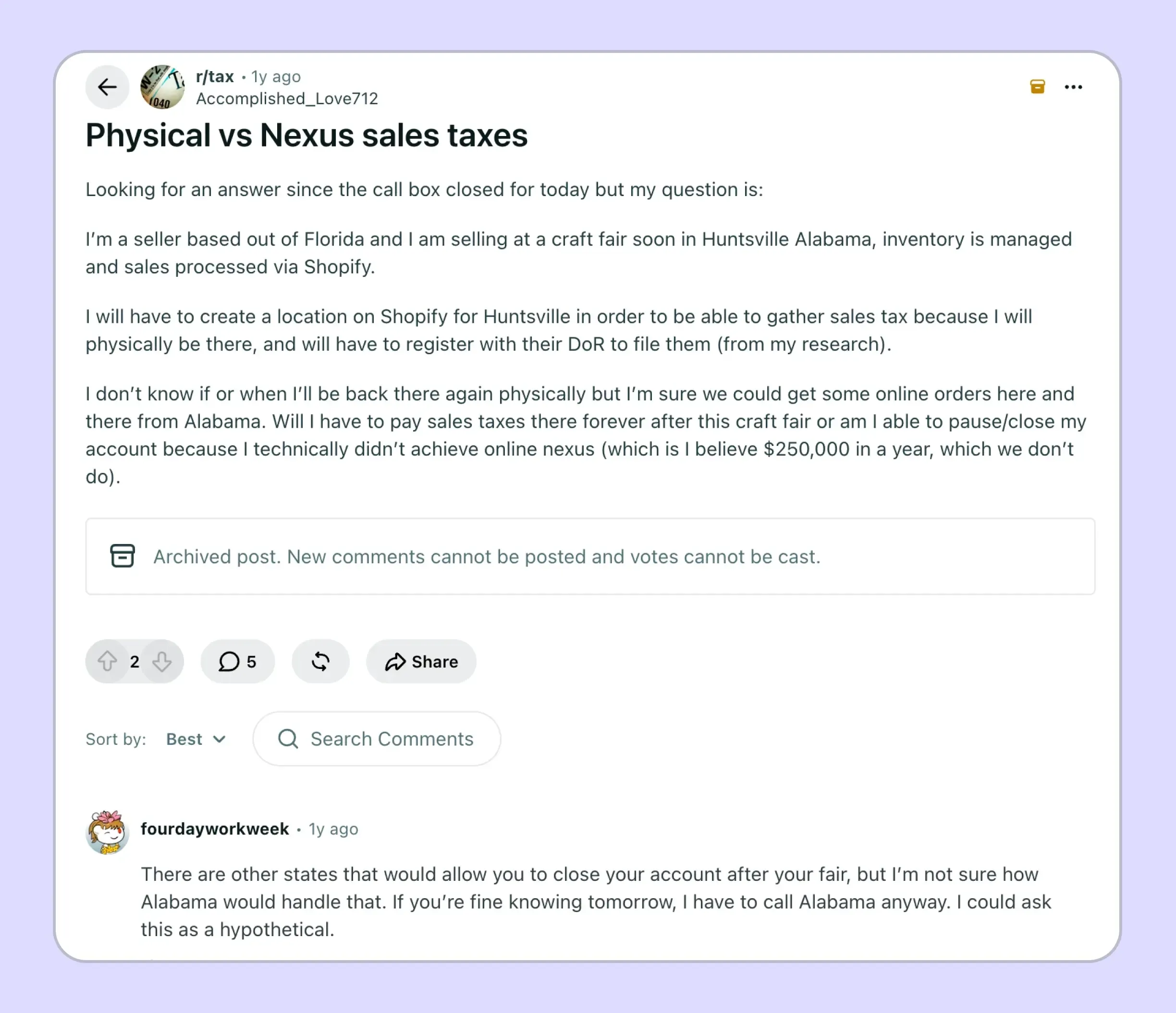
A 2025 Reddit discussion involved a Florida seller preparing for a craft fair in Huntsville. The seller understood that attending the event could trigger an Alabama registration requirement, but was unsure whether occasional online sales afterward would require the Alabama account to remain open indefinitely.
Another ecommerce discussion focused on Alabama's $250,000 remote-seller threshold. The seller understood the basic threshold but highlighted the broader difficulty of keeping track of economic nexus rules that vary by state.
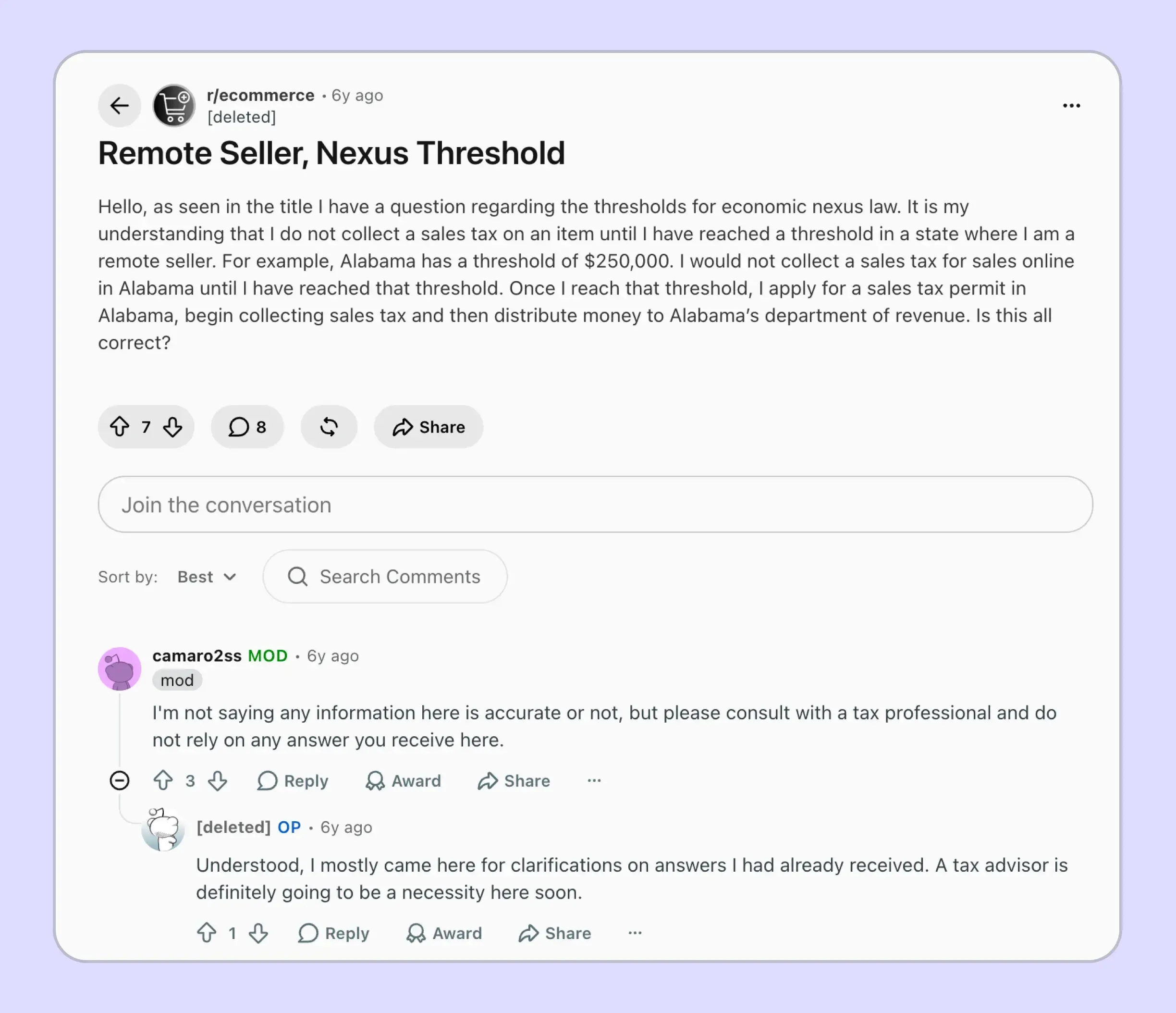
For a business filing only one straightforward SSUT return, these tasks may remain manageable internally. The difficulty increases when Alabama sits alongside states with different thresholds, filing frequencies, return formats, local taxes, exemption rules, and portal requirements.
That is where a managed filing model becomes crucial. Instead of asking finance teams to interpret each state's workflow, reconcile source data, monitor deadlines, and respond when something goes wrong, Galvix manages these activities through a single multistate compliance process.

How Does Galvix Manage Alabama and Multistate Sales Tax Filing?
Galvix manages Alabama sales tax returns through a supported sales tax compliance workflow rather than leaving finance teams to prepare each filing internally. Transaction data is reconciled, returns are prepared, specialist review is completed, customer approval is obtained, and filing follows the schedule assigned to each tax account.
For Alabama, the filing process can include separating direct and marketplace activity, preparing SSUT or standard return data, reviewing exemptions, and maintaining supporting records. As obligations change, businesses can also track current Alabama sales tax nexus rules, along with registrations, filing schedules, certificate requirements, and state notices.
Transaction data can be imported into Galvix via more than 10 supported sales tax integrations. Ecommerce teams can connect platforms such as Shopify, while accounting teams can use QuickBooks. ERP data can also flow through NetSuite, with APIs and file uploads available for other systems.
Galvix uses modular pricing, so businesses select only the compliance services they need. Exact pricing depends on the workload associated with each service, allowing companies to combine filing with nexus monitoring, registrations, exemption management, or notice support without purchasing an unnecessary all-inclusive package.
What Can Galvix Manage for Alabama Sellers?
- Reconcile transaction data before each filing period.
- Prepare Alabama sales tax returns for specialist review.
- Connect exemption records with reported untaxed transactions.
- Monitor nexus and registrations across additional states.
- Track deadlines, confirmations, notices, and state correspondence.
This connected approach keeps return preparation, exemptions, registrations, nexus monitoring, and post-filing support within one managed process. It gives finance teams clearer oversight while reducing the recurring work required to keep each registered-state filing accurate and on schedule.
Book a Galvix demo to review your Alabama and multistate filing workflow before the next reporting period.
Frequently Asked Questions
Can I change from regular Alabama sellers use tax to SSUT?
A qualifying seller can apply for SSUT if it meets Alabama’s eligibility requirements and receives program approval. Participation is not created simply by changing the return inside MAT. Review your current nexus position and account structure before changing collection methods, since storefront or affiliation circumstances can affect eligibility.
Can an SSUT participant request quarterly or annual filing?
SSUT participants file monthly and remit monthly payments through MAT. The reduced filing schedules available to qualifying standard sales or sellers-use filers do not replace the SSUT monthly requirement. Standard filers can request alternative frequencies when they meet Alabama’s liability or activity thresholds and follow the request process.
Does an Alabama marketplace seller need its own sales tax account?
A marketplace-only seller may not need its own account when a participating facilitator collects and remits all qualifying Alabama taxes. Sellers making direct taxable sales can have separate obligations. In-state marketplace-only sellers may also need an exemption certificate for resale purchases even when a sales/use account is unnecessary.
How do I amend an Alabama sales tax return after submission?
To amend an Alabama sales tax return online in MAT, locate the previously filed period and select View or Amend Return. The captured SSUT workflow shows filed periods as Received while outstanding periods offer File Now, helping users distinguish corrections from new filings.
Can I save an Alabama return in MAT and finish it later?
Yes. The captured SSUT summary screen provides Save Draft before final submission, allowing the filer to return later rather than transmitting unfinished information. Saving a draft does not constitute filing; the return must still be completed and submitted before the applicable deadline.
What happens to SSUT eligibility if my business establishes physical presence in Alabama?
Physical activity can affect SSUT eligibility, although the outcome depends on the form of presence and the seller’s circumstances. Alabama specifically addresses storefront presence and qualifying affiliations in its SSUT rules. Review the current account position before changing collection or filing treatment.
Can I make an Alabama sales tax payment separately from the return?
Yes. MAT provides payment functions separate from return preparation, and SSUT participants can also use an approved ACH Credit method. When filing and payment occur separately, keep evidence for both transactions so your records can establish the return submission and the corresponding payment.
How do I close an Alabama sales tax or SSUT account?
Account closure should be completed through the appropriate MAT account process once the business has stopped the activity associated with that registration. Before closing, confirm all assigned returns and outstanding balances are addressed, since closing the account does not automatically resolve earlier filing periods or unpaid liabilities.