When you are hunting for the ultimate sales tax solution, you might find yourself staring down two industry giants. Figuring out the ideal choice between Avalara and Vertex isn't just a coin toss; it requires a deep dive into your business needs, technical stack, and whether your team actually has the bandwidth to wrestle with a heavy platform.
Both of these heavyweights have dominated the sales tax compliance space for years, offering robust tax technology solutions for folks managing tricky global supply chains. But let's be real, navigating the wild world of sales tax regulations and comparing their complicated deployment timelines can feel totally overwhelming! You need to evaluate these tax compliance tools thoroughly to dodge any nasty corporate budget surprises.
If you are comparing them right now, you need to know exactly what you are signing up for before committing to a multi-year contract. This guide breaks down how Avalara vs Vertex stack up across features, pricing, and support. We will show you why a modern managed alternative like Galvix delivers fully done-for-you tax compliance. This fully managed compliance service remains the strongest operational choice for your rapidly scaling corporate team!

How Do Avalara and Vertex Compare at a Glance?
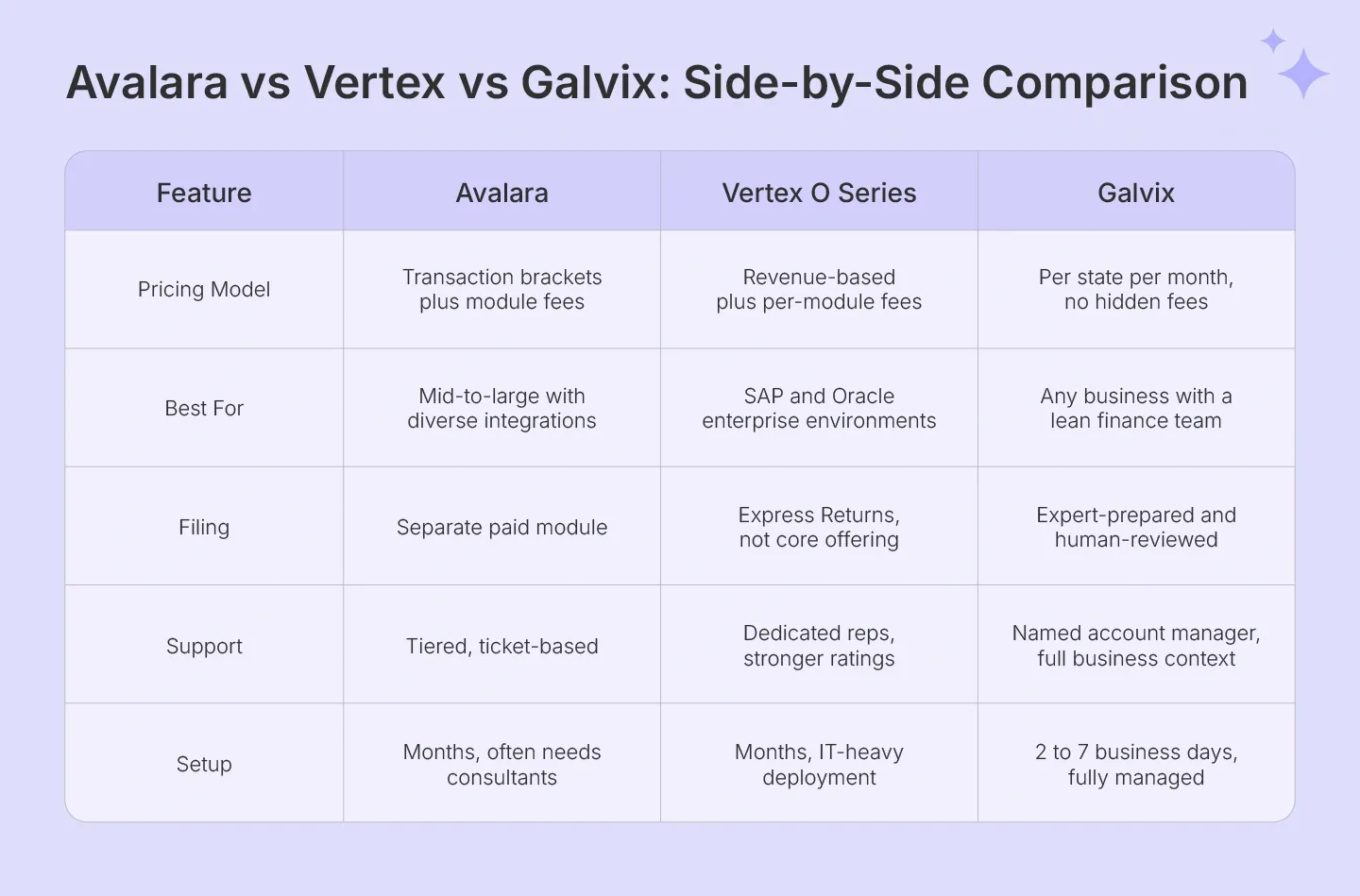
When evaluating Avalara vs Vertex, the core distinction comes down to integration breadth versus ERP depth. Here is a quick comparison of both platforms:
| Basis | Avalara | Vertex |
|---|---|---|
| Pricing Model | Custom quote; transaction-based brackets plus per-module fees | Custom quote; partly revenue-based, meaning costs rise as your business grows |
| Best For | Mid-to-large businesses with diverse integrations and e-commerce or SaaS revenue | Large enterprises running SAP or Oracle in regulated industries like manufacturing and telecom |
| Deployment | Cloud-based | Cloud and on-premise via O Series |
| Integration Breadth | 1,200-plus integrations; Shopify app discontinued April 2025 | Fewer total connectors but deeper ERP certification for SAP S/4HANA and Oracle |
| Support Model | Tiered; full tax expertise access limited to higher-tier plans | Dedicated representatives with consistently stronger support ratings across review platforms |
| Managed Filing | Available as a separate paid module via Avalara Returns | Express Returns launched in 2025 for basic US and Canadian filing; not a core offering |
What Are the Key Feature Differences Between Avalara and Vertex?
Understanding how Vertex and Avalara handle core sales tax compliance functions will guide your final corporate software procurement decision:
- Tax Calculation Engine: When it comes to the brain of the operation, the tax engine is everything. Vertex O Series lets you get super granular with your complex sales tax rules at the jurisdictional and product levels. On the flip side, Avalara Avatax deploys a bit faster and plays nicely with businesses of all sizes. However, it might give you less wiggle room if you have crazy-specific taxability needs across specialized product catalogs.
- Returns Filing: Avalara Returns is a separate paid module that sits outside the base subscription. Vertex launched Express Returns in 2025, yet managed filing remains a supplementary capability rather than a core part of their platform's primary value proposition.
- Exemption Certificate Management: Avalara's Exemption Certificate Management tool is available on tiered plans with its own annual fee structure. Vertex's Certificate Center also adds a significant amount to the annual cost, making exemption management an additional line item for both platforms, regardless of which you select.
- Global Tax Coverage: Vertex covers over 300 million tax rates worldwide and handles complex multi-country indirect tax scenarios natively. Avalara addresses international compliance through separate product modules that operate independently from its core US sales tax infrastructure.
What Are the Integration Capabilities of Each Platform?
Integration depth is another crucial factor when evaluating Vertex or Avalara for an enterprise deployment. The right choice depends on your existing technology stack and where your primary revenue flows originate.
ERP Integrations
Vertex is the stronger choice for organizations running SAP or Oracle as their primary business system. It offers certified integrations for SAP S/4HANA Cloud, SAP ECC, Oracle Cloud ERP, and Oracle E-Business Suite, with tax logic embedded directly at the transaction processing layer.
Avalara also supports ERP environments, with connectors available for NetSuite, Microsoft Dynamics, and Sage. However, Avalara's ERP integrations are generally not embedded as deeply at the system level as Vertex's certified SAP and Oracle connectors, which matters for high-volume transactional environments.
E-Commerce and Marketplace Integrations
Avalara historically offered over 1,200 integrations across e-commerce platforms, marketplaces, and accounting systems. However, Avalara discontinued its Shopify app in April 2025, signaling a deliberate strategic shift toward enterprise-scale customers and away from the mid-market e-commerce segment it previously served.
Vertex added enhanced Shopify cross-border tax logic in 2025, yet neither platform was created as the natural choice for multichannel e-commerce sellers managing high SKU volumes across multiple storefronts. Both legacy platforms struggle to provide a natural fit for growing multichannel ecommerce retail sellers.
Basic software calculators require your busy finance team to configure complicated integrations and manually map product taxability rules. Galvix provides a managed service where our dedicated tax experts handle the entire technical setup process for you.
Our native Shopify integration automatically syncs your transaction data, while our human team continuously monitors economic nexus thresholds. Whenever your business crosses a new regional state limit, our specialists handle the complex government registration paperwork entirely.
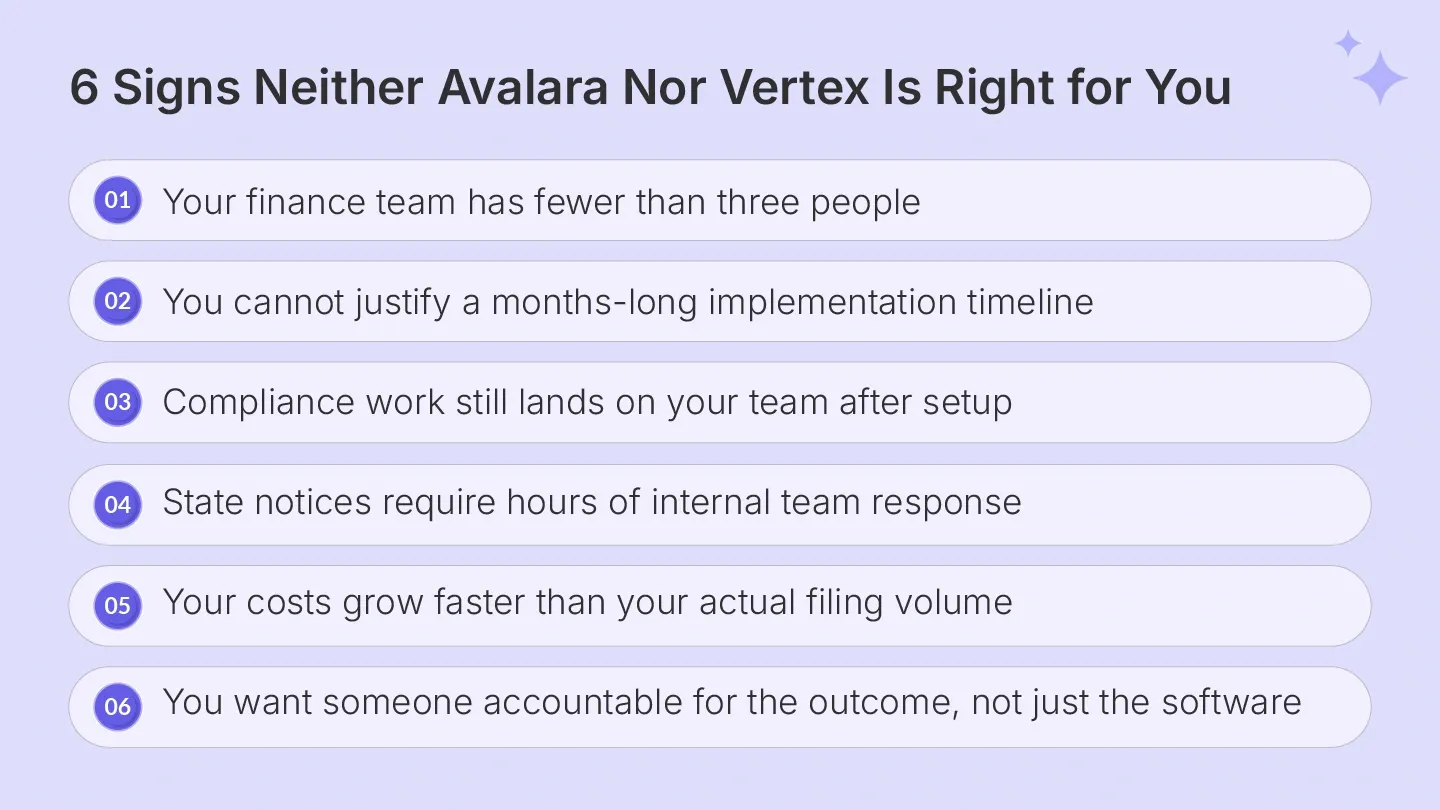
What Are the Signs Neither Avalara Nor Vertex Suits Your Business?
Recognizing software mismatches early prevents massive financial compliance disasters for your growing commercial business operations. You should evaluate alternative managed service providers when you encounter any of the following six internal warning signs.
- Your finance team has fewer than three people: Lean finance departments lacking dedicated tax experts struggle to manage complex corporate compliance software operations effectively every single day. Forcing small internal finance teams to navigate intricate enterprise platform configurations often invites dangerous systemic sales tax calculation errors.
- You cannot justify a months-long implementation timeline: Legacy software platforms demand massive initial technical investments spanning several consecutive months before achieving basic functional compliance operations. Rapidly growing commercial businesses require fast software deployment solutions to protect their expanding regional sales territories securely today.
- Compliance work still lands on your team after setup: Enterprise platforms automate basic calculations while forcing your internal staff to execute the actual monthly government filings manually. This frustrating operational dynamic creates massive ongoing administrative burdens, completely defeating the original purpose of purchasing compliance software.
- State notices require hours of internal team response: Resolving complex government discrepancy letters demands significant specialized legal knowledge and substantial internal company time. Legacy software platforms alert you to these pressing issues without providing direct assistance with government correspondence.
- Your costs grow faster than your actual filing volume: Utilizing rigid transaction brackets or revenue-linked pricing models forces your compliance budget to expand uncontrollably during high sales seasons. Finding transparent outcome-based pricing models becomes absolutely critical for maintaining highly accurate annual corporate financial budget forecasts today.
- You want someone completely accountable for the outcome: Purchasing expensive software licenses leaves your corporate entity holding total financial liability whenever technical configuration errors trigger government penalties. Choosing a managed service provider completely transfers this massive operational risk directly onto dedicated external tax compliance professionals.
How Does Pricing Compare Between Avalara and Vertex?
Comparing Avalara and Vertex requires carefully examining their complex financial models and unpredictable long-term software enterprise billing structures.
What Does Avalara Pricing Look Like?
Avalara pricing is driven by three variables:
- Annual transaction volume
- Specific compliance modules selected
- Number of platform integrations
Each module, including AvaTax, Avalara Returns, and Exemption Certificate Management, carries its own fee. Their Sales Tax Registration services start from $403 per location, while the charges for Business License guidance start from $119 per license.
Overage charges apply when transaction brackets are exceeded, and per-connector billing means that multichannel businesses pay incrementally as they add revenue sources. First-year implementation costs, particularly in ERP-integrated environments, frequently require additional investment in professional services beyond the base subscription.
What Does Vertex Pricing Look Like?
Vertex uses a revenue-based pricing model for certain plan configurations, meaning your compliance costs increase alongside your business revenue, regardless of whether your actual filing complexity changes. This structure creates cost unpredictability for fast-growing businesses that did not anticipate revenue-linked fee escalation at the time of contract signing.
The Vertex Certificate Center and other add-on modules carry their own annual fees that are separate from the base platform cost. Like Avalara, Vertex implementations in SAP or Oracle environments often involve third-party consultants, adding significant first-year deployment costs beyond the platform subscription alone.
Here is a side-by-side look at how all three platforms compare on pricing transparency, cost structure, and total cost of ownership:
| Pricing Factor | Avalara | Vertex O Series | Galvix |
|---|---|---|---|
| Published Pricing | No, custom quote required | No, custom quote required | Yes, starts at $60/state/month |
| Base Cost Structure | Transaction-based brackets plus per-module fees | Revenue-based for some configurations; costs grow as your revenue grows | Per state per month; costs grow only when you register in new states |
| State Registrations | $403 per location | Not included in base; separate service required | Included in compliance service; no separate fee |
| Business License Guidance | From $119 per license | Not a core offering | Managed by the Galvix compliance team |
| Exemption Certificate Management | Separate module; tiered annual fee | Certificate Center add-on; approximately $1,200 annually | Included; Certificates stored in an audit-ready repository |
How Do Avalara and Vertex Handle Customer Support?
Support quality is another meaningful differentiator when comparing Vertex and Avalara for long-term compliance management. Let’s understand how both platforms compare in terms of customer service:
Day-to-Day Support Experience
Vertex consistently receives stronger support ratings than Avalara across G2, Capterra, and Software Advice, with users citing more responsive representatives and more consistent access to specialists across plan tiers.
Avalara's support quality varies significantly depending on plan level. Standard-tier customers frequently report slow response times, frequent account representative changes, and back-and-forth exchanges with agents who lack context about their specific business setup and filing history.
Avalara offers a tiered ticket-based model where standard users frequently wait days for responses from agents with no account context. Whereas every Galvix customer has direct access to a named account manager who already knows their business, filing history, and integration setup from day one.
Onboarding and Implementation
Avalara's accuracy guarantee depends on correct platform configuration, which is frequently achieved only with paid professional services. Misconfiguration during onboarding can create silent filing errors that surface months later as state notices or penalty assessments.
Vertex's onboarding process is more guided for SAP and Oracle environments, contributing to stronger post-implementation satisfaction scores in enterprise accounts.
However, both platforms require meaningful internal resource investment during deployment, particularly for businesses without a dedicated internal tax technology function. Highlight:
While Avalara and Vertex O Series implementations routinely span multiple months and require paid consulting resources, Galvix completes the full onboarding process in 2 to 7 business days. The Galvix team handles all setup, including integrations, product mapping, and state registration configuration, with no technical lift required from your internal team.

Is Avalara or Vertex Right for Your Business?
Choosing between Avalara vs Vertex requires a deep understanding of your internal corporate resource limitations.
- Choose Avalara if your business needs the broadest possible integration ecosystem and your primary ERP is not SAP or Oracle. Avalara suits mid-to-large organizations with diverse e-commerce, marketplace, and SaaS revenue streams that require a wide network of pre-built connectors across multiple platforms and business systems.
- Choose Vertex if your business runs SAP or Oracle and needs tax logic embedded directly at the ERP transaction layer. Vertex is purpose-built for highly regulated industries such as telecommunications and heavy manufacturing, where deep rule customization and accurate certified ERP integration are operational requirements rather than preferences.
- Consider neither if your organization has a lean finance team without an in-house tax specialist. Both Vertex vs Avalara require significant internal investment to configure, maintain, and operate accurately. Compliance accountability remains with your team in both cases, regardless of the platform's level of advancement.
Why Is Galvix Worth Considering Over Both Platforms?
Both Avalara and Vertex are built on the same core assumption: that your organization has the internal capacity to operate them. They provide a powerful compliance engine and expect your team to configure it correctly, monitor it actively, and manage all support interactions when issues arise.
For a large enterprise with a dedicated internal tax team, that is a reasonable operational model. For a growing company with a lean finance function of one to three people, it means absorbing significant ongoing compliance work on top of everything else your team is already managing every month.
Galvix is built on a different premise. Most growing businesses want their compliance handled entirely, rather than running another complicated application:
- No Platform Fee: Galvix charges no monthly platform subscription fee. Pricing is per state per month, starting at $60 per state, based on your total state count and business profile, with no separate filing fees or hidden add-ons attached. Visit the Galvix pricing page for an exact figure based on your specific filing footprint.
- Expert-Prepared Returns: Tax specialists prepare every return using data synced from all your connected channels. They reconcile your billing data independently before filing. You review, approve, and Galvix files on your behalf with full accountability for the outcome.
- True Multi-Channel Nexus Monitoring: Unlike platforms that track only the channels they are directly integrated with, Galvix monitors your economic nexus exposure across all your revenue streams simultaneously, with proactive alerts at 75%, 85%, and 95% of each state's threshold. Take a free Nexus study to see your current exposure today.
- Managed Onboarding From Day One: Galvix's team handles your full setup from initial integration through product mapping and exemption configuration. This eliminates the configuration risk that can quietly produce filing inaccuracies on self-operated platforms months after launch. You can review all available Galvix platform integrations to confirm compatibility with your existing systems.
- A Real Person When It Matters: Whenever a state revenue department sends an unusual discrepancy notice, a dedicated specialist provides immediate assistance. You receive direct communication with real tax experts, completely replacing slow ticketing queues.
Avalara and Vertex represent strong technological products for their enterprise customers. The critical question remains whether your growing business actually fits that exact corporate customer profile.
If you operate a lean finance team avoiding complex software implementations, their overhead highlights a massive operational gap. Galvix is built specifically to serve your modern corporate business needs.
Schedule a personalized Galvix demo today and see what managed compliance looks like for your specific team.
Frequently Asked Questions
Is Vertex better than Avalara for SAP users?
For businesses running SAP S/4HANA or SAP ECC, Vertex is the stronger choice. Its certified integrations embed tax logic directly at the SAP transaction layer, reducing manual configuration and lowering the risk of calculation errors. Avalara also supports SAP, but the integration depth is not equivalent to Vertex's certified SAP connector architecture.
Does Avalara or Vertex offer better customer support?
Vertex consistently receives stronger support ratings than Avalara across major review platforms, including G2 and Capterra. Avalara's support quality varies significantly by plan tier, with standard users frequently reporting slow response times and agents lacking business context. For businesses that need responsive, knowledgeable support without enterprise-tier pricing, Galvix assigns a dedicated account manager to every account from day one.
Which is more expensive, Avalara or Vertex?
Both platforms use custom pricing that is not publicly listed, making direct comparison difficult without a sales consultation. Avalara costs scale by transaction volume, modules selected, and integration count. Vertex uses revenue-based pricing for some configurations, meaning your costs grow as your business grows. Both carry significant first-year implementation costs, particularly in ERP-integrated enterprise environments with complex product catalogs.
Can small businesses use Avalara or Vertex?
Both platforms were designed for mid-to-large enterprises with dedicated tax and IT teams. Small businesses can technically access Avalara at lower tiers, yet the platform's complexity and modular pricing structure create operational overhead that lean teams struggle to manage effectively. Vertex is firmly enterprise-only. For small and mid-sized businesses, a managed service like Galvix delivers better compliance outcomes without the self-service operational burden.
What is the main difference between Avalara and Vertex?
The primary difference in the Avalara vs Vertex comparison is integration breadth versus ERP depth. Avalara offers over 1,200 pre-built connectors across a broad range of platforms. Vertex offers fewer total integrations, yet provides deeper certified connections within SAP and Oracle enterprise environments.